

 Wine Peeps is an independent wine blog dedicated to helping you get the most bang for your buck in wine. We do this through blind tastings of wine from around the world and calculations of
Washington’s I-1183: A Win-Win For Almost Everyone
By John ~ November 28th, 2011
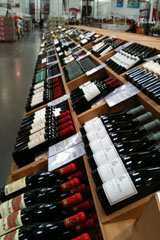 There is no such thing as a perfect initiative, but I-1183 is a huge step in the right direction. Wine Peeps supported this initiative from the get-go so we were thrilled to see it pass. We finally got the state out of the liquor business (the 43rd state to do so) and defeated the Wine and Spirits Wholesalers disingenuous campaign to maintain their Depression-era monopoly on the sale of alcohol in Washington State. Jim Senegal of Costco, speaking about their support of I-1183, “It was a matter of principle against monopoly and for the consumer.†As a result of I-1183, wine sales’ restrictions are relaxed, spirits sales are privatized, and beer sales are basically left alone.
If you believe in our free enterprise system, you had to support I-1183 despite it’s imperfections. Anyone under the illusion that if we gave them a little more time, our legislature would have solved these problems is very naïve about politics in our state. Our legislature has had over 50 years to take care of this and has done nothing. They never even got a bill out of committee. And that wasn’t going to change any time soon. As Mike Veseth of The Wine Economist, said, “Washington voters are usually suspicious of initiatives, but in this political environment some ballot issues are seen as a lesser evil to grid-locked legislation.â€
If there is a loser after I-1183, it’s the wholesalers’ lobby, and they deserve it for the way they lied their way through both of the campaigns on this issue, last year and this year. As fellow blogger, former Esquin Wine Merchants owner, and excellent Washington wine historian Rand Sealey said in his Review of Washington Wines, “If the wholesalers had supported the legislation that was in committee last year, they would be a lot better off than they are now. By opposing I-1183 in the guise of “Protect our Communities†(really “Protect our jobsâ€), the wine and spirits wholesalers showed total hypocrisy. They deserve what they got.â€
I believe everyone else is a winner to one degree or another:
Consumers should get slightly lower prices as well as seeing wine, spirits, and specialty superstores like Beverages and More (BevMo) or the equivalent come into Washington State. Having shopped in this type of store in other states, I’m looking forward to them coming to our state. It’s long overdue. In Seattle, I expect that over time, Wine World Warehouse and maybe Esquin Wine Merchants and others will expand to compete at that level.
Public Safety was a bogus concern promoted by the wholesalers’ lobby. There is no evidence to suggest that state-controlled states are safer than non-control states. And there is not going to be a proliferation of mini-marts selling spirits because of the square-footage provision. It creates tougher fines and doubles the penalties for selling liquor to minors.
The State of Washington gets out of the liquor business from a sales standpoint but continues to license, set fees, and enforce liquor laws. Being an enforcer and seller at the same time was a clear conflict of interest, like the rooster guarding the henhouse. From a fiscal standpoint, projections show the state gaining $400 million in additional revenue from I-1183 over the next six years, and not at the consumer’s expense.
The big retailers, who can now get volume discounts on wine, will not squeeze Smaller Wine Retailers out of business. Yes, for certain national brands, Costco, other big box retailers, and grocery store chains like Safeway will be in a position to offer lower prices. However, that represents a very limited number of SKUs, and some retailers believe they will even be offering a smaller selection of wine as they use shelf space for spirits.
My family has been a small business retailer for several generations in several different industries, and my dad told me about similar fears when shopping malls first came in and then later when Wal-Mart arrived on the scene. The reality was that we as small retailers had never competed on price. Our advantages were selection, customer service, and good advice, and those advantages for small retailers remain today. If a small wine shop follows this model, they will not only survive but also thrive.
Andy Perdue of Wine Press Northwest recently interviewed Doug Charles of Compass Wines, a long-time veteran of wine retailing in Washington, where he said that he was generally positive from the perspective of both small wineries and retailers. He said that he believes their shop will be now able to retail to other retailers and restaurants, and this will help small wineries from across the state sell their wines. Furthermore, he echoed the comment I made earlier that large grocery-type stores in his trade area won’t have as much space for wine because of adding spirits space, so he’ll get some of the wine business they used to get. Finally, he believes that his store will be more competitive than they were when state liquor stores could buy cheaper than him, which was really in violation of their own fixed price rules.
I will concede that the worst part of this initiative is the square footage minimum to sell spirits. It was necessary to allay fears of every mini-mart selling spirits. I believe it would be relatively simple for the legislature to remedy this situation, and, in fact, Tom Wark of Fermentation has a suggested remedy to get the discussion going.
Large Wineries, of which you can count on one hand in Washington, will undoubtedly take advantage of the opportunity to offer volume discounts to Costco and others. If Ste. Michelle Wine Estates, by far the biggest wine player in Washington, thought they would be a loser in this, we would have heard from them and seen them lobbying against I-1183.
Small Wineries such as the Family Winemakers of Washington were pro-I-1183, although some small wineries have expressed concerns. For the same reasons I shared earlier that the small retailers who focus on selection, customer service, and good advice will survive, small wineries that have a good product, stay close to their customers, are great hosts to their visitors, and give excellent service will survive. And retailers like Doug Charles will provide another distribution channel for small wineries. A successful small winery business model is not based on being the low-cost provider in the first place. As winemaker Jamie Brown, who runs three small boutique wineries and voted “yes†on I-1183, was quoted by Paul Gregutt as saying “Let the big boys duke it out with the Costco’s or Safeway’s… space and cash. I could care less.â€
Restaurants, through their state association, were big supporters of I-1183. Most believe they will benefit from lower prices through volume discounts. As Anthony Anton, President of the Washington Restaurant Association said, “Allowing competition in the distribution of liquor and wine will bring about efficiencies, better product availability, more choices for consumers, and lower liquor and wine prices….â€
Costco and other big-box retailers will quickly get into the spirits business as a result of the initiative’s passage. They will also benefit from volume discounts and central warehousing. Jim Senegal of Costco, in an interview with Bruce Ramsey, said, “Costco will have lower price on liquor than the state stores, but liquor taxes will prevent prices from dropping too much. The big drop will be in prices for wine, which was also the subject of I-1183. Costco already sells wine in Washington, but it has operated under a state rule forbidding quantity discounts.â€
Workers losing their jobs was another bogus issue from the “no†on I-1183 crowd. Sure, the state liquor stores will close, but more liquor outlets will open and those outlets will need workers. Anyone with industry experience and a good work ethic should have no trouble finding work. In fact, Costco has said it will accept applications from everyone losing their job in the state system.
In sum, the result of I-1183 should be win-win for almost everyone, and finally bring Washington State into the 21st century on liquor regulations. And, if we can get the legislature to amend the square footage rules to accommodate more existing wine sellers, it would be almost perfect.
Cheers!
Filed under: American Wine, Miscellaneous, Washington State Wine


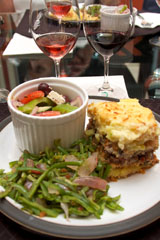 While I generally prefer flavorful but simple-to-prepare recipes, I decided to make Greek moussaka for this month’s
 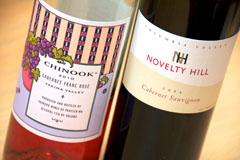 2010 Chinook Cabernet Franc Rosé (Yakima Valley, Washington): Pale, pinkish salmon in color. Aromatic with strawberry, raspberry, and floral notes on the nose. Watermelon and raspberry come through on the palate. Dry and light to medium-bodied with crisp acidity. Well-balanced with a long, refreshing finish.
 This week’s Wine Word of the Week is IGT.
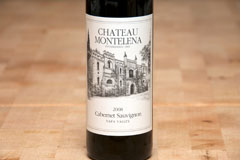 2008 Chateau Montelena Cabernet Sauvignon (Napa Valley, California): 86% Cabernet Sauvignon, 12% Merlot, and 2% Cabernet Franc. Deep red in color. Nice nose with blackcurrant and oak aromas. Blackcurrant, black cherry, oak, and leather come through on the palate. Full-bodied with lively acidity and medium to high, chewy tannins. Well-balanced with a long finish.
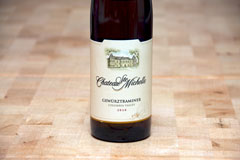 Would you like a quick suggestion for a good wine to drink tonight (or this weekend) that won’t break your budget and is widely available? Many of our readers have said this is something they would like, so here is this week’s selection, the 2010 Chateau Ste. Michelle Gewurztraminer from the Columbia Valley of Washington State.
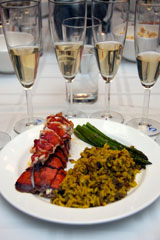 The holidays always get me in the mood for
  NV Taittinger Brut Champagne (Reims, Champagne, France): Medium straw yellow. Small, fairly fast bead of bubbles. Aromatic with apple, apricot, yeast, and floral notes on the nose. Apple, pear, lemon, and some creaminess come through on the palate. Dry and light to medium-bodied with crisp acidity. Well-balanced with a long, refreshing finish.
 This week’s Wine Word of the Week is DOCG.
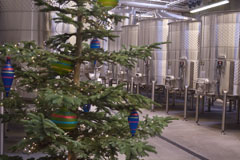 The holiday season is upon us! Retail stores already have Christmas decorations up, and Starbucks is featuring eggnog lattes and peppermint mochas. Thanksgiving is next week, and while I don’t want to gloss over that holiday because of premature Christmas excitement, it is time to make plans for December events.
 New for this year’s event, Shuttle Express will be offering safe and convenient transportation for guests to participating wineries. The
 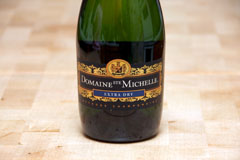 Would you like a quick suggestion for a good wine to drink tonight (or this weekend) that won’t break your budget and is widely available? Many of our readers have said this is something they would like, so here is this week’s selection, the NV Domaine Ste. Michelle Extra Dry Sparkling Wine from the Columbia Valley of Washington State.


