
Perfect Balance: Ciel du Cheval Vineyard


By Kori ~ March 14th, 2011

Kori S. Voorhees, our Wine Peeps Editor-in-Chief, is also a regular contributor to Washington Tasting Room Magazine, a quarterly magazine that focuses on Washington State wine with articles about wineries, vineyards, travel, and lifestyle. The following article, written by Kori, appeared in the Fall 2010 issue.
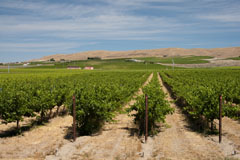
A source of elegant wines, grapes from Ciel du Cheval Vineyard are sought by winemakers for their ripeness, maturing, and perfect balance.

Attentive. Goal-oriented. Brilliant. Stable. Conscientious. Cutting-edge. These are qualities winemakers and winery owners use to describe Ciel du Cheval’s owner Jim Holmes and vineyard manager Ryan Johnson. Two of the hardest working and most well respected men in the Washington wine industry, their work ethic combined with Ciel du Cheval’s exceptional site make it a world-class vineyard.

“The character of the fruit, the quality of the fruit, the location itself, and the attention to detail by the growers is really a perfect mix of site and human influence,” says Bob Betz, owner and winemaker of Betz Family Winery. Ciel du Cheval is his single largest supplier of fruit.

Started in 1975 by friends of current owner Jim Holmes, Ciel du Cheval is located on Red Mountain just outside of Benton City, Washington. At the time, Jim Holmes and John Williams were business partners at Kiona Vineyards across the road.

In 1991, Kiona purchased Ciel du Cheval and when Holmes and Williams separated their business interests in 1994, Williams took the Kiona property and Holmes took Ciel du Cheval. Holmes made many improvements to the vineyard and hired Ryan Johnson as vineyard manager in 2000.
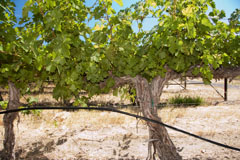
Today, Ciel du Cheval has thirteen grape varieties planted on 120 acres, including Cabernet Sauvignon, Syrah, Merlot, Sangiovese, Cabernet Franc, Grenache, Mourvedre, Petit Verdot, Nebbiolo, Viognier, Roussanne, Counoise, and Pinot Gris.

Currently, about 30 producers purchase Ciel du Cheval grapes, including DeLille, Betz, Andrew Will, Mark Ryan, and Grand Rêve. When asked to characterize the overriding traits of Ciel fruit, Johnson, Betz, and Jay Soloff, co-owner of DeLille Cellars, all make mention of its ripeness, maturity, and balance.

Soloff, whose DeLille Cellars purchases about 30 percent of Ciel’s grapes, says, “When we bring in grapes from Ciel du Cheval, we know what kind of wine it’s going to make. We know that Jim has created for us grapes with flavor, grapes with not only maturity in the pulp but also maturity in the skin and skin tannins, balance with acidity and pH, everything perfect.”

The original owners intended to pay homage to the Horse Heaven Hills, which can be seen from the vineyard, when they named Ciel du Cheval. “They had had some high school French and didn’t get it quite right,” recalls current owner Jim Holmes.

“Every Frenchman who comes by gives us a hard time about it. It kind of translates to ‘Horse Sky’, which doesn’t make any sense, but it was meant to be Horse Heaven.”

No matter the origins of the name, having Ciel du Cheval on a bottle of wine is quite notable. Holmes keeps track of critics’ scores for wines made from his fruit for validation of what’s being done in the vineyard. “For our 2007 vintage, we have something like 50 wines that have been tasted and ratings published, and the average score across all of the wines and all of the wineries is 92 points.”

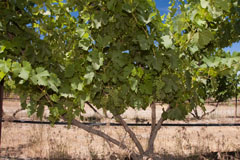
Ciel du Cheval utilizes different trellising systems, including fan-trained vines as well as the more common bilateral cordon. Fan-trained vines actually have four trunks and disperse the vigor throughout an eight-foot spacing instead of a four-foot spacing. Vineyard manager Ryan Johnson explains, “It catches the sun wonderfully; it’s kind of like a catcher’s mitt—great wind pass-through, great spray coverage, and a great natural shading.”

Some winemakers swear by the fan-trained vines while others prefer bilateral cordon. Holmes and Johnson work with each winemaker who purchases Ciel fruit to decide what’s best.

In addition, the newest vines at Ciel du Cheval are skewed in a diagonal orientation instead of just north/south or east/west so that they get equal heat units on each side of the vine.

At 120 acres, the vineyard is completely planted out, with the exception of a five-acre parcel in the middle of the vineyard reserved if they decide to open a winery someday, though there are no immediate plans to do so. Meanwhile, Holmes and Johnson continue to work hard to maintain Ciel du Cheval’s lofty status.

Johnson says, “It goes back to something that Jim Holmes told me on my first day on the job: ‘If you don’t stay cutting edge, someone else will pass you by.’ That’s our underlying philosophy out here.”

Ciel du Cheval has three different soil types: Hezel sandy loam, Warden silt loam, and scooteney. Since Red Mountain is a desert, one extremely important tool in the Ciel du Cheval arsenal is irrigation management. They have moisture sensors located at one, two, and three feet deep, which provide them with constant updates on the moisture depletion.

Holmes says, “We have forty different blocks out there (in the vineyard), and every morning I’m on my computer looking at the soil moisture profiles. I look at every block and evaluate it. Ryan is out there going up and down the rows.”

One of their most exciting projects is still in the development stages. The desert soils do not offer a lot of nutrition, there is little organic matter, and nitrogen levels are very low. In an effort to work away from using synthetic fertilizers to replace nitrogen, Holmes has partnered with Washington State University and Steven Link, a professional desert biologist, to develop a program to use native, nitrogen-fixing plants as a cover crop.

Bringing in synthetics and even the compost used by some vineyards can change the character of the soil, so Holmes’ goal is to sustain the unique terroir of Ciel du Cheval by using native plants instead. “We want to maintain our terroir as it was in the beginning because that is what defines us and makes us unique. We don’t want to change it, we just want to make it work in a natural way,” says Holmes.

Since the project started two years ago, they have completed a species-sorting part of the project and are currently developing a seed basis for these native plants, along with building their own nursery. The results so far have been promising, but there is quite a bit of research yet to be done.

Holmes and Johnson go above and beyond with hands-on farming practices, cutting edge technology, and excellent customer service to help their customers ultimately produce the best wine possible.

Bob Betz remembers, “One time I could not get over and it was very close to harvest. I had been over on Friday, and we weren’t going to make a decision until Wednesday on when to pick. Ryan picked clusters that morning, put them in a FedEx box, and overnighted them to me just so I could take a look. That’s the kind of communication and passion that they have for their site.”

Ciel du Cheval delivers, in every sense of the word.


Filed under: American Wine, Vineyards, Washington State Wine, Washington Tasting Room Magazine, Wine Magazines
 

A Wine for Tonight: 2007 Chateau Thieuley Bordeaux Rouge


By Kori ~ March 10th, 2011

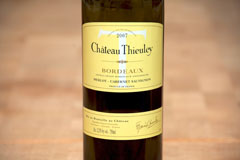
Would you like a quick suggestion for a good wine to drink tonight (or this weekend) that won’t break your budget and is widely available? Many of our readers have said this is something they would like, so here is this week’s selection, the 2007 Chateau Thieuley Bordeaux Rouge from the Bordeaux region of France.
Our selection criteria include:

  • A very good Quality rating of >=3.5 stars (out of 5)
  • A price tag of <=$15
  • Must be widely available

Chateau Thieuley, located in the Bordeaux region of France, came into the Courselle family in 1950. Andre Courselle laid the foundation for their vineyards. His son, Francis, took over management in 1972. Today, Chateau Thieuley remains family-owned with Francis Courselle’s daughters, Marie and Sylvie, running the business. Marie is in charge of the winemaking while Sylvie runs the commercial side of the business.

“Dark color. Nose of red fruits, spices, slightly oaked. Powerful, with a good structure with tannins which need at least 3 years to be softer. This wine is a typical Bordeaux red.” –Chateau Thieuley

2007 Chateau Thieuley Bordeaux Rouge (Bordeaux, France): 70% Merlot and 30% Cabernet Sauvignon. Deep ruby red in color. Nice nose with red fruit, earth, and vegetal aromas. More red fruit and bell pepper comes through on the palate. Medium to full-bodied with lively acidity, medium to high tannins, and a long finish.
Quality: 3.5 stars (out of 5)
QPR: 5 bangs for your buck (out of 5)
Where to buy: Received as sample, suggested retail $14; Available elsewhere, $10 to $20


Filed under: A Wine for Tonight, Five-Bangs For Your Buck Wines, French Wine, Red Wine, Wines Under $15, Wines Under $20, Wines Under $25
 

Are You a Washington Wine Super Fan? Win VIP Access to Taste Washington


By Kori ~ March 9th, 2011

Wine Press Northwest is running their second annual “Washington Wine Super Fan” contest in which the winner will receive VIP treatment at Taste Washington in Seattle, the largest single-region wine and food event in the country.

It’s easy to enter. Just fill out an entry form and write a brief essay on why you are a Washington Wine Super Fan. The editors of Wine Press Northwest will judge the essays and announce a winner next week. The winner of this contest will get to attend The Seminars on Saturday, March 26th, and receive VIP access to the Grand Tasting on Sunday, March 27th.

For more information about Taste Washington, be sure to refer back to my Taste Washington 2011 Preview.

Good luck!


Filed under: American Wine, Contest, Washington State Wine, Wine Activities/Events
 

Book Review: WineTrails of Walla Walla


By John ~ March 9th, 2011

Let me cut right to the chase. If you ever plan to go to Walla Walla, Washington (or go back to Walla Walla), you need to buy this book, WineTrails of Walla Walla. You can find it in most Washington wine shops and winery tasting rooms, or you can order it online.
This is Steve Roberts’ fourth book in his series of WineTrails guidebooks. He began this wine book odyssey with the best seller, WineTrails of Washington, and followed it up with WineTrails of Oregon and WineTrails of Idaho. Steve is one of the nicest guys you’ll ever meet, and his interest in wine is only surpassed by his skills as a writer and photographer. I love his work.

What makes WineTrails of Walla Walla different, and more valuable, than his first three guidebooks is that it’s not just a book of wine trails. This book has valuable sections on places to eat, places to stay, and things to do in Walla Walla in addition to his signature WineTrails about wineries to visit.

I’ve been to Walla Walla many times, but I had no idea that there was a children’s museum that my granddaughter could visit or a symphony or a balloon stampede. I did think that I knew most of the places to eat and places to stay, but Steve found a few that were new to me. I’m really looking forward to exploring some of these new finds on my next trip to Walla Walla.

To make your visit to Walla Walla’s wineries with public tasting rooms easier, Steve divided the wineries into five separate WineTrails: West (9), Downtown (25), Airport (16), East (4), and South (19). As you can see by the number of wineries on each WineTrail indicated in parentheses, it could take you many, many days or a number of trips to Walla Walla to visit them all.

So curl up with this book and plan your first or next trip to Walla Walla. I believe that using this guidebook will make it your best Walla Walla trip ever.

By the way, after I wrote this review, Steve called it to our attention that he had mentioned Wine Peeps in his write-up about Rotie Cellars. Somehow I missed it in my first pass through the book. So be sure to check out page 86.

Have fun!


Filed under: American Wine, Washington State Wine, Wine Books, Wine Travel
 

Wine Word of the Week: Shoot positioning


By Kori ~ March 8th, 2011

This week’s Wine Word of the Week is shoot positioning.
Official definition from Jancis Robinson’s The Oxford Companion to Wine:
Shoot positioning is the spring and summertime viticultural practice of placing vine shoots in the desired position to assist in trimming, leaf removal, and harvest operations, to facilitate the control of vine diseases and vine pests.

Layman’s terms from Kori:
Shoot positioning is a canopy management technique in which shoots are arranged so that the microclimate has good sunlight penetration and good air circulation to all leaves.


Filed under: Wine Word of the Week
 

Taste Washington 2011 Preview


By Kori ~ March 7th, 2011

Washington State ranks second nationally in wine production with over 700 wineries and 40,000 vineyard acres. As I’ve said numerous times before, Washington wines are perfectly positioned to thrive in our current economy. Washington State is producing outstanding wines that consistently deliver great bang for your buck.
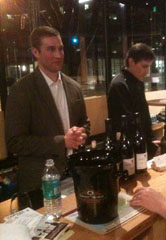
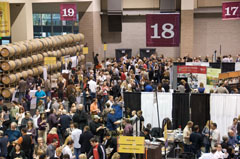
If you love Washington wine, want to learn more about Washington wine, or are just looking for a fun event to attend, the upcoming Taste Washington in Seattle is just the event for you. Hosted by the Washington Wine Commission, Taste Washington is the ultimate carnival for wine and food lovers and the perfect way to cap off Washington Wine Month. Of the 700+ wineries in the state, over 220 of them are expected to be on hand pouring their wines at the Grand Tasting on Sunday, March 27th, at the Qwest Field Event Center. There will also be a vineyard area in which you can taste wines that several different wineries have produced from a single source. In addition, approximately 75 of the best Seattle-area restaurants will be serving small bites. And to round out the carnival-like atmosphere, there will also be fun and games, cooking demonstrations, a live jazz band, and much, much more. The Grand Tasting begins with a two-hour VIP tasting from 2-4pm, followed by three hours of general admission from 4-7pm. It is a huge event and can be overwhelming if you are not prepared. You will be wise to plan a strategy ahead of time. Be sure to refer back to my post from last year with tips for making the most of Taste Washington.

If a smaller, more intimate gathering is more your speed or you want to further your knowledge of wine and Washington wine in particular, The Seminars on Saturday, March 26th, might be of interest to you. Held at the Bell Harbor International Conference Center, eight seminars will be offered on a variety of topics. These seminars afford attendees the opportunity to taste, discuss, meet, and learn from some of the biggest names in the Washington wine industry as well as a few notable guests from outside of Washington State.

The “Common Ground” seminars the past two years were such a hit that they are offering another one this year which will focus on Seven Hills Vineyard in the Walla Walla Valley. A couple of other seminars that sound very interesting are “A Sort of Homecoming: Food and Wine Pairing with Michael Mina” (help Chef Mina decide which Washington wines go best with his world-class dishes) and “In Search Of: Washington’s Singular Style” (explore whether Washington has or needs a singular style of wine which can’t be made anywhere else).
Recently, I attended the Taste Washington TweetUp hosted by the Washington Wine Commission at Soul Wine, Pike & Western’s new wine shop at South Lake Union, which featured wines that will be poured at the Grand Tasting (see my notes below). The total cost to buy a bottle of each of the ten wines I tasted would set you back $316, but you can purchase a ticket to Taste Washington for $75 and taste these wines as well as many more.

We’ll be there both days and hope that those of you who live in the greater Seattle area will plan to attend as well. For more information or to purchase tickets, visit the Taste Washington website.

Here are the wines I tasted during the Taste Washington TweetUp, listed in the order I tasted them, with my Twitter-style notes as well as Quality and QPR ratings:

2007 Northstar Winery Merlot (Columbia Valley, Washington): Nice black fruit, very smooth.
Quality: 4 stars (out of 5)
QPR: 4 bangs for your buck (out of 5)
Suggested retail price: $40

2007 Fall Line Winery Cabernet Sauvignon (Yakima Valley, Washington): Fruit sourced from Artz and Boushey Vineyards. Great fruit, big, bold, yet smooth tannins.
Quality: 4.5 stars (out of 5)
QPR: 5 bangs for your buck (out of 5)
Suggested retail price: $25

2007 Fall Line Winery Artz Vineyard Red Wine (Red Mountain, Washington): 39% Cabernet Franc, 36% Merlot, and 25% Cabernet Sauvignon. Black fruits, vegetal notes, long finish, a little rough on the back end.
Quality: 3.5 stars (out of 5)
QPR: 3 bangs for your buck (out of 5)
Suggested retail price: $25

2008 Dusted Valley Vintners Stained Tooth Syrah (Columbia Valley, Washington): Appropriately named, dark fruit, hint of leather and spice.
Quality: 3.5 stars (out of 5)
QPR: 4 bangs for your buck (out of 5)
Suggested retail price: $24

2005 Tranche Slice of Pape (Columbia Valley, Washington): A blend of Grenache, Syrah, and Cinsault. Very Rhone-like as you might expect. Good fruit and earthy notes.
Quality: 3.5 stars (out of 5)
QPR: 2 bangs for your buck (out of 5)
Suggested retail price: $35

2008 Gramercy Cellars Lagniappe Syrah (Columbia Valley, Washington): Fruit-forward, herbal notes, classic Syrah.
Quality: 3.5 stars (out of 5)
QPR: 2 bangs for your buck (out of 5)
Suggested retail price: $40

2008 Chinook Cabernet Franc (Yakima Valley, Washington): Nice fruit. Some vegetal, earthy, and barnyard notes as well.
Quality: 3.5 stars (out of 5)
QPR: 4 bangs for your buck (out of 5)
Suggested retail price: $22

2009 Maison Bleue Winery Jaja Red (Yakima Valley, Washington): 50% Grenache, 50% Syrah. Gorgeous nose, red and black fruits, licorice, leather.
Quality: 4 stars (out of 5)
QPR: 5 bangs for your buck (out of 5)
Suggested retail price: $20

2009 Maison Bleue La Montagnette Grenache (Upland Vineyard, Snipes Mountain, Washington): Gorgeous, extremely food-friendly, good complexity, black fruits, plum, smoked meat, very smooth.
Quality: 4.5 stars (out of 5)
QPR: 5 bangs for your buck (out of 5)
Suggested retail price: $35

2009 Maison Bleue Graviere GSM (Upland Vineyard, Snipes Mountain, Washington): 25% Grenache, 50% Syrah, and 25% Mourvedre. Another winner from Jon Martinez. Black fruits, nutmeg, spice, licorice, very smooth.
Quality: 4 stars (out of 5)
QPR: 3 bangs for your buck (out of 5)
Suggested retail price: $40

To try these wines for yourself, make plans to attend Taste Washington later this month.


Filed under: American Wine, Cabernet Franc, Cabernet Sauvignon, Five-Bangs For Your Buck Wines, Grenache, Merlot, Red Wine, Shiraz/Syrah, Washington State Wine, Wine Activities/Events, Wines Over $25, Wines Under $25
 

A Wine for Tonight: 2009 Columbia Winery Cellarmaster’s Riesling


By Kori ~ March 3rd, 2011

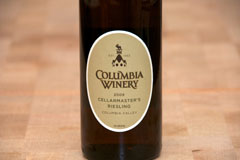
Would you like a quick suggestion for a good wine to drink tonight (or this weekend) that won’t break your budget and is widely available? Many of our readers have said this is something they would like, so here is this week’s selection, the 2009 Columbia Winery Cellarmaster’s Riesling from the Columbia Valley of Washington State.
Our selection criteria include:

  • A very good Quality rating of >=3.5 stars (out of 5)
  • A price tag of <=$15
  • Must be widely available

Columbia Winery, located in Woodinville, Washington, was founded in 1962 by ten friends, six of whom were University of Washington professors. Originally known as Associated Vintners, it was the first premium winery in Washington State. The late Master of Wine David Lake was the founding winemaker; Kerry Norton, who now serves as Director of Winemaking, succeeded him. In 2008, Ascentia Wine Estates acquired Columbia Winery.

The Columbia Winery Cellarmaster’s Riesling holds a special place in my “wine” heart. My first real exposure to wine was visiting the nearby wineries in Woodinville with friends during my days at the University of Washington. Back in 1998, there were not nearly as many wineries in Washington State. A wine tasting trip to Woodinville generally consisted of two stops, Chateau Ste. Michelle and Columbia Winery, which are located across the street from each other. Of the wines we tasted in those early days, the Cellarmaster’s Riesling was my clear favorite. As a wine newbie, I was drawn to this sweet white wine. These days, I don’t drink sweet whites very often. However, I was glad to see this wine do well in a recent blind samples tasting.

“On the nose are notes of pears, apples, and a hint of nutmeg. The sweetness is balanced by the zing of vibrant acidity that makes this such a food-friendly wine.” –Director of Winemaking Kerry Norton

2009 Columbia Winery Cellarmaster’s Riesling (Columbia Valley, Washington): 97% Riesling and 3% Gewurztraminer. Pale, greenish straw yellow. Nice nose with honey, melon, and pear aromas. Cantaloupe, honeydew melon, honey, and apricot come through on the palate. Medium-bodied and sweet with crisp acidity and a long finish. Residual Sugar: 6.1%
Quality: 3.5 stars (out of 5)
QPR: 5 bangs for your buck (out of 5)
Where to buy: Received as sample, suggested retail $12; Available elsewhere, $10 to $12


Filed under: A Wine for Tonight, American Wine, Five-Bangs For Your Buck Wines, Riesling, Washington State Wine, White Wine, Wines Under $15, Wines Under $20, Wines Under $25
 

Digging into the Cellar Party III: 2006 Washington Syrah


By John ~ March 2nd, 2011

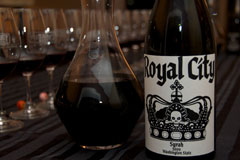
Recently, the Wine Peeps team hosted our third Digging into the Cellar Party for about fifteen of our closest wine loving friends. For our first DITC Party, the theme was Rhone-style wines. For our second DITC Party, the theme was Red Blends. For this party, the theme was Washington Syrah, and we bookended a blind tasting of eleven 2006 Syrahs from Washington State with the 2006 O*S Dineen Vineyard Syrah, our Wine Peeps Washington Wine of the Year for 2009, and the 2006 Charles Smith Royal City Syrah, which Paul Gregutt of Wine Enthusiast gave a perfect score of 100 points. 2006 was an excellent vintage in Washington wine country, and we wanted to see how these wines were doing and determine which ones we thought still had a lot of life left.
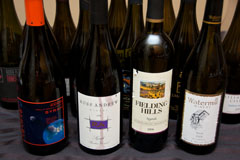
What we found was that all of the wines were drinking very well, and we estimate that many of them could easily go another 7 to 10 years. Although this was not a serious, take-copious-tasting-notes event, each attendee was asked to turn in the sack numbers of their three favorites so that we could get a composite favorites list. With this group of wines, which were all very good, it was a difficult task.

After unveiling the sacked bottles, the consensus favorite of the group turned out to be the 2006 SYZYGY Syrah from the Walla Walla Valley. Other group favorites were the 2006 Ross Andrew Boushey Vineyard Syrah, the 2006 Fielding Hills Riverbend Vineyard Syrah, and the 2006 Watermill Walla Walla Valley Syrah. Other favorites of Kori and mine were the 2006 Long Shadows Sequel Syrah and the 2006 Alma Terra Coeo Syrah.

While the two bookend wines were not tasted blind, they received considerable praise from a number of the attendees; although, it was clear that the Charles Smith Royal City Syrah would not have received a perfect score of 100 points from this group. In fact, the O*S Dineen Vineyard Syrah received just as much praise, if not more, than the Royal City.
All in all, it was another super party with great friends and spectacular wine. We’re looking forward to doing it again.

Cheers!


Filed under: American Wine, Red Wine, Shiraz/Syrah, Washington State Wine, Wine Activities/Events
 

Wine Word of the Week: Shoot thinning


By Kori ~ March 1st, 2011

This week’s Wine Word of the Week is shoot thinning.

Official definition from Jancis Robinson’s The Oxford Companion to Wine:
Shoot thinning is the vineyard operation normally carried out by hand in the early spring which consists of breaking off unwanted shoots arising from the vine’s head or cordon. …. The aim of shoot thinning is to reduce the density of the canopy and to avoid leaf congestion later in the season.

Layman’s terms from Kori:
Shoot thinning is a canopy management technique in which unwanted shoot growth is removed during the spring.


Filed under: Wine Word of the Week
 

Women of Washington Wine: Hillary Sjolund of Sonoris Wines


By Kori ~ February 28th, 2011

Today’s post is part of a series featuring the Women of Washington Wine. In an industry once dominated by men, more and more women are joining the ranks as winery owners, vineyard owners, and winemakers. Being a woman myself, I am fascinated by these women and what they have done and continue to do. Through this series, I hope to introduce you to some of the brightest female faces in the Washington wine industry.

Hillary Sjolund is the owner and winemaker for Sonoris Wines. A native of California, Hillary graduated with a degree in Fermentation Science from UC Davis and got her start in the wine industry as a harvest intern at Pine Ridge Winery in Napa. She spent time working harvest in Chile in 2003 and returned to Pine Ridge as assistant winemaker. Hillary moved to Washington State in 2006 and became winemaker for DiStefano Winery in Woodinville. In January, Hillary left DiStefano to focus full-time on her own Sonoris Wines. She purchased her first Cabernet Sauvignon grapes from Blue Mountain Vineyard in Walla Walla in 2008. From those grapes, she made her first Sonoris wine, “Burney’s Blend” named for her grandfather, which will be released this spring.
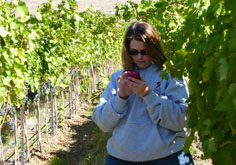
Recently, Hillary was kind enough to take time out of her busy schedule to answer some questions for me and our Wine Peeps readers.

Highlights from Q&A with Hillary Sjolund:

How did you first get involved in the wine business?
I was taking an “introduction to winemaking” class at UC Davis, and I caught the fever. Winemaking was all I wanted to think about from that moment on.

What were the steps that led to where you are now?
In 2000, I took a job as a harvest intern with Pine Ridge Winery in Napa, California. I quickly became the intern that never left. In 2003, after a brief winemaking journey to Chile, I returned to Pine Ridge as their Assistant Winemaker. In 2006, Mark Newton of DiStefano Winery recruited me to Washington State, where I have made a home in winemaking. In January of 2011, I decided to branch out on my own with Sonoris Wines.

Has being a woman been an advantage or a disadvantage in your wine journey?
I’ve never seen any disadvantages, only challenges. I think you are either born with the passion to do this, or you aren’t. It’s the passion, the constant drive to make next year better than last, to get the most from your fruit, to learn at every step, and to never stop tasting, testing, and progressing.

What advice do you have for a woman wanting to get involved in the wine business today?
Try your hand at everything to find your fit. Winemaking may sound grand, but perhaps wine marketing is more your thing. Know your strengths and weaknesses, ask for help, be open to suggestions, and don’t be afraid to step out of your comfort zone.

I understand that you have worked harvest in Chile in addition to your work at wineries in Washington and California. What have you learned from those experiences?
Chile taught me how to be connected to the “culture” of wine. They taught me how to read the land, take in its fruit, and make it what it is, not what it isn’t. Be true to your land; be true to your culture.

What are your thoughts about the Washington wine industry, in general?
It’s an exciting time to be making wine in Washington. I think we offer the greatest quality to value ratio anywhere in the country. Our fruit is expressive, and our winemaking talent unique. We are becoming more aware of our soils and what grows best where. The industry here is very open to sharing new ideas and lending a helping hand. It feels like family here.

In recent years the Washington wine industry has grown at a rapid rate. Do you expect that trend to continue?
Not at the same rate, but I do think it will continue to grow. I think you are going to see a lot more “co-ops” for winemaking where several winemakers are under the same roof developing a multitude of wines from vineyards all over the state. I think the “urban” winemaking scene is very interesting and creative. I can’t wait to see what happens next.

What is your vision for the future of Sonoris Wines?
Sonoris is new and developing. I started with a Cabernet Sauvignon blend because that is what I love. This year I plan on adding a white wine to the portfolio. Production will remain under 1,000 cases for now. My goal is make up to four wines in the next two years.

Many thanks to Hillary for sharing her story and thoughts with us. I wish her all the best and will continue following her work and Sonoris Wines with great interest, and I hope that you will too.

(Photos from Sonoris Wines)


Filed under: American Wine, Interview, Washington State Wine, Women of Washington Wine