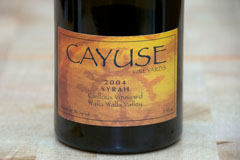
 Before we delve into the lab analysis, let me give you some background information in case you are not familiar with Cayuse and the great debate that rages between Cayuse lovers and Cayuse skeptics. Cayuse Vineyards, founded in 1997 by French-born Christophe Baron, is often thought of as a Washington winery. While Cayuse does have a tasting room in downtown Walla Walla (though it is rarely, if ever, open), the Cayuse winery and vineyards are located near Milton-Freewater, Oregon, in an area known as The Rocks. Viticulturally-trained in Champagne and Burgundy, Baron first visited the Walla Walla area in 1993. A few years later he had plans to buy land in Oregon’s Willamette Valley and plant a vineyard when he stumbled upon a field full of softball-sized stones near Walla Walla that reminded him of the cobblestone vineyards of Châteauneuf-du-Pape in France. He changed course, bought the stone-filled farmland, and planted his first vineyard. While he makes a few other wines, Baron’s focus is on Syrah. Cayuse produces about 3,000 cases per year of their vineyard-designated, biodynamically-farmed wines. The wines are sold exclusively through a mailing list, which has a very long waiting list. Cayuse regularly receives high scores and accolades from wine critics. At the same time, though, Cayuse also has many detractors who do not care for their wines.
Cayuse wines have very good fruit, but it’s hard to get through to the fruit when you taste the wines because of all of the “funkâ€, and that’s where the differences of opinion come into play. Cayuse lovers will say it’s unique terroir, an Oregon Châteauneuf-du-Pape, and if you don’t like the wines, you don’t have a sophisticated palate. On the other hand, Cayuse skeptics say the wines have serious faults and what you are smelling and tasting is the result of those faults. It’s been an ongoing debate for years, but the lovers have tended to prevail because most of the well-known wine critics have been in their corner.
For several years, both John (Dad) and I have been in the Cayuse skeptics’ camp and have been criticized for it. However, I did considerable research on wine faults when I was studying for the Certified Specialist of Wine exam and have tasted wines from all over the world. John has tasted wine for over 40 years. We both have a pretty good idea of what we like in a wine and what we don’t like as well as what’s good and what is not good. We’re not easily fooled by a wine whose proponents call it a product of unique terroir when, in our educated opinion, it is basically a flawed wine. As Lloyd Bentsen famously said to Dan Quayle, who had defended his inexperience as similar to that of John F. Kennedy, in their Vice Presidential debate, “Senator, I served with Jack Kennedy. I knew Jack Kennedy. Jack Kennedy was a friend of mine. Senator, you are no Jack Kennedy.†Well, we know Châteauneuf-du-Pape and, believe me, Cayuse is no Châteauneuf-du-Pape. Nor is it a Côte-Rôtie, Cornas, or Hermitage either.
In recent years, we at Wine Peeps have reviewed as many Washington State wines as anyone; and I have contended all along that the Cayuse wines I’ve tasted all have had faults (which is why we have written about very few), some bottles showing more pronounced sensory defects than others. While other Cayuse critics have suspected brettanomyces might be the culprit, I thought one of the first bottles we tasted showed signs of volatile acidity, and another bottle showed signs of one of the volatile sulfur compounds like mercaptans. John had taken Amy Mumma’s Wine Faults short course in the CWU World Wine Program and thought I was correct, but how would we ever know for sure?
We love Washington wines and believe they are some of the best in the world. The Walla Walla Valley AVA and especially The Rocks area south of the Washington/Oregon state line have prospered in no small part due to the efforts of Christophe Baron at Cayuse. However, it has always been curious to me that other wines produced from grapes in The Rocks, some literally within a stone’s throw, do not taste at all like Cayuse. Those wines made me suspect that the differences are not terroir but rather winemaking. Talking to a number of respected winemakers and vineyard managers who are in a position to know confirmed our suspicions that there might be problems with Cayuse wines.
Recently, Paul Gregutt, author of Washington Wines and Wineries and a contributing editor for Wine Enthusiast magazine reviewing Pacific Northwest wines, posted on his blog about his review of the 2007 Cayuse wines, and waxed eloquently as usual about Christophe, his unique terroir, and his wines, painting them as an “outriderâ€, with the implication once again that it takes a special palate to appreciate this special wine.
“When a Cayuse wine is placed in the midst of a blind tasting it will often show poorly. I have seen this happen in a group of extremely knowledgeable wine professionals. Plop any of the Cayuse syrahs into a syrah tasting and see what happens. Odds are, unless someone in the group spots them (either by bottle size or scent) as what they are, they will not be applauded.†–Paul Gregutt on PaulGregutt.com
John commented, interpreting that as meaning:
“If you don’t know it’s Cayuse, you probably won’t like it. But if you do know it’s Cayuse, you know you are supposed to like it.â€
Naturally, Paul disagreed.
In another comment to Paul’s post, a reader said:
“…there were too many flaws for me to recognize any terroir.â€
Paul responded:
“I see terroir rather than flaws. I suppose a lab analysis would be the most scientific way to resolve that debate.â€
Voila! What a great idea, Paul. So we set up an account at the renowned ETS Laboratories in St. Helena, California, one of the most advanced wine analysis labs in the world and ordered samples kits and labels in case we needed them. Then we looked in our cellars and found a 2004 Cayuse Cailloux Vineyard Syrah and a 2005 Chateau de Beaucastel Châteauneuf-du-Pape to put in our private tastings lineup.
As regular Wine Peeps readers know, usually several times a week, the Wine Peeps team gets together for dinner and we have a private tasting with two wines blind. The setup for these dinners is slightly different from our monthly tasting dinners. Periodically, we sack up pairs of wines we have acquired that we would like to blind taste against each other. We label the pairs with a letter (A, B, C, etc.) to keep them together and also indicate on the sacks if they are red or white wines. After sacking up anywhere from six to ten pairs, we put them away. By the time we pull them out of the cabinet for one of our family dinners, we have usually forgotten what the wines are. Depending on the meal that is being prepared, we grab either a red or white pair. These tastings are considered double-blind.
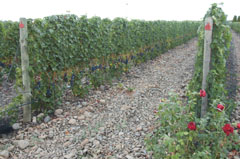 On Monday evening, October 25th, the two wines that we tasted with dinner turned out to be the 2004 Cayuse Cailloux Vineyard Syrah and 2005 Chateau de Beaucastel Châteauneuf-du-Pape. It did not take long for all four of us to suspect that Wine #2 was a Cayuse wine. Paul Gregutt is correct, it is an “outrider†but not in a good way for us. The wine had aromas of pickle brine, almost to the point of being vinegary, as well as olives, cooked cabbage, and burnt matches. On the palate, it was hard to get to the fruit because of the flavors of canned corn, rotten vegetables, and decomposed greens. With our steak dinner, the wine seemed very bitter and even had a formaldehyde taste. We all agreed that we thought it was flawed and that we should submit the wine to ETS for analysis. By the way, we greatly preferred Wine #1 (which turned out to be the Beaucastel) to Wine #2 (which was the Cayuse as we suspected). The Beaucastel was an excellent wine.
After dinner, we poured the remaining wine into the lab bottles and labeled the samples for submission to ETS. We requested three tests on the Cayuse, a standard chemistry panel, a sulfides panel, and an ethylphenols panel. [Note: The samples sent to ETS are identified with a sample number so ETS did not, and still does not (unless they read this post) know the identity of the wine they tested.]
Within two days, we had the results, posted online and emailed to us. Then we had a follow-up call with a representative at ETS to discuss the results. The evidence was clear. The Cayuse was a flawed wine. It had volatile acidity slightly above the normal sensory threshold but at a level a massive Syrah can support, but the worst result from the chemistry panel was that it had a high pH level, which made it more susceptible to bacterial attack. The most damning result, however, came from the sulfides panel. Published literature and ETS studies say that low levels of dimethyl sulfide can contribute roundness, fruitiness, or complexity; however, at levels greater than 50 ug/L, it may contribute vegetative, cooked cabbage, or sulfide smells to wines. According to the ETS representative, this wine had the highest dimethyl sulfide level he had ever seen (312 ug/L), more than 10 times the normal sensory threshold (17-25 ug/L), which accounts for the canned corn, rotten vegetables, and decomposed greens flavors. And, those dimethyl sulfide levels and resulting unpleasant sensory characteristics will only increase with wine age, according to ETS. A layman’s analogy for the effects of dimethyl sulfide in wine would be like salt in food. If you add a little salt to your food while you are cooking, it enhances the flavor, but if you dump in the whole salt shaker, all you will taste is salt.
In case you are wondering what might cause an extremely high dimethyl sulfide level, ETS lists “Possible Causes of Sulfide Problems in Wine†in their Volatile Sulfide Analysis Technical Bulletin:
- residues from vineyard spray programs
- high turbidity
- yeast strains
- must nitrogen deficiencies
- other nutritional deficiencies
- high fermentation temperatures
- fermentor size and shape
- inadequate aeration during fermentation
- gross lees contact and extended lees contact
In the interest of fairness and full disclosure, I must mention that we have only lab tested this one bottle of Cayuse; however, it had the same unmistakable aromas and flavors as every other bottle of Cayuse wine that we’ve tasted through the years. Lab tests like we had performed at ETS Labs are very expensive, costing over four times what we actually paid for the bottle in the first place, but we believe it was worth it in order to either validate our professional opinion that the wine was flawed [which it did] or to admit that they are technically good, but we just don’t like the flavor profile of Cayuse wines.
The popularity of Christophe Baron and his Cayuse wines has been an invaluable asset to the Washington wine industry and especially to the Walla Walla Valley AVA, even though Cayuse is actually an Oregon winery. Walla Walla Fall Release weekend was built on the back of Cayuse’s Fall Release, though Christophe has now moved his release date to April. I’m sure that the successful promotion of his wines has made many landowners in The Rocks very wealthy. Nothing we’ve learned should diminish the potential of vineyards in the area, as long as good vineyard and winemaking practices are followed.
You may be thinking that panning Cayuse is political suicide in Washington wine circles, and maybe it is. But we believe that the truth is more important than politics, and that’s what we endeavor to provide at Wine Peeps. As many can attest, if you make good, fault-free wine, which many, many wineries do here in Washington, we’ll tout you from the rooftops. But if you don’t, we won’t make excuses for you just to stay in line with the popular opinion. Our readers, wine consumers, deserve nothing less.

 Wine Peeps is an independent wine blog dedicated to helping you get the most bang for your buck in wine. We do this through blind tastings of wine from around the world and calculations of
 This week’s Wine Word of the Week is loess.

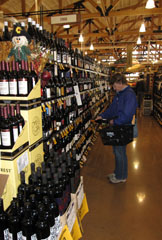 Obviously the answer to the above question depends partially on who you are, a wine consumer, a winery, or a wine reviewer. If you are a novice wine consumer, wandering through the wine section of your local Fred Meyer store, how else will you have a clue as to where to start in identifying a good wine to buy? Even if you are an experienced wine lover, how will you find the time or money to taste all of the possibilities in a given varietal without using someone else’s ratings as a point of reference?
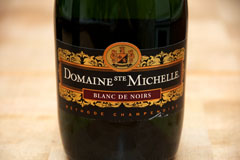 Would you like a quick suggestion for a good wine to drink tonight (or this weekend) that won’t break your budget and is widely available? Many of our readers have said this is something they would like, so here is this week’s selection, the NV Domaine Ste. Michelle Blanc de Noirs from the Columbia Valley of Washington State.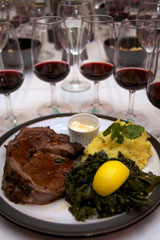
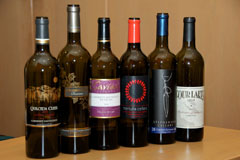 From 1st to last in the group consensus rankings:
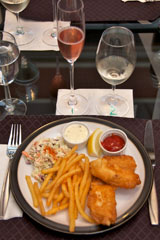 A good friend gave us some fresh fish from Alaska including a package of ling cod so I thought it would be fun to have fish and chips for this month’s
 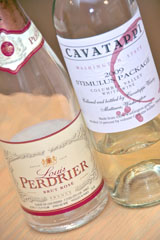 NV Louis Perdrier Brut Rosé (France): Pale to medium pink in color. Nice nose with strawberry, floral, and hoppy aromas. Pear, hops, and a hint of strawberry come through on the palate. Medium-bodied with crisp acidity and a long finish. A refreshing bubbly.
 This week’s Wine Word of the Week is port.
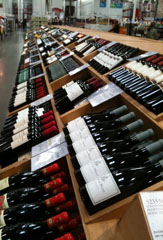 If you know exactly what wine you want to buy, then the only issues are availability and price. A big box store like Costco or Sam’s, a wine mega-store like BevMo in California, Spec’s in Texas, Davidson’s in Denver, or Total in the Southeast (if you have one of those in your area) may fill the bill for you perfectly. Most wine merchants try to move their excess stock twice a year, many in January and August, so those are usually especially good times to buy.
 For this endeavor, look for a wine shop, not a supermarket or liquor store. Notice the temperature when you walk in the door. Make sure it almost feels a little cool to you. Also, notice whether the wine stock looks fresh, not dank and dusty. Ideally the shop will organize its wines by country or region or varietal. Ask the wine steward what their system is for displaying wines. That will also give you a clue as to whether the staff really knows wine and can answer questions intelligently. Fortunately, many independent wine shops are owned and managed by bright, wine enthusiasts who are happy to assist you on your wine journey.
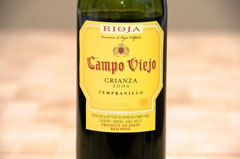 Would you like a quick suggestion for a good wine to drink tonight (or this weekend) that won’t break your budget and is widely available? Many of our readers have said this is something they would like, so here is this week’s selection, the 2006 Campo Viejo Rioja Crianza Tempranillo from the Rioja region in Spain.
 In July, Paul Zitarelli of
 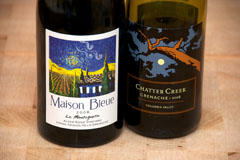 2008 Maison Bleue La Montagnette Grenache (Alder Ridge Vineyard, Horse Heaven Hills, Washington): 85% Grenache and 15% Syrah. Deep purple in color. Very aromatic with red fruits, raspberry, spice, oak, and a hint of buttered popcorn on the nose. Fruit-forward with raspberry, clove, and strawberry Twizzlers on the palate. Medium-bodied with crisp acidity and soft tannins. Well-balanced and smooth with a long finish.


