Paso Robles: Crash Courses at Steinbeck Vineyards


By Kori ~ May 26th, 2010

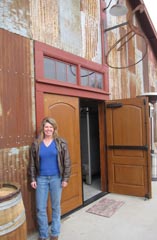
Looking for a unique wine country experience that takes you beyond the tasting room? The Crash Courses at Steinbeck Vineyards in Paso Robles, California, could be the answer for you. Members of the Steinbeck family, who have been farming in the Paso Robles area for six generations, teach the courses. Participants have the rare opportunity to experience the vineyards firsthand.

The Steinbeck family has been farming in the heart of California’s Central Coast since 1884. Howie and Bev Steinbeck, fourth generation Paso Robles natives, founded Steinbeck Vineyards in 1982. The family grows thirteen different grape varieties on 500 acres. Their daughter, Cindy Steinbeck Newkirk, and her husband Tim moved back home in 1997 to join the family business. Tim gave up a career as an air traffic controller, and Cindy had been a youth minister. After working with Cindy’s parents to grow the vineyard business, Cindy and Tim decided it was time to do something that could be “theirs” and would honor the heritage of the family’s vineyard. They founded Steinbeck Winery in 2006. Only 1 percent of their fruit annually goes into their wine program while they continue to sell 99 percent. Cindy and Tim’s son, Ryan Newkirk, and his wife Caitlin have also returned to the vineyard to pursue Ryan’s dream of working side-by-side with his grandfather. The Steinbeck’s are in the process of transitioning the vineyard management from Howie to Ryan.

Cindy has a background in education with a Masters in History and Theology. She loves people and teaching and developing the Crash Courses was her idea. About six years ago, she crafted a business model that would bring people onto the ranch and give them an experience in the vineyard. Formerly known as The Wine Yard at Steinbeck Vineyards, the Crash Courses feature six different modules on a variety of topics, with each session lasting one to one and a half hours. Participants board a vintage jeep that takes them through the vineyards and to the Steinbeck schoolhouse for their class. Each module concludes with a complimentary wine tasting at the Steinbeck Winery tasting room.

Crash Course module topics:

  1. Sustainable Wine Growing—vineyard practices, planting a vineyard, and conservation efforts
  2. Home Tours and the History of the Paso Robles Region—tour historic ranch homes, learn the history of agriculture and wine growing in Paso Robles
  3. Economics of Vineyards and Wine—economics of planting vineyards and growing grapes, selling wine, building toward the future
  4. Taste of Steinbeck—offered in September and October, taste ripe fruit in the vineyard, learn ripeness factors and the logistics of picking
  5. Farm Equipment and Modern Mechanization—equipment used in farming wine grapes, mechanization versus hand work
  6. My Father’s Vineyard: The Wisdom of the Vine—Scriptural perspective on life in the vineyard

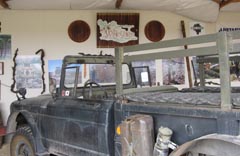
On my trip to Paso Robles in March, I had the pleasure to visit Steinbeck Vineyards and Winery and meet Cindy Newkirk. We got to take a ride through the vineyards in one of the vintage jeeps that is used for the Crash Courses, a 1975 Jeep 715 from Camp Pendleton. If our brief peek into the Crash Courses was any indication, I think that wine enthusiasts of all levels would enjoy them. I am not aware of another wine education opportunity like this but would like to see more wineries around the country offering similar agri-tourism experiences.


Filed under: American Wine, California Wine, Vineyards, Wine Travel
 

Challenging Wine Pairing: Chicken Stir-Fry


By LaGayle ~ May 25th, 2010

We have had beautiful warm weather in Seattle lately, so I decided that this month’s challenging wine pairing should be something easy and light that would call for refreshing white wines.

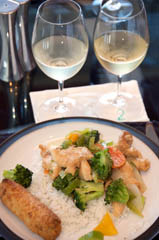
My family and I love Asian food, so I decided to prepare a chicken stir-fry with rice and egg rolls. All items were easily prepared and quite delicious. Another thing about a stir-fry is that it’s very healthy with many choices of vegetables that can be utilized along with the meat. Our stir-fry included chicken breast, broccoli, carrots, snap peas, onion, celery, and bell peppers.

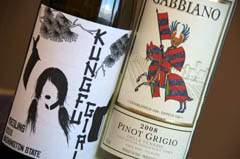
Again, I referred to my favorite book, What to Drink with What You Eat, by Andrew Dornenburg and Karen Page and decided to try an off-dry Riesling and a Pinot Grigio. This challenge gave us the perfect opportunity to try the 2009 Kung Fu Girl Riesling by Charles Smith Wines, which is a favorite of many here in Washington State, and the 2008 Gabbiano Pinot Grigio, whose Chianti we have enjoyed in the past. Both wines were very enjoyable; however, the Kung Fu Girl Riesling was the unanimous choice with and without food.

We have a lot of fun with these challenging wine pairings so I encourage you to try your own challenging pairings at home. Also, we would love for you to suggest challenging wine pairing meals for us to try in the future.

Bon Appétit!

2009 Kung Fu Girl Riesling (Evergreen Vineyard, Columbia Valley, Washington): Produced by Charles Smith Wines. Very pale, straw yellow. Nose is a bit tight at first, then some minerality comes through. Citrus fruits, particularly lime and lemon, and tropical fruits explode on the palate. Off-dry and medium-bodied. Well-balanced and crisp with a long finish. Excellent by itself and paired perfectly with the stir-fry. Residual Sugar: 1.41%
Quality: 4 stars (out of 5)
QPR: 5 bangs for your buck (out of 5)
Where to buy: Fred Meyer (Seattle, Washington), $12.49; Available elsewhere, $11 to $17

2008 Gabbiano Pinot Grigio (Delle Venezie IGT, Italy): Pale, golden yellow. Moderate pear aromas lead to flavors of pear, apple, and melon. Dry, medium-bodied, and lively with a medium finish. A decent wine but a bit plain.
Quality: 3 stars (out of 5)
QPR: 4 bangs for your buck (out of 5)
Where to buy: Fred Meyer (Seattle, Washington), $8.99; Available elsewhere, $7.50 to $10


Filed under: American Wine, Challenging Wine Pairing, Five-Bangs For Your Buck Wines, Food & Wine, Italian Wine, Pinot Grigio/Pinot Gris, Riesling, Washington State Wine, White Wine, Wines Under $10, Wines Under $15, Wines Under $20, Wines Under $25
 

Va Piano Vineyards: The Feel of Tuscany, Walla Walla-Style


By Kori ~ May 24th, 2010

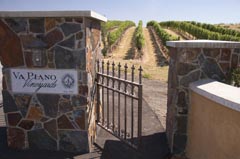
Va Piano Vineyards, located in Walla Walla, Washington, officially opened its doors in 2005. Owner/winemaker Justin Wylie and his wife Liz planted Va Piano Vineyards in 1999. They built Va Piano’s Tuscan-themed winery and tasting room in 2004. Justin is a native of Walla Walla and was inspired to return home and try his hand at winemaking after spending his senior year at Gonzaga University studying in Florence, Italy.

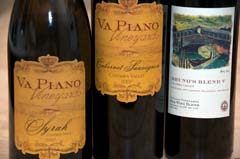
Recently, we had the opportunity to taste four wines from Va Piano Vineyards in a blind samples tasting. The 2007 Syrah was excellent, but we would recommend all four wines. While the winery and tasting room have the look and feel of Tuscany, the Va Piano wines are a true reflection of Washington State fruit. They source fruit from their own 20-acre estate vineyard in the Walla Walla Valley as well as from other top vineyards throughout the Columbia Valley.

Va Piano Vineyards also has a heart for philanthropy. They produce two Bruno’s Blend wines, one red and one white, named for Father Bruno Segatta. Justin met Father Bruno when he was at Gonzaga University and was inspired to give the way Father Bruno has given. The labels of the Bruno’s Blend wines feature Father Bruno’s paintings. When the Bruno’s Blend wines are sold out, Va Piano donates a portion of the proceeds to a charity of Father Bruno’s choice.

2007 Va Piano Syrah (Columbia Valley, Washington): Deep, dark purple. Black fruit and vegetal aromas on the nose; tons of cinnamon, black tea, and black fruits on the palate. Medium to full-bodied and lively with medium to high tannins. Well-balanced with a long finish.
Quality: 4 stars (out of 5)
QPR: 4 bangs for your buck (out of 5)
Where to buy: Received as sample, suggested retail $38; Available elsewhere, $33

2007 Va Piano Cabernet Sauvignon (Columbia Valley, Washington): Deep, ruby red. It takes a while for the aromas to come through. Flavors of black fruits and leather. Medium to full-bodied and lively with medium, drying tannins and a long finish.
Quality: 3.5 stars (out of 5)
QPR: 4 bangs for your buck (out of 5)
Where to buy: Received as sample, suggested retail $38; Available elsewhere, $33 to $39

Va Piano Bruno’s Blend V (Columbia Valley, Washington): 67% Syrah, 19% Cabernet Sauvignon, and 14% Merlot. Medium-deep, purplish red. Nose is a bit tight at first. Fruit-forward with red fruits, especially raspberries, coming through on the palate. Medium-bodied and crisp with round tannins and a long finish.
Quality: 3 stars (out of 5)
QPR: 3 bangs for your buck (out of 5)
Where to buy: Received as sample, suggested retail $23; Available elsewhere, $20

Va Piano Bruno’s Blend I Sauvignon Blanc (Columbia Valley, Washington): Light straw yellow. Citrus and tropical fruit, almond, and floral aromas lead to papaya and melon flavors. Dry, light-bodied, crisp acidity, and a long finish.
Quality: 3 stars (out of 5)
QPR: 2 bangs for your buck (out of 5)
Where to buy: Received as sample, suggested retail $15


Filed under: American Wine, Cabernet Sauvignon, Red Wine, Sauvignon Blanc, Shiraz/Syrah, Washington State Wine, White Wine, Wines Over $25, Wines Under $20, Wines Under $25
 

Wine Word of the Week: Clos


By Kori ~ May 22nd, 2010

This week’s Wine Word of the Week is clos.

Official definition from Jancis Robinson’s The Oxford Companion to Wine:
Clos is French for ‘enclosure’, and any vineyard described as a Clos should be enclosed, generally by a wall. This is a particularly common term in Burgundy, but is also used elsewhere.

Layman’s terms from Kori:
Clos is an enclosed or walled vineyard.


Filed under: Wine Word of the Week
 

An Open Letter to Warren Buffett Regarding H.R. 5034


By John ~ May 21st, 2010

Dear Mr. Buffett:

You are certainly one of the most astute investors in history. As such, I’ve noticed with interest that one of your companies has recently purchased several beer, wine and spirits distributors. Obviously, this means that you believe that the future is bright in the wholesaling business.

What I want to know is whether this also means that you are a supporter of H.R. 5034? I cannot believe that someone like yourself, such an advocate of and poster boy for the American free enterprise system, would support such an anti-American, anti-consumer, and anti-free and fair trade bill such as H.R. 5034.

The Warren Buffett that I have admired for the 40+ years I have been in the investment management business wouldn’t have supported this self-serving legislation for a minute. But to date, you have been silent on this issue. Please speak out against this legislation so I will know that my admiration for you has not been misplaced. Wholesalers can still make good money without destroying small wineries.

Today, I understand that there are more than 6,000 wineries in the U.S., most of them making very small amounts of wine. Yet while the number of wineries has grown tremendously, I read that just six wine and spirits distributors now control over 50 percent of the market. To me, this means that wholesalers cannot possibly handle more than a fraction of the wineries that want to expand their sales out of their home state. So as any smart entrepreneur like you, Mr. Buffett, would do, these small and mid-sized wineries started marketing direct to the consumer.

Wholesalers, used to having a monopoly under our Depression-era three-tier system, fought back by pushing legislation at the state level to stop direct shipments. The direct marketing advocates countered with a number of lawsuits challenging the legality of the special interest legislation. Several lawsuits even reached the Supreme Court. When it became obvious that wholesalers were slowly but surely losing more and more of their old state mandated legal protection for their monopoly, they have now resorted to special interest legislation of the worst kind, H.R. 5034, which looks to me like a blatant attempt to buy in Congress what they have been losing in the courts.

Mr. Buffett, I buy wine from many sources, including direct from wineries, when I can’t find what I want at an independent wine shop or at a big-box store or even through an online retailer. I want to continue to have this freedom to buy wine from a variety of vendors, whichever best fits what I am looking for today. I certainly don’t want the government, under undue influence of the wholesalers lobby, to limit my buying choices. What about you?

Sincerely yours,

John Sosnowy


Filed under: American Wine, Miscellaneous
 

A Wine for Tonight: 2005 Columbia Winery Syrah


By Kori ~ May 20th, 2010

Would you like a quick suggestion for a good wine to drink tonight (or this weekend) that won’t break your budget and is widely available? Many of our readers have said this is something they would like, so here is this week’s selection, the 2005 Columbia Winery Syrah from the Columbia Valley of Washington State.

Our selection criteria include:

  • A very good Quality rating of >=3.5 stars (out of 5)
  • A price tag of <=$15
  • Must be widely available

Columbia Winery, located in Woodinville, Washington, was founded in 1962 by ten friends, six of who were University of Washington professors. Originally known as Associated Vintners, it was the first premium winery in Washington State. The late Master of Wine David Lake was the founding winemaker; Kerry Norton, who now serves as Director of Winemaking, succeeded him. In 2008, Ascentia Wine Estates acquired Columbia Winery.

“Bright red plums, dark berries and earth fill the nose.  The palate is filled with dark ripe fruits, smoke and black pepper followed by a rich and lengthy finish.” –Director of Winemaking Kerry Norton

2005 Columbia Winery Syrah (Columbia Valley, Washington): Deep, purplish red. Aromatic with cinnamon and black fruits on the nose; black plums, blackberries, and mocha on the palate. Medium to full-bodied with lively acidity, medium tannins, and a long finish.
Quality: 3.5 stars (out of 5)
QPR: 5 bangs for your buck (out of 5)
Where to buy: Fred Meyer (Seattle, Washington), $10


Filed under: A Wine for Tonight, American Wine, Five-Bangs For Your Buck Wines, Red Wine, Shiraz/Syrah, Washington State Wine, Wines Under $15, Wines Under $20, Wines Under $25
 

Wine Tasting Dinner: Washington Syrah 2006, Part 2


By Kori ~ May 19th, 2010

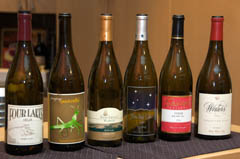
Last Friday, we hosted our monthly wine tasting dinner featuring Washington Syrah from the 2006 vintage. You may remember that we also had Washington Syrah 2006 in our December tasting dinner. Since that was such a stellar tasting, we decided to have another one to try more wines from this vintage that is sometimes forgotten amid the hype about the 2005 and 2007 vintages in Washington State. It is the more challenging vintages like 2006 that really set apart the great winemakers.

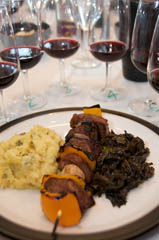
It was another fabulous dinner with good wines across the board. All six wines paired well with Mom’s dinner of creamy tomato basil soup, butter lettuce salad with a garlic/Dijon mustard vinaigrette, beef tenderloin shish kabobs, sautéed red kale, cilantro lime mashed sweet potatoes, and German chocolate dessert.

Like Butler making it to the finals of the NCAA tournament, our consensus favorite, the 2006 Four Lakes Syrah from Chelan, was a sleeper that outperformed some better-known wines. We first visited Four Lakes Chelan Winery last summer. Their tasting room, which opened in 2009, boasts gorgeous views of, you guessed it, four lakes: Wapato Lake, Roses Lake, Dry Lake, and Lake Chelan. Founded in 2003, Four Lakes is owned and operated by the Koester family; Don Koester is the owner, and Karl Koester is the winemaker and manager.

The consensus second place wine, the 2006 Watermill Praying Mantis Syrah, is from Watermill Winery in Milton-Freewater, Oregon. Since they are located in the Walla Walla Valley, we take a broad view and include them with Washington wines. The Brown family, a third generation apple-growing family and the owners of Blue Mountain Cider, founded Watermill Winery in 2006. They own some prized land in “The Rocks” and have pulled up some of their apple orchards to plant vineyards.

Rounding out our top three was the 2006 Bunchgrass Syrah. I had not previously tasted any wines from Bunchgrass so was excited to discover this excellent wine, and I look forward to trying others from this small production winery in Walla Walla, Washington.

From 1st to last in the group consensus rankings:

2006 Four Lakes Syrah (Columbia Valley, Washington): Dark purple, looks a bit like prune juice. Very aromatic with black plums, prunes, and spice coming through on the nose; chocolate, cinnamon, meat, and earth on the palate. Medium to full-bodied and lively with medium to high tannins and a long finish. Well-balanced and very complex. This wine has a lot going on.
Quality: 4.5 stars (out of 5)
QPR: 5 bangs for your buck (out of 5)
Where to buy: Winery, $29

2006 Watermill Praying Mantis Syrah (Walla Walla Valley, Oregon): Deep, dark purple. Has a beautiful bouquet with aromas of dark black fruits, spice, oak, leather, and earth. Black fruits and spice dominate the palate. Medium to full-bodied and lively with medium to high, drying tannins and a long finish. Well-balanced.
Quality: 4 stars (out of 5)
QPR: 4 bangs for your buck (out of 5)
Where to buy: Winery, $30

2006 Bunchgrass Syrah (Lewis Vineyard, Columbia Valley, Washington): Deep, dark purplish red. Aromas of raisins and cinnamon lead to flavors of bitter dark chocolate and blackberry. Medium to full-bodied and lively with medium to high, drying tannins. Well-balanced and smooth with a long finish.
Quality: 4 stars (out of 5)
QPR: 4 bangs for your buck (out of 5)
Where to buy: Compass Wines (Anacortes, Washington), $32

2006 Five Star Cellars Syrah (Walla Walla Valley, Washington): Deep, dark purple. Nose is a bit tight at first, then dark fruits and vanilla show through. Lots of juicy, black fruits on the palate. Fruit-forward, medium to full-bodied, lively acidity, round tannins, and a long finish.
Quality: 3.5 stars (out of 5)
QPR: 4 bangs for your buck (out of 5)
Where to buy: Pete’s Wine Shop (Bellevue, Washington), $25

2006 Saviah Cellars Walla Walla Valley Syrah (Walla Walla Valley, Washington): Dark purplish red. Aromas of leather and oak; flavors of black fruits, oak, and licorice. Medium to full-bodied and lively with medium to high tannins and a long finish.
Quality: 3.5 stars (out of 5)
QPR: 4 bangs for your buck (out of 5)
Where to buy: Winery, $32 (currently, on sale for $20)

2006 Waters Forgotten Hills Syrah (Forgotten Hills Vineyard, Walla Walla Valley, Washington): Deep, dark purplish red. Earth, spice, cocoa powder, and barnyard aromas on the nose; earth, barnyard, and dill on the palate. Medium to full-bodied and smooth with medium tannins and a medium finish.
Quality: 3 stars (out of 5)
QPR: 1 bang for your buck (out of 5)
Where to buy: Full Pull Wines (Seattle, Washington), $37; Available elsewhere, $17 to $35


Filed under: American Wine, Five-Bangs For Your Buck Wines, Red Wine, Shiraz/Syrah, Washington State Wine, Wine Tasting Dinners, Wines Over $25
 

Wines of Chile: Exploring Chilean Sauvignon Blanc


By Kori ~ May 18th, 2010

Last week, we had the pleasure to take part in an online Chilean Sauvignon Blanc tasting hosted by Wines of Chile. Sauvignon Blanc is the primary white variety planted in Chile. Eight Chilean winemakers/winery representatives convened in Chile to talk about their wines via video conference to 51 wine bloggers across the United States while Master Sommelier Fred Dexheimer moderated from New York City.

The presenting winemakers/winery representatives included:

They answered questions and shared personal stories on top of discussing their own wines and their love of Sauvignon Blanc in general. Most of the bloggers, including me, were tweeting during the event. If you’d like to review the stream, check out #SBChile.

In addition to tasting wines, I thoroughly enjoy it when I have the opportunity to visit with winemakers and kick the dirt in the vineyards. While my first choice would be to visit in person, I am thankful for the technology that allowed me (and my fellow bloggers) to visit with winemakers on another continent. One of these days I hope to be able to visit Chile so that I can complete the experience and kick the dirt in the vineyards, as well as meet some of these talented winemakers in person.

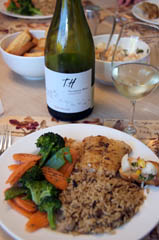
My favorite wine of the tasting was the 2009 Undurraga T.H. (Terroir Hunter) Sauvignon Blanc from the Leyda Valley. It was very refreshing and had screaming acidity. In fact, it reminded me a lot of New Zealand Sauvignon Blanc, which I love. The Undurraga is an excellent sipper by itself and also great with food. While we tasted through all eight wines without food during the online event, Wines of Chile had sent a recipe for a shrimp and scallop ceviche that they thought would pair well with the wines. So the next day, we made the ceviche to accompany our dinner of blackened halibut, wild rice, and mixed vegetables and drank the Undurraga T.H. with it. The ceviche and halibut were scrumptious, and the Undurraga really shined with food.

If you have not had Chilean Sauvignon Blanc, I encourage you to give it a try.

Here are the wines we tasted, listed in my personal order of preference:

2009 Undurraga T.H. Sauvignon Blanc (Leyda Valley, Chile): T.H. stands for Terroir Hunter. Pale yellow in color. Very aromatic with grapefruit, melon, and citrus fruits on the nose. More citrus fruits, particularly grapefruit, melon, and a hint of bell pepper come through on the palate. Medium-bodied with screaming acidity. Well-balanced with a long finish. Reminds me of a New Zealand Sauvignon Blanc.
Quality: 4 stars (out of 5)
QPR: 4 bangs for your buck (out of 5)
Suggested Retail Price: $15.99 – $16.99

2009 Santa Rita Medalla Real Sauvignon Blanc (Leyda Valley, Chile): Pale, greenish yellow. Grapefruit, grass, and some green vegetables on the nose; lots of lime, lemon, grapefruit, and some green notes on the palate. Medium-bodied with crisp acidity. Good balance and a long finish.
Quality: 3.5 stars (out of 5)
QPR: 3 bangs for your buck (out of 5)
Suggested Retail Price: $19.99

2009 Casa Silva Cool Coast Sauvignon Blanc (Paredones Estate, Colchagua Valley, Chile): Pale, greenish straw yellow. Grapefruit aromas lead to flavors of grapefruit, lime, pineapple, tropical fruits, and toasted nuts. Medium-bodied and very crisp with a slight effervescence. Good balance and a long finish.
Quality: 3.5 stars (out of 5)
QPR: 2 bangs for your buck (out of 5)
Suggested Retail Price: $22.99

2009 Cono Sur Organic Sauvignon Blanc (San Antonio Valley, Chile): Pale yellow in color. Tropical fruits and minerality come through on the nose; more tropical fruits, particularly pineapple, on the palate. Medium-bodied and very crisp with good balance and a long finish.
Quality: 3.5 stars (out of 5)
QPR: 4 bangs for your buck (out of 5)
Suggested Retail Price: $13

2009 Veramonte Sauvignon Blanc Reserva (Casablanca Valley, Chile): Pale, greenish straw yellow. Fresh, grassy aromas lead to flavors of lime and melon with a hint of saltiness. Light to medium-bodied with crisp acidity and a long finish.
Quality: 3 stars (out of 5)
QPR: 4 bangs for your buck (out of 5)
Suggested Retail Price: $10.99

2009 Haras de Pirque Haras Estate Sauvignon Blanc (Maipo Valley, Chile): Pale, greenish straw yellow. Minerality, creosote, and petrol aromas on the nose; minerality and faint citrus notes on the palate. Medium-bodied with crisp acidity and a long finish.
Quality: 2.5 stars (out of 5)
QPR: NR (not recommended)
Suggested Retail Price: $12

2009 Ventisquero Queulat Sauvignon Blanc (Casablanca Valley, Chile): Pale, greenish yellow. Minerality and citrus aromas and flavors. Medium-bodied with crisp acidity and a long finish. Very different and not very pleasant.
Quality: 2.5 stars (out of 5)
QPR: NR (not recommended)
Suggested Retail Price: $17

2009 Valdivieso Single Vineyard Wild Fermented Sauvignon Blanc (Leyda Valley, Chile): Medium golden yellow in color. Unusual nose with aromas of petrol, kiwi, and honeysuckle. Heavy on the palate; tastes like a hardware store. Medium-bodied and lively with a long finish. A very different style from the others. Not my cup of tea.
Quality: 2 stars (out of 5)
QPR: NR (not recommended)
Suggested Retail Price: $21.99

Full Disclosure: We received these wines as samples.


Filed under: Chilean Wine, Sauvignon Blanc, White Wine, Wine Activities/Events, Wines NOT To Buy (1 & 2 Star), Wines Under $15, Wines Under $20, Wines Under $25
 

A Lifetime of Wine: Interview with Dink and Marie Morris


By Kori ~ May 17th, 2010

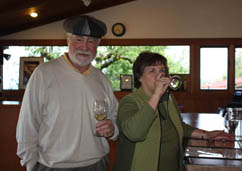
We all have special people in our lives who have influenced us and introduced us to new things. When it comes to fine wine, those special people for me are my Dad’s cousin Marie Morris and her husband Dink. Dink and Marie live in northern California and have been wine lovers for over 40 years. Their younger daughter, Kim, and I have been close since we were kids so I take advantage of any opportunity to visit the Morris family. They were the ones who first took me to visit wineries, introduced me to Riedel wine glasses and the difference good wine glasses can make, and led me through my first blind wine tasting dinner.

Recently, Dink and Marie were kind enough to take time to answer my questions and share their thoughts and experiences with me and our Wine Peeps readers. I hope that you find their story interesting and, especially for those of you who are new to wine, inspiring. Wine can sometimes be intimidating, but it doesn’t have to be. If you are interested in learning more about wine, don’t let anyone or anything stand in your way. Just visit some wineries, buy new wines to try, attend wine tastings and events, read this blog, and enjoy.

When did you take your first trip to wine country? How old were you and what made you decide to do it?
Our first trip was in the fall of 1968. We were 22 years old at the time.  We were back at Cal [University of California at Berkeley] for the fall semester and wanted a getaway. Napa County was close and inexpensive (at the time), and we wanted to try the hot springs at Calistoga. The wine tasting was a secondary activity, which turned out to be more interesting.

What were your first impressions then, and what was your first favorite wine?
Our first impression was that it was an interesting activity. We were not serious about wine, nor did we consume much.

Marie: I had not grown up with wine. Mother liked Gewurztraminer but preferred a martini, and my father preferred bourbon.

Dink: I grew up with wine in the house, but it was often homemade by my grandfather or step-grandfather or jug wine that my father bought.

We found the wineries interesting and welcoming. We particularly remember Louis Martini Winery that had old doors laid across barrels for the tasting bar, and we went to Beringer to see the famous caves. Overall we liked the wines, and it was the start of our interest; although, we did not return for a couple of years. We cannot remember a specific wine from that early adventure. Over time, we started drinking wines when we were out to dinner in a restaurant (because the wine was cheaper than cocktails), but we did not initially have wine at home. Our second visit, when we were becoming more interested in wine, was in the early 70s. We continued to go to the Napa area including the Silverado Trail area and frequently camped and bicycled around the valley. Over time, we expanded our tastings to the Sonoma Valley and the Russian River area. We started having annual Thanksgiving weekend tastings with Jim and Jeri [Marie’s brother and his wife]; we would taste in Napa Valley on Friday and Sonoma Valley on Sunday. When the children were small they would have to endure these wine tasting adventures. We always tried to go to old favorites and add some new wineries as well. We would look for small, often family-owned wineries. We had unforgettable experiences talking with the owners and winemakers. On one such adventure, we tasted at Raymond Winery when it was still being built; they were installing the insulation that day. We sat on the stemmer/crusher and were introduced to the wines by Walter Raymond (or “Old Man Raymond” as he was introduced by his son). Raymond became one of our favorites, as did Cakebread. At that time, you needed an appointment, and we called the owner’s auto shop business in the East Bay to make arrangements. Cakebread is where we remember having our first barrel tasting. It was a Cabernet that we loved; unfortunately, it was released and sold out before we could get any. But our favorite wine from those early days was Louis Martini’s Cabernet Sauvignon. One time we found some in a corner grocery store in San Francisco and bought all they had, for $3 a bottle.

What are the most vivid changes that stick out in your mind in the wine industry since your first trip?
The most vivid change is how much the wine industry has moved to big business. So many of the wineries today are large, fancy structures that focus on the mass market, and the tasting experience is much less personal. The one that stands out as the first new style winery for us was Sterling; it just seemed so out of place. The other change is the tasting fees. In the early days, it seemed that the winemakers wanted you to taste their wines because they were proud of what they produced and hoped that you would like them. Of course, they were pleased when you made purchases. Although we did have one time when we tasted a late harvest Riesling from Raymond that was just like honey; he did not want to sell it to us, he just wanted us to taste it. For us, if we can taste the wines, we will most likely buy something. One consequence of the tasting fees and the lack of connection is that we no longer feel that we should acknowledge the winemaker by buying something. We stopped going to Napa Valley years ago because of the people, traffic, and cost. And we avoid the festivals, etc. It sometimes feels like wine tasting is just a destination event now.

How different is the wine you buy today from the wine that you bought then?
We continue to buy pretty similar wines; our tastes have changed some but not a lot. However, it seems the wines now are made to be [immediately] drinkable. We do not find the wines to age like we did before, particularly ones that are reasonably priced. Different wineries cater to different consumers within the mass market; some focus on large volume and drinkability and others on small lots and, often, higher prices. That higher priced wine may ultimately be a better wine, but is it a good value?

Are the differences good or bad?
We do not like this trend as we like the more complex wines that will age into an interesting mature wine, and, of course, we prefer to find that at a reasonable price.
Where have your wine travels taken you over the years?
We are fortunate to have many wonderful wineries nearby, and we generally do day and weekend wine tasting trips in northern California. Some areas that we frequent are the Carneros region, the Sonoma valley, the Russian River area, the Livermore area, and Amador County, and the Mother Lode area, but there are many more. When we travel to other areas in California and to other states, if there are wineries we will generally try them, but we do not travel long distances just to taste wine.

How do wines from your native California stack up with those from other wine regions you have visited?
We have not liked any as well as California wines; although we acknowledge that this is partially bias. We have tasted interesting, drinkable wines, but haven’t found them to have the character we like. Sometimes the variety is not our favorite; many Oregon wineries make good Pinot Noir, but we do not care for Pinot Noir. Admittedly, there are many California wines that we do not like, but we have so many to choose from that it is not a problem to find wines that suit our taste.

I know you often do blind tastings at home. Are those tastings just for fun or do you believe that blind tasting really helps you determine which wines are best?
The wine group started as a pretty serious wine tasting, at least 25 years ago. It was an opportunity to try new wines and share thoughts and to try wines that we might not purchase for ourselves. Over time, the composition of the group has changed. We now pair the wines with a dinner. At times, we are surprised where a particular wine lands in the rankings and which wine may be the best value. Doing it as a blind tasting does take away everyone’s predisposition for different wineries, etc. We have toyed with putting the same wine in multiple bottles to see what would happen. As with any group of twelve, we have different tastes in wine, which adds an interesting element to the tastings. We also go on weekend wine tasting trips, and the opportunity to experience the wines of a new region is especially interesting when you do it with a group.

What are some of your favorite wines today?
It is hard to say what our favorite wine is. There are wines that we drink regularly because we enjoy them and they are more reasonably priced. And there are wines that are wonderful, but we don’t have them very often. Vintage also makes a difference in our experience. We had the opportunity to have Kathryn Kennedy Cabernet last weekend, and it was outstanding, but it is not something we get very often. We also were able to taste at Alysian, a small Russian River winery and had a particularly good Pinot Noir. Since we don’t usually like Pinot Noir, it was quite a find. As far as varietals go, for reds, we both like Cabernet Sauvignon and Cabernet blends; in addition, Dink likes Zinfandel, and Marie often likes Syrah. For whites, we both like Chardonnay. As for what we buy the most: Retzlaff Cabernet and Retzlaff Blend, and Schug Chardonnay.

What suggestions do you have for someone just getting into wine?
We would recommend that they try different varieties and different viticultural areas. Over time, they will develop a sense of what wines are a good fit for them. And when they go wine tasting, try to get away from the glitzy tasting room. There are still wineries out there where you can come away with an education about their wines and with a real feeling for the winery and the people behind it. A wine tasting group is also a good option; it allows you to expand your experience. And often restaurants offer wine tastings or winemaker’s dinners that can be really interesting experiences.

Prices for many of the better wines have really dropped in recent times as a result of the recession. Do you think that the best buying opportunity is now or that prices will go even lower?
We have not seen a reduction in prices here so cannot really comment on that. What we have seen are some sales on case purchases and free shipping. We do purchase futures, which gives you a discounted price, from some wineries where there has been consistency in their product, but fewer wineries are offering that option.

Is there anything else you believe our readers would like to know about your life in wine? Any interesting stories you have to share from along the wine trail?
Of course, there is the story of taking you wine tasting, and the difference a glass makes. After 40 years, there are just too many wonderful stories to include them all.  But the things we remember above all are the interactions with so many interesting people, including immigrant winemakers and gentleman farmers. Our interest in wine over those 40 years has allowed us to develop an appreciation for wine and the craft that it is.

Many thanks to Dink and Marie for sharing their experiences and thoughts with us. And, personally, I can’t thank them enough for introducing me to fine wine and setting me on my own wine journey.

Cheers!


Filed under: General Wine Information, Interview
 

Wine Word of the Week: Ampelography


By Kori ~ May 15th, 2010

This week’s Wine Word of the Week is ampelography.

Official definition from Jancis Robinson’s The Oxford Companion to Wine:
Ampelography is the science of description and identification of the vine species vitis and its cultivated vine varieties. A volume of vine descriptions is also called an ampelography, the word coming from the Greek ampelos for vine, and graphe for writing.

Layman’s terms from Kori:
Ampelography is the plant science concerned with identification and classification of grapevines.


Filed under: Wine Word of the Week