Thinking About the Importance of Vintages


By John ~ March 19th, 2010

Recently, I’ve read posts from wine writers whose opinions I respect (Paul Gregutt and 1WineDude) discussing and mostly panning the importance of “vintage” in today’s wine world. Those posts got me thinking more about the issue and whether or not I find “vintage” as important as I used to.

What causes vintage variation? I believe the main cause is the weather: temperature, water, and sunshine. Can we control any of those any more today than we used to? Certainly we cannot control temperature, but to some extent good vineyard management can minimize the effects of sunshine variation, and with irrigation we can control water in some places such as here in the state of Washington. Today we also have tools in the winemaking process that can reduce vintage variation, but this presupposes that you have great winemaking skills, which is certainly not always the case.

So I’d have to say that I believe that “vintage” is still important, but maybe not as important as it was 50 years ago. Almost anyone can make good wine in a perfect weather year. However, in a challenging weather year, grapes from the well-managed vineyards that are going to producers with great winemaking skills can still result in great wine. But grapes from marginally managed vineyards going to mediocre winemakers aren’t likely to result in even good, much less great, wine.

Here’s how I would recommend that consumers use vintage ratings:

  1. What is generally regarded as a mediocre or poor vintage year is the year that you can use to identify the truly great winemakers, the ones whose wine you want to buy every year.
  2. In a great weather year, the wine consumer is in the catbird seat, because virtually everyone is making good wine, and you can find great values (more wines with good QPR) from more producers.

Two final points on the subject: I generally ignore vintage information from winery PR folks, because according to them everything is great at their winery all the time, every vintage. However, I have found vintage information from the major wine review publications helpful, and use them as I described previously.

As far as I’m concerned, “vintage” is still important.


Filed under: General Wine Information
 

A Wine for Tonight: 2007 Spice Route Chakalaka


By Kori ~ March 18th, 2010

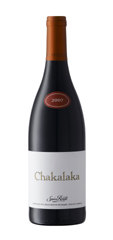
Would you like a quick suggestion for a good wine to drink tonight (or this weekend) that won’t break your budget and is widely available? Many of our readers have said this is something they would like, so here is this week’s selection, the 2007 Spice Route Chakalaka from the Swartland region of South Africa.

Our selection criteria include:

  • A very good Quality rating of >=3.5 stars (out of 5)
  • A price tag of <=$15
  • Must be widely available

Spice Route Winery was founded in 1997 by Charles Back, owner/vintner of Fairview Winery in South Africa. That year, Back bought a farm called Klein Amoskuil near Malmesbury in the Swartland region northwest of Paarl. His goal was to expand his vineyard sources beyond those he already had at Fairview. He immediately went to work transforming the site by removing underperforming grape varieties and planting new varieties that he thought would flourish given the site’s composition and climate. The winery’s name pays homage to those who braved the “Cape of Storms” to bring exotic Eastern spices to Western Europe along the so-called Spice Route.

“This is a new wine in our range and I am very excited about the style and character that it is showing already. The vineyards that we used are providing expressive fruit and this wine is laden with spice and deep fruit, with a medium bodied appeal. It is very approachable now, but should be drinking at its best around 2012.” –Winemaker Charl du Plessis

Mom (LaGayle) and Dad (John) had the pleasure to meet Charles Back on their trip to South Africa last year. If you haven’t already, be sure to check out the video interview in which Charles answers their questions on a wide variety of topics and explains why he believes that South African wine is not truly New World nor Old World but somewhere in-between because of the unique geology of South Africa’s winemaking regions.

2007 Spice Route Chakalaka (Swartland, South Africa): 57% Shiraz, 20% Grenache, 17% Mourvedre, 6% Carignan. Ruby red with aromas of smoke, cedar, and vanilla. Plums come through on the palate. Medium-bodied, medium tannins, and a long, crisp finish. Slightly bitter but softens with food.
Quality: 4 stars (out of 5)
QPR: 5 bangs for your buck (out of 5)
Where to buy: Wine Exchange (California), $14.99; Available elsewhere, $17 to $22


Filed under: A Wine for Tonight, Five-Bangs For Your Buck Wines, Red Wine, South African Wine, Wines Under $15, Wines Under $20, Wines Under $25
 

Wine Tasting Dinner: Washington Single Vineyard Red Blends


By Kori ~ March 17th, 2010

Oftentimes, wineries in the United States produce blends from their leftovers. They put their best grapes into their varietal wines and then produce a blend from the grapes that don’t quite make the cut. There are some wineries, however, who strive to produce Bordeaux-style blends using the very best grapes that they can get. Over the past few years, we’ve had the pleasure to visit a number of the top vineyards in the state of Washington and have come to respect the “sense of place” that is evident in the wines from each particular vineyard.

Last Friday evening, we had the pleasure to taste six single vineyard red blends from Washington State in our monthly wine tasting dinner. It was another fabulous evening of good wines, the company of wonderful friends, and Mom’s excellent food.

Not only did four of the six wines receive a Quality rating of 4 stars or higher (out of 5), but the top three also received a QPR rating of 5 bangs for your buck (out of 5). Even though these wines are not inexpensive, they are well worth the money.

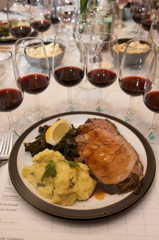
All six wines paired well with Mom’s dinner of tomato basil soup, candied walnut gorgonzola salad, prime rib, braised kale, cilantro lime mashed sweet potatoes, and topped off with a German chocolate dessert with whipped cream and shaved chocolate.

The consensus favorite was the 2005 Côte Bonneville Carriage House Red Wine. Côte Bonneville, located near Sunnyside, Washington, is the estate winery for DuBrul Vineyard. Both the winery and the vineyard are owned by Hugh and Kathy Shiels. The Shiels planted their first wine grapes in 1992 and started their own winery in 2001 after their last child left home. They are running a first class operation: amazing fruit, amazing wines, and amazing people. [To read more about DuBrul Vineyard, check out my article in the current Spring 2010 issue of Washington Tasting Room Magazine.]

I would encourage you to try any of these wines, especially with a meal, to get a sense of how Washington wines can stack up against the world’s best such as French Bordeaux.
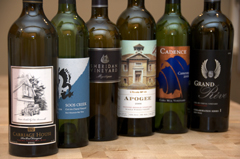
From 1st to last in the group consensus rankings:

2005 Côte Bonneville Carriage House Red Wine (DuBrul Vineyard, Yakima Valley, Washington): 73% Cabernet Sauvignon, 26% Merlot, 1% Cabernet Franc. Deep, dark purplish red and very aromatic. Black fruits, spice, oak, and a hint of bacon come through on the nose; more black fruits and spice on the palate. Medium to full-bodied with medium to high, drying tannins. Well-balanced and smooth with a long, lingering finish. Great from the first sip right on through the meal.
Quality: 4.5 stars (out of 5)
QPR: 5 bangs for your buck (out of 5)
Where to buy: Winery, $50; Available elsewhere, $45 to $65

2006 Soos Creek Ciel du Cheval Vineyard Red Wine (Ciel du Cheval, Red Mountain, Washington): 73% Cabernet Sauvignon, 18% Cabernet Franc, 9% Merlot. Dark purplish red and very aromatic. Aromas and flavors of juicy red fruits and black cherry along with nicely integrated oak. Medium to full-bodied with lively acidity, medium to high tannins, and a long finish. Really shines with food.
Quality: 4.5 stars (out of 5)
QPR: 5 bangs for your buck (out of 5)
Where to buy: Full Pull Wines (Seattle, Washington), $27; Available elsewhere, $25

2006 Sheridan Vineyard Mystique (Sheridan Vineyard, Yakima Valley, Washington): 50% Merlot, 40% Cabernet Sauvignon, 10% Cabernet Franc. Dark, dense red in color and very aromatic. Aromas and flavors of black fruits, smoked meat, leather, and tobacco. Medium to full-bodied with lively acidity, medium to high, drying tannins, and a long finish. Big and bold when sipped by itself, yet tannins soften and almost seem a bit sweet with food.
Quality: 4 stars (out of 5)
QPR: 5 bangs for your buck (out of 5)
Where to buy: Full Pull Wines (Seattle, Washington), $23; Available elsewhere, $30

2006 L’Ecole Nº 41 Apogee (Pepper Bridge Vineyard, Walla Walla Valley, Washington): 46% Cabernet Sauvignon, 42% Merlot, 8% Malbec, 4% Cabernet Franc. Deep purple and very aromatic. Oak and vanilla dominate the nose with dark fruits and earth showing through as well. Loads of oak on the palate along with blackberry, black cherry, and spice. Medium to full-bodied and lively with very drying tannins and a long finish. Well-balanced and gets better with food.
Quality: 4 stars (out of 5)
QPR: 2 bangs for your buck (out of 5)
Where to buy: Received as sample, suggested retail $50; Available elsewhere, $38 to $53

2006 Cadence Camerata (Cara Mia Vineyard, Red Mountain, Washington): 94% Cabernet Sauvignon, 6% Cabernet Franc. Deep, dark purple in color. Aromatic with cinnamon, vanilla, and a hint of coconut coming through on the nose. Cinnamon and black fruits show through on the palate. Full-bodied with lively acidity and medium to high, drying tannins and a long finish. A little heat is present on the back end but improves with food.
Quality: 3.5 stars (out of 5)
QPR: 1 bang for your buck (out of 5)
Where to buy: McCarthy & Schiering (Seattle, Washington), $55; Available elsewhere, $53 to $63

2005 Grand Rêve Collaboration Series I Red Wine (Ciel du Cheval Vineyard, Red Mountain, Washington): 62% Cabernet Sauvignon, 13% Cabernet Franc, 13% Petit Verdot, 12% Merlot. Winemaker Ben Smith of Cadence Winery. Deep, dark purplish red with black licorice, black cherry, and leather aromas along with hints of spice and cloves. More black fruits, spice, and coffee come through on the palate. Full-bodied with high, drying tannins and a long, smooth finish.
Quality: 3.5 stars (out of 5)
QPR: 1 bang for your buck (out of 5)
Where to buy: Winery, $55; Available elsewhere, $55


Filed under: American Wine, Five-Bangs For Your Buck Wines, Red Wine, Vineyards, Washington State Wine, Wine Tasting Dinners, Wines Over $25, Wines Under $25
 

Challenging Wine Pairing: Grilled Pork Chops


By LaGayle ~ March 16th, 2010

While my family and I do not eat much pork, we do enjoy it on occasion. As I started planning another challenging wine pairing meal, I remembered the garlic seasoned broiled pork chops that my aunt used to make. I cannot remember the last time that I had a pork chop, but the more I thought about it, the more I craved them. I find it interesting that I mention that we don’t eat a lot of pork, yet this is the second meal in this series that has included pork. Oh, well, I guess this series has given us a reason to splurge.

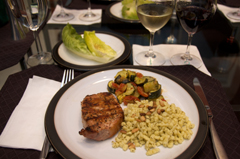
The day was beautiful, which is not always the case at this time of year in Seattle, so I decided to take advantage of the great weather and cook outside on the grill. As I began planning the menu and thinking about those garlic flavored pork chops, I decided to plan around a somewhat Italian-seasoned meal. The menu included salad made with hearts of romaine, garlic seasoned grilled pork chops, roasted garlic zucchini and tomatoes, and pesto spaetzle. Now, the spaetzle is a German egg noodle, but it was seasoned with pesto so I thought, “Why not?”

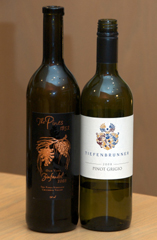
Again, I referred to my favorite book, What to Drink with What You Eat, by Andrew Dornenburg and Karen Page and decided to try a Pinot Grigio and a Zinfandel. I headed to a local wine shop with the intention of buying an Italian Pinot Grigio to go with our Italian-themed meal and a Washington State Zinfandel since we love to feature Washington State wines. I ended up selecting the 2008 Tiefenbrunner Pinot Grigio and the 2008 The Pines 1852 Old Vine Zinfandel, which it turns out is actually an Oregon wine.

When I arrived at the shop, I asked the shopkeeper for directions to the Washington Zinfandel section, and once I was there I found the The Pines Old Vine Zinfandel. I specifically asked about it being in the Washington section since the label indicated it was an Oregon winery.  I was told that the winery is in Oregon, but that the vineyard is in Washington in the Columbia Valley. Upon returning home and doing some research, I discovered that the vineyard is located in the Columbia Valley of Oregon. So, we had an Oregon Zinfandel rather than one from Washington. Disappointing to not get what I was expecting, but the wine does come with a good story and even an Italian connection. The Pines Vineyard is one of the oldest in the Northwest and was planted by an Italian stone mason in the late 1800’s.

While we enjoyed both wines, the unanimous choice as to which paired best with the pork chops was the Zinfandel; although, we all agreed that, on its own, we preferred the Pinot Grigio.

Bon Appétit!

2008 Tiefenbrunner Pinot Grigio Delle Venezie IGT (Alto Adige, Italy): Greenish straw yellow in color. Pears and hay come through on the nose; more pears on the palate. Medium-bodied and crisp with a long finish. A slight fizz on the back end. A refreshing sipper.
Quality: 3.5 stars (out of 5)
QPR: 4 bangs for your buck (out of 5)
Where to buy: Esquin Wine Merchants (Seattle), $13.99; Available elsewhere, $10 to $18

2008 The Pines 1852 Old Vine Zinfandel (The Pines Vineyard, Columbia Valley, Oregon): Deep ruby red in color. Aromas of butter, buttered popcorn, oak, and cinnamon lead to flavors of red fruits and cocoa. Good fruit but not overly fruity. Medium-bodied and lively with medium, very drying tannins and a long finish. A bit of heat on the back end.
Quality: 3 stars (out of 5)
QPR: 1 bang for your buck (out of 5)
Where to buy: Esquin Wine Merchants (Seattle), $38.99; Available elsewhere, $39


Filed under: American Wine, Challenging Wine Pairing, Food & Wine, Italian Wine, Oregon Wine, Pinot Grigio/Pinot Gris, Red Wine, White Wine, Wines Over $25, Wines Under $15, Wines Under $20, Wines Under $25, Zinfandel
 

Trio Vintners: One of the Walla Walla Incubator Wineries


By Kori ~ March 15th, 2010

One of the Walla Walla, Washington, incubator wineries, Trio Vintners is located in one of the five almost identical buildings built by the Port of Walla Walla near the regional airport. The incubator concept was developed with the entrepreneurial spirit in mind. Each incubator winery must be brand new to lease space and at the end of a six year lease, they must move out to make room for another new winery.

The trio of winemakers responsible for Trio Vintners, Steve Michener, Denise Slattery, and Tim Boushey, all cut their winemaking teeth at the Institute for Enology and Viticulture at Walla Walla Community College. Husband and wife Steve Michener and Denise Slattery moved to Walla Walla with their two young boys to pursue their winemaking dream. Steve is a Registered Nurse, and Denise has a freelance marketing strategy and writing services business. While studying at the Institute for Enology and Viticulture, they met Tim Boushey who continues to work as a sales engineer by day.

All three of the Trio partners contribute to the whole winemaking process, from spending time in the vineyards to helping sell the final products. Steve, Denise, and Tim feature the Wallula Gap, a prominent geographical formation in the region, on some of their labels as a nod to the “sense of place” they feel in Eastern Washington.

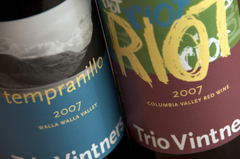
Recently, we had the opportunity to taste two of their wines in a samples tasting, the 2007 Trio Tempranillo and the 2007 Trio The Riot Red Wine. As I’ve mentioned before, Tempranillo is really starting to show some promise in the State of Washington, so we were thrilled to discover another excellent example of this emerging varietal. Credit goes to Steve and Denise’s sons for the name of their red blend, who pointed out that the letters in “Trio” mixed up spelled “riot”. A somewhat unusual blend of Sangiovese, Syrah, and Mourvedre, The Riot is a very good wine. And best of all, both wines deliver good bang for your buck. I encourage you to give either of these wines a try if you have the chance.

2007 Trio Vintners Tempranillo (Les Collines Vineyard, Walla Walla Valley, Washington): 83% Tempranillo, 9% Carmenere, 8% Sangiovese. Deep red in color and very aromatic. Cinnamon and vanilla come through on the nose; black cherry, spice, and coffee on the palate. Medium-bodied and lively with medium tannins. Well-balanced and smooth with a long finish.
Quality: 4 stars (out of 5)
QPR: 4 bangs for your buck (out of 5)
Where to Buy: Received as sample, suggested retail $28; Available elsewhere, $26 to $28

2007 Trio Vintners The Riot Red Wine (Columbia Valley, Washington): 52% Sangiovese, 36% Syrah, 12% Mourvedre. Deep ruby red in color. Aromas of popcorn and licorice lead to flavors of cherry, blueberry, and a hint of smoke. Medium to full-bodied and lively with medium tannins. Well-balanced with a long finish.
Quality: 3.5 stars (out of 5)
QPR: 4 bangs for your buck (out of 5)
Where to Buy: Received as sample, suggested retail $18; Available elsewhere, $18


Filed under: American Wine, Red Wine, Tempranillo, Washington State Wine, Wines Over $25, Wines Under $20, Wines Under $25
 

Wine Word of the Week: Old vines


By Kori ~ March 13th, 2010

This week’s Wine Word of the Week is old vines.

Official definition from Jancis Robinson’s The Oxford Companion to Wine:
Old vines are reputed to produce grapes which make better quality wine. The concept that older vines make better wine is much used in marketing wine in the Old World and has more recently been adopted by some California and Barossa Valley producers. Conversely, some winemakers observe that young vineyards produce their highest-quality wine in the first year or two of production, perhaps at least partly because yields are relatively low at this point.

Layman’s terms from Kori:
Old vines is a term typically used to imply a wine is of high quality. However, while mature vines can produce excellent wines, it is certainly not a given. And since there is no legal definition of the term, there is really no way to know whether a bottle labeled as old vines is made from 20 year-old vines or 120 year-old vines. The French term for old vines is vieilles vignes.


Filed under: Wine Word of the Week
 

Toast: It’s not just what’s for Breakfast; it’s what’s in the Barrel


By John ~ March 12th, 2010

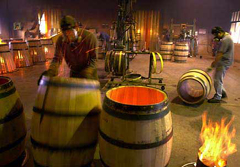
When we talk about “toast” as it relates to wine, it’s not what you serve alongside bacon and eggs. “Toast” is the result of heating the inside of oak staves for wine barrels. The degree of charring is the amount of “toast,” from light to heavy.

Most white wines see no oak at all, Chardonnay being a notable exception. Most red wines get some treatment in oak, though not because oak is an inexpensive storage medium; in fact, it is not. Oak barrels are very expensive as compared to stainless tanks, but oak gives off desirable aromatic qualities, and its porous nature allows slow oxidation that softens the wine.

French oak has traditionally been the gold standard for oak barrels, but its cost, more than twice as expensive as American oak, has had a growing minority of winemakers looking for suitable alternatives. The tighter grained French oak produce subtle aromas and add more tannins. The wider grained American oak adds bigger, bolder vanilla and, some say, coconut aromas. Toasting the inside of the barrel adds further aromas, from the natural wood flavor of light toast to the caramel-like flavors of medium toast to the charcoal-like flavors of heavy toast.

Obviously, the first year a new barrel is used, it provides the most aromatics to a wine. However, this impact fades with each year of use. By its fifth year of use, a barrel is considered virtually neutral, not imparting any unique flavors to the wine. Many winemakers not only use some combination of French and American oak, but new and older barrels to get just the right combination of wood flavors that they want in their wine. In order to further reduce costs, some winemakers today are flavoring wine produced entirely in stainless tanks by soaking it with oak chips, shavings, or barrel staves without the expense or effort of using wine barrels at all.

Just like you selecting the right bread to toast with breakfast, it’s important for the winemaker to select the right barrel and toast it just right.


Filed under: General Wine Information
 

A Wine for Tonight: 2008 Nobilo Regional Collection Sauvignon Blanc


By Kori ~ March 11th, 2010

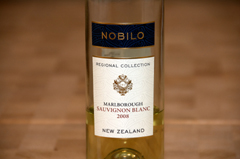
Would you like a quick suggestion for a good wine to drink tonight (or this weekend) that won’t break your budget and is widely available? Many of our readers have said this is something they would like, so here is this week’s selection, the 2008 Nobilo Regional Collection Sauvignon Blanc from the Marlborough region of New Zealand.
Our selection criteria include:

  • A very good Quality rating of >=3.5 stars (out of 5)
  • A price tag of <=$15
  • Must be widely available

Regular readers know that as far as white wines go, we Wine Peeps love Sauvignon Blanc from New Zealand. But as far as Mom (LaGayle) is concerned, New Zealand Sauvignon Blanc is the best wine period. Therefore, today, in honor of Mom’s birthday, I thought it was fitting to feature one of her favorite go-to wines.

The Nobilo Regional Collection Sauvignon Blanc is consistent from vintage to vintage and widely available. It is crisp, refreshing, and an excellent sipper no matter whether you are sitting on the deck on a sunny afternoon or curled up with a book on a winter’s evening.

In the 1940’s, Nikola Nobilo emigrated from Croatia and planted some of the first commercial grapevines in New Zealand. He was one of the pioneers responsible for the worldwide popularity of New Zealand Sauvignon Blanc.

“Light yellow in color with green hues and brilliant clarity. A distinctive bouquet of ripe tropical and citrus fruit. Nobilo Regional Collection Sauvignon Blanc is bursting with flavors of lemon, passion fruit, and melon. Crisp and zesty, the palate has excellent weight and balance, lingering in a full, refreshing finish.” –Winemaker’s notes

2008 Nobilo Regional Collection Sauvignon Blanc (Marlborough, New Zealand): Greenish straw yellow and very aromatic. Gorgeous aromas of grapefruit, grass, lemon zest, apricots, and melon come through on the nose; grapefruit, lemon, and green apples on the palate. Light-bodied, extremely crisp and refreshing. Well-balanced with a long finish. A classic New Zealand Sauvignon Blanc.
Quality: 4 stars (out of 5)
QPR: 5 bangs for your buck (out of 5)
Where to Buy: Fred Meyer (Seattle, Washington), $9.99; Available elsewhere, $9 to $14


Filed under: A Wine for Tonight, Five-Bangs For Your Buck Wines, New Zealand Wine, Sauvignon Blanc, White Wine, Wines Under $10, Wines Under $15, Wines Under $20, Wines Under $25
 

Markham Vineyards: Cabernets and Philanthropy


By Kori ~ March 10th, 2010

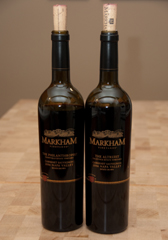
While we enjoy Cabernet Sauvignon from Napa Valley, too often we find them to be priced way out of our budgets. Recently, we discovered two Napa Cabs that, while not inexpensive, deliver good bang-for-your-buck. And on top of that, they recognize philanthropic efforts which are a great thing in my book. We had the opportunity to taste both the 2006 Markham Vineyards The Philanthropist and the 2006 Markham Vineyards The Altruist in a samples tasting, and both were excellent.
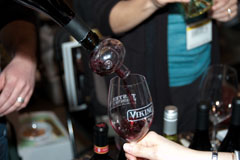
Markham Vineyards is one of the oldest wineries in California’s Napa Valley. Originally established as Laurent Winery by Bordeaux immigrant Jean Laurent in 1874, Bruce Markham purchased and renamed the winery in 1978. Today, Markham Vineyards is one of the brands in the Terlato Wines International portfolio.

Each year, Markham Vineyards awards two $25,000 grants to individuals or groups in the U.S. who are committed to philanthropic efforts in their neighborhood, town, or city. The winners are awarded the Markham Mark of Distinction. The 2006 inaugural vintage of The Philanthropist and The Altruist are dedicated to the 2008 Mark of Distinction winners.

Both wines are single-vineyard, limited production, estate grown Cabernet Sauvignon. The Philanthropist is sourced from Markham’s Yountville Estate Vineyard, located on a hillside benchland in the Mayacamas Mountains range. Meanwhile, The Altruist is sourced from Markham’s Calistoga Estate Vineyard, located further north at the base of Mt. St. Helena.

While both are excellent, well-made wines that received a Quality rating of 4 stars, I personally gave a slight edge to The Philanthropist which is just a bit bigger and more fruit-forward. I encourage you to give either of these wines a try if you have the chance.

2006 Markham Vineyard The Philanthropist Cabernet Sauvignon (Yountville Estate Vineyard, Napa Valley, California): Medium-deep red and very aromatic. Cinnamon and spice dominate the nose; blackberries, black cherry, black plums, and spice come through on the palate. Fruit-forward, medium to full-bodied, and lively with drying tannins. Well-balanced with a very long finish.
Quality: 4 stars (out of 5)
QPR: 4 bangs for your buck (out of 5)
Where to Buy: Received as sample, suggested retail $55; Winery, $55

2006 Markham Vineyards The Altruist Cabernet Sauvignon (Calistoga Estate Vineyard, Napa Valley, California): Medium-deep red and aromatic. Aromas of wood and vanilla lead to flavors of red and black fruits and spice. Medium to full-bodied and lively with medium to high tannins. Well-balanced and smooth with a long finish.
Quality: 4 stars (out of 5)
QPR: 4 bangs for your buck (out of 5)
Where to Buy: Received as sample, suggested retail $55; Winery, $55


Filed under: American Wine, Cabernet Sauvignon, California Wine, Red Wine, Wines Over $25
 

Tips for Taste Washington


By Kori ~ March 9th, 2010

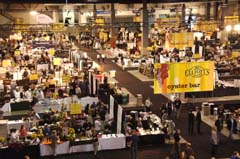
Taste Washington in Seattle is rapidly approaching. Over 200 wineries and 75 restaurants will be pouring wines and serving bites at the Grand Tasting on Sunday, March 28th, at the Qwest Field Event Center. If you are not familiar with this fabulous event, check out my Taste Washington 2010 Preview post for further information.

For those of you who will be attending Taste Washington for the first time, I’d like to share some tips for making the most of the event. Taste Washington is a huge event and can be overwhelming if you are not prepared. You will be wise to plan a strategy ahead of time.

Whether you attend the Grand Tasting which lasts three hours or pay extra for an additional two hours of tasting, it is impossible to visit every booth and taste every wine being poured and every bite being served.

First, I suggest that you visit the Taste Washington website to preview the list of participating wineries. Make a list of the wineries that you’d like to visit, and then prioritize that list. Start with the ten you don’t want to miss, then mark the next ten you’d like to visit if you have time and so on. According to the Washington Wine Commission, the event program should be posted on the Taste Washington website sometime next week which will include a map of where the winery booths will be located. [Editor’s Note: Event Program is now available here.] I encourage you to print it out so you can plan your route. It really gets crowded during the general admission hours, so you might not get to as many wineries as you’d like. But if you visit only ten winery booths and try all three wines they are serving, that’s thirty wines right off the bat. Then depending on time, crowds, etc., you can try more if you’d like.

If you’re looking for suggestions of which wineries you should be sure to try, I encourage you to take a look at our “go-to” list of Washington wineries for 2009.

Once you have determined which wineries you’d like to try and you are actually at the event, there are several things to keep in mind to make sure you make the most of the event while tasting responsibly. These tips are important to remember for wine tasting newbies and veterans alike.

  • Remember the Taste Washington motto: It’s Hip to Spit! This is extremely important. We always spit when we attend large tasting events like this or are visiting wineries. Otherwise, you end up drinking too much which won’t feel good the next morning and you won’t be able to really tell which wines you like and don’t like after the first few you taste.
  • Drink water. Alcoholic drinks dehydrate your body so it is important to drink lots of water to help your body rehydrate.
  • Eat. Be sure to eat a good meal before the event begins so that you are starting with a full stomach. Then, once inside, stop at the restaurant booths to keep your stomach full. Try to eat something at least between every fifteen to twenty wines you taste.
  • Make safe transportation arrangements. After you’ve enjoyed this fabulous event, we want to make sure you get home safely.

And last, but certainly not least, have fun!


Filed under: American Wine, General Wine Information, Washington State Wine, Wine Activities/Events