
Private Tasting: Bordeaux Blends, France vs. Washington


By Kori ~ February 9th, 2009

Recently, we had one of our double-blind private tastings. This time when we sat down for our dinner of grilled beef tenderloin steaks, brown and wild rice, and mixed vegetables, all we knew were that the two wines in front of us were red, but we did not know their region of origin or varietal. For a more complete description of how we set up these private tastings, please refer to How We Taste.
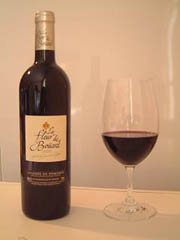
20090209_lafleurdebouardWhile we thought both wines paired well with our steak dinner, all four of us slightly preferred one over the other. When we finished eating and pulled off the sacks to reveal what we had been drinking, we found two Bordeaux-style blends, one from France and the other from Washington State. The 2004 La Fleur de Bouard from Lalande de Pomerol, Bordeaux, France, beat the 2006 Saviah Big Sky Cuvee from Columbia Valley, Washington. The La Fleur de Bouard definitely has more earthy, Old World characteristics versus the more fruit-forward, New World style of the Saviah Big Sky Cuvee. When comparing these two, it really comes down to personal preference and knowing your own palate. Remember, the key to wine tasting is to try lots of wines and determine what you like best. (Photo from Chateau La Fleur de Bouard)

Both of these wines are predominantly Merlot. While Merlot got a bad rap in the movie Sideways, it is an excellent, classic varietal that should not be dismissed. In fact, Merlot is the most widely planted variety in Bordeaux.

While we had tasted a previous vintage of the Saviah Big Sky Cuvee, we had not previously had the La Fleur de Bouard. I learned about it from reading Gary Vaynerchuk’s 101 Wines book in which it was his #60. Since it was reasonably priced for Bordeaux, I decided to pick up a bottle to put up against a Washington wine with the same price point. It did not disappoint. With a Quality rating of 4 stars and a QPR of 5 bangs for your buck, the La Fleur is a great buy.

“This wine really reminds me of how great Merlot can be, and how unfortunate it is that one silly movie, however entertaining, can totally blacklist a grape that has made great wine for centuries.” –Gary Vaynerchuk, Gary Vaynerchuk’s 101 Wines

2004 La Fleur de Bouard (Lalande de Pomerol, Bordeaux, France): 85% Merlot, 10% Cabernet Franc, 5% Cabernet Sauvignon. Earthy, slightly musty aromas give way to flavors of tobacco and pencil shavings. Big, bold, and very tannic. Improves with food. Well-balanced with a long finish.
Quality: 4 stars (out of 5)
QPR: 5 bangs for your buck (out of 5)
Where to buy: K&L Wine Merchants (California), $19.99 [was $35 when I bought it]

2006 Saviah Big Sky Cuvee (Columbia Valley, Washington): 61% Merlot, 26% Cabernet Sauvignon, 8% Cabernet Franc, 3% Malbec, 2% Petit Verdot. Aromas and flavors of ripe cherries, plums, and other dark fruits. Fruit-forward and medium-bodied. Mellows with food.
Quality: 3.5 stars (out of 5)
QPR: 2 bangs for your buck (out of 5)
Where to buy: Winery, $35

All in all, this was a great tasting. Both are good red wines that are worth a try if you see them on the shelf at your local wine shop.


Filed under: American Wine, Five-Bangs For Your Buck Wines, French Wine, Merlot, Red Wine, Washington State Wine, Wines Over $25
 

Wine Peeps News: Redesigned Site, New Logo, Twitter, and More


By Kori ~ February 7th, 2009

20090207_blog_snapshotWelcome to our newly redesigned Wine Peeps site! For those of you reading this via RSS, email, or some other medium, we hope you’ll drop by the new site to check it out.
Redesigned Site

We launched the new site tonight and think we have all of the bugs out, but please take a look around and let us know if anything looks amiss. Many thanks to my wonderful husband Colby (our Wine Peeps tech guy) for all his hard work in getting the new site up and running.

After a year of working hard to build up interesting, competent content, we thought that it was time to spruce up the look and feel of Wine Peeps. The changes are purely cosmetic, though; all of our content remains intact. You will still be able to search, browse categories, read older posts, and visit our tabbed pages for additional information.

I’d like to highlight a few of the changes we’ve made:

  • Recent Posts and Recent Comments – We added the Recent Posts and Recent Comments sections on the left to give you a quick snapshot of recent Wine Peeps activity.
  • Tell a Friend – We added the Tell a Friend button to the end of each post so that you can quickly and easily share the post via email or by posting it to Facebook, Twitter, or another social networking or bookmarking site.
  • Subscribe to Updates – We have made our Subscribe to Updates via RSS and Email more prominent on the right and hopefully easier to use.
  • Follow/Friend Me – We added this section on the right so that you can easily follow or friend me on several social networking sites. More on those below.
  • Avatars in Comments – Now you have the ability to personalize your comments with an avatar (a picture or symbol that represents you). If you do not already have a personalized avatar and would like one, you can go to Gravatar to sign up. When you leave a comment on Wine Peeps with the same email address that you’ve registered with Gravatar, your avatar will automatically appear.

As time goes on, we will be doing additional tweaking and possibly adding even more new features. We hope that you like what we’ve done and will continue to come back as well as tell your friends about us.

Logo1New Logo

As we began discussing ideas for our site redesign, we felt that our first priority was to develop a Wine Peeps logo so that readers would have a visual image to associate with us. Many thanks to our good friend Ross Heeter for the fabulous new logo.

Twitter

Recently, I jumped on the Twitter bandwagon. I had been observing Twitter from a distance over the past year but after attending the Wine Bloggers Conference last October and seeing how many Twitter devotees are out there, I felt that it was time to get on board. Twitter is an excellent way to engage in the wine blogging community as well as interact with readers and fellow wine lovers in an informal atmosphere (in short, 140 character messages). In addition to tweets announcing new Wine Peeps blog posts, I will be tweeting about other wine-related things that I am doing or that are on my mind. It will allow me to share about wines that I am drinking that may not make it into a formal blog post or ones that may appear in a post down the road. I’ll also tweet about random non-wine things from time to time just to keep things interesting, but I’ll do my best not to bore you with trivial things like “I’m off to wash my hair now.” If you are already on Twitter or if I’ve enticed you to sign up, please Follow Me.

And More

In addition to Twitter, I am also on a couple other social networking sites. I invite you to Friend Me on OpenWine Consortium and LinkedIn as well.

Please let us know what you think of our new site. Whether you love it, hate it, or fall somewhere in between, please leave a comment below or send us a message via our Contact Us form. We’d love to know what you like as well as what needs improvement so that we can continue to make Wine Peeps better and better.


Filed under: Announcements
 

Book Review: The Cork Jester’s Guide to Wine


By John ~ February 6th, 2009

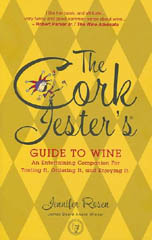
20090206_corkjesterThe Cork Jester’s Guide to Wine: An Entertaining Companion For Tasting It, Ordering It, and Enjoying It by Jennifer Rosen was a stocking stuffer from Kori a couple years ago. I finally got around to reading it and wished that I hadn’t waited so long. I found it to be an extremely entertaining read. It has good information for the novice as well as for the more experienced wine aficionado, all in an easy-to-read style. It doesn’t wear you out like some wine books do.
“Cork Jester Jennifer Rosen’s books should be on the shelf of any wine lover whose palate is connected to their funny bone.” –Paul Gregutt, Seattle Times

The book is divided into eleven parts covering everything from the vineyard, tasting, and storage to the restaurant experience and even science projects. Author Jennifer Rosen is a cork jester; she’s opinionated and witty but not offensive.

A couple of my favorite quotes from the book:

“I get just as big a kick tuning Americans in to the seductive whisper of old and subtle wine as I do giving Europeans permission to just go ahead and enjoy the fruit. Proclaiming one style better seems as silly as asking, ‘What should music be: Mozart or that danged rock and roll?’ Answer: all of that and more.” –Author Jennifer Rosen on wine styles

“Syrah enjoys the sort of universal approval normally reserved for puppies and firemen. …. If you don’t want to devote hours of it [your life] to memorizing wine factoids, stop! Just order Syrah, the wine that nobody doesn’t like. (If you write now and tell me you don’t like it, you’re probably the kind of person who kicks puppies. My fireman’s going to come beat you up.” –Author Jennifer Rosen on varietals

The examples above are representative of what goes on all throughout this breezy, informative read. But let me save some of the best for you to read yourself, like in Part 9 where she gives advice to singles on wine and dating.

If you enjoy wine and have a sense of humor, I believe that you will like this book so treat yourself to a copy or put it on your wish list. For $10 in paperback at Amazon.com, this book has a high QPR.

Have you already read The Cork Jester’s Guide to Wine? If so, what did you think of it?

Cheers!


Filed under: Wine Books
 

Wine Word of the Week: Brix


By Kori ~ February 5th, 2009

winepeeps_wotw_2-1bThis week’s Wine Word of the Week is Brix.
Official definition from Jancis Robinson’s The Oxford Companion to Wine:
Brix is the scale of measuring total dissolved compounds in grape juice, and therefore its approximate concentration of grape sugars. It is used in the United States and, like other scales used elsewhere, it can be measured with either a refractometer or hydrometer. Degrees Brix indicate the percentage of solutes (of which about 90 percent are sugars in ripe grapes) by weight in the liquid, at a temperature specified for the instrument used. One degree Brix corresponds approximately to 18 g/l sugar.

Layman’s terms from Kori:
In the United States, sugar in grapes is measured in degrees Brix. To estimate the final alcohol level in a wine, the general rule is to divide the Brix measurement by two. For example, grapes harvested at 26 degrees Brix will probably yield a wine that is about 13 percent alcohol.


Filed under: Wine Word of the Week
 

Washington’s 2007 Vintage may be its Best Ever!


By Kori ~ February 4th, 2009

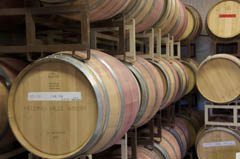
20090204_fhbarrelsAs I have been reflecting on the past year and all of the winery and vineyard visits we have made as well as looking ahead to the coming year, one number keeps coming to mind…2007, the year 2007. And specifically, the 2007 vintage. We had the pleasure of tasting barrel samples at four different Washington State wineries last year, Saviah Cellars in Walla Walla, Gilbert Cellars in Yakima, Fielding Hills in Wenatchee, and Adams Bench in Woodinville. The most recent vintage in the barrel at that time was the 2007. I was blown away by the quality of those samples. And I’m not talking about just one particular varietal. Across the board, the 2007’s were excellent.
Most wine people around the state acknowledge that 2005 was an excellent vintage, and I certainly agree. But that is even more reason why I am so excited about the 2007’s. For example, I gave my first 5-star quality rating for a Washington wine to the 2005 Fielding Hills Syrah. When we visited Fielding Hills in August, I had the opportunity to taste their 2007 Syrah in the barrel. It was even better than the 2005!

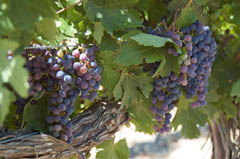
20090204_grapesAgriculture of any sort can be a finicky business. And grape growing is agriculture so vineyards and, therefore, wineries are at the mercy of Mother Nature. Some years she smiles on the grapes; some years she doesn’t. Fortunately, the 2007 growing season in Washington State enjoyed near perfect conditions. Hot summer weather segued into cool but dry weather in September and October which allowed the grapes to be harvested under ideal conditions.
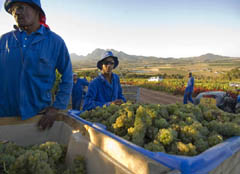
The reason that this is important now is because many of these 2007’s will be released this year. So be on the lookout for the 2007 vintage from Washington State to hit the shelves at your local wine shop this spring. Better yet, get on the mailing lists for some of these Washington wineries now. I will be surprised if the 2007 vintage releases don’t sell out quickly.

Since my daughter was born in 2007, I am particularly fond of the year anyway. And I’m certainly hoping that my predictions are correct because I would love to find the perfect Washington State wine from the 2007 vintage to put away for her 21st birthday.

Mark my words, folks, Washington’s 2007 vintage may be its best ever!


Filed under: American Wine, Washington State Wine
 

South Africa: An Old Wine Region Beginning To Realize Its Potential


By John ~ February 3rd, 2009

20090203_fairviewsaYou probably wouldn’t believe me if I told you that the wine industry in South Africa dates back to 1659, but it’s true. In fact, South African wine celebrated its 350th birthday yesterday. During the 1700’s one of the most expensive and sought after wines in the world was Vin de Constance, or “Constantia,” a sweet Muscat wine from the Western Cape of South Africa. Over the past 100 years, the wine industry, like the rest of South Africa, has ridden a rollercoaster of political and economic highs and lows as apartheid caused most of the developed world to boycott all forms of trade with South Africa. (Photo from Fairview)
After apartheid ended in 1994, South Africa re-emerged onto the world scene, but it has taken time for its wine industry to replant, rebuild, and rebound. Today, South Africa is again becoming a factor in the world of wine. With favorable exchange rates to the dollar, South African wines are generally reasonably priced.  Our mission over the next month is to assess the quality in relation to price and see how South African wines stack up.

As you read this post, LaGayle and I are on our way to Cape Town to visit the major winelands (as they call them) of the Western Cape and taste as many of their wines as we can that are available in the United States. While Steen (Chenin Blanc) and Pinotage (a cross between Pinot Noir and Cinsault) have historically been the big two varietals in South Africa, major replanting in recent years has focused on the big five international varieties, Sauvignon Blanc, Chardonnay, Syrah, Merlot, and Cabernet Sauvignon.

We’ll be reporting our findings in coming weeks. Stay tuned!


Filed under: South African Wine, Wine Travel
 

2009 American Wine Blog Awards


By Kori ~ February 2nd, 2009

20090202_awbaYou, the reader, are the reason for our existence. Everything we do is designed to help you get the most bang for your buck in wine. Thank you for your continued support of Wine Peeps.
As a wine enthusiast (and I doubt that you would be visiting us or any other wine blog if you weren’t a wine enthusiast), we would like to urge you to participate in the third annual American Wine Blog Awards competition that is presented and produced by Tom Wark’s blog, Fermentation. These awards recognize the best the English-language wine blogging world has to offer.

The awards are currently taking nominations in various award categories (7 in all). Nominations will be taken until February 8th. It will only take a few minutes to make your nominations. Whether you nominate Wine Peeps or not, the main thing is to get as many worthy nominations for the awards as possible. However, if you believe that Wine Peeps is a worthy nominee, we would certainly appreciate your vote and support.

Click one of the following award categories to make your nominations:

The nominations for finalists in the different categories come from the public. Those nominees, assuming they meet basic criteria, will be handed off to a set of judges who will together choose finalists in each category. Once finalists are determined, the winners will be chosen based on a vote of the public and judges, with the public given 70% of the weight towards determining the winner in each category.


Filed under: Wine News
 

Spotlight On: Lionheart Wines


By Kori ~ January 30th, 2009

Lionheart Wines, located in Half Moon Bay, California, was founded in 2005 by owner/winemaker Leon C. Glover III. Leon has had the dream of making wine since he was a boy and admired his father’s extensive wine collection. Due to high start up costs and the knowledge required to start a winery, he put his dream on hold while he worked as a software engineer to pay the bills. Several years ago, he found himself looking to change industries as the joy he had in developing high-tech products was fading.

“I did not want to wake up 55 years old in a cube farm somewhere wondering why I did not enjoy life more.” –Leon C. Glover III, owner/winemaker

20090130_lionheartLeon has taught himself about winemaking through reading books on the subject, taking the WSET Diploma course, and being a cellar rat for two harvests at Crushpad, a custom crush facility in San Francisco. In fact, his full-time switch to winemaking came as a result of a Christmas present from his wife, adopting a barrel of wine from Crushpad. As the owner of the wine, he had control of how it was handled until bottling. He found the whole process fascinating and was officially hooked. This is great news for you and me as in just three short years, he is already producing excellent wines.
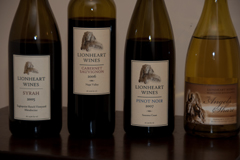
Prior to the Wine Bloggers Conference in October, I knew nothing about Lionheart Wines. Leon was on hand pouring his 2007 Lionheart Wines McGinley Vineyard Roussanne during the Live Wine Blogging event. It was excellent…crisp, creamy, and refreshing! Recently, I had the opportunity to taste four more Lionheart wines, the 2007 The Angel’s Share (White Blend), the 2007 Pinot Noir, the 2006 Cabernet Sauvignon, and the 2005 Eaglepoint Ranch Vineyard Syrah.

As a group, I was blown away by Lionheart’s wines. All four wines were good, but I especially enjoyed the Pinot Noir and the Syrah. In fact, the 2007 Lionheart Pinot Noir is one of the best Pinots that I’ve ever tasted. This is an excellent wine, not just an excellent Pinot. I would gladly drink it anytime, with a meal or without. And regular readers know that it’s not often that I give high praise to a Pinot. Apparently others agree as the 2007 Pinot Noir was recently awarded with a gold medal at the 2009 San Francisco Chronicle Wine Competition in the $35 and higher category.

Syrah, on the other hand, is probably my favorite varietal. And we have definitely had more than our fair share of Syrah over the last year. Lionheart’s 2005 Eaglepoint Ranch Vineyard Syrah rates right up there with some of the best we’ve had; certainly among the best California Syrah we’ve tasted. It’s big and bold, just the way I like it.

“I differentiate myself from other winemakers based on my wine style (food-friendly wines made at a good price point), a willingness to experiment with new techniques and varietals, and passion to produce great wines for my friends and family.  I want my wines to be served proudly for family and friends over social gatherings where people ‘suck the marrow out of life.’” –Leon C. Glover III, owner/winemaker

Currently, Lionheart produces about 300 cases each year. They have plans to ramp up their production as their brand gains traction. As a self-taught chef, Leon strives to produce food-friendly wines. Going forward, he plans to select a few varietals to become his signature varietals. Right now he is leaning towards focusing on Pinot Noir and the Rhone varietals. Given the fact that I really enjoyed his Pinot Noir and Syrah, I think that is a wise decision. I encourage you to try to get your hands on a bottle or two of Lionheart wine and enjoy.

2007 Lionheart Wines Pinot Noir (Sonoma Coast, California): Very aromatic with cherry, cotton candy, and burnt rubber coming through on the nose. Medium-bodied and medium tannins with lively acidity. Full of cranberry flavors. Well-balanced and a medium finish. One of the best Pinots I’ve ever had.
Quality: 4 stars (out of 5)
QPR: 4 bangs for your buck (out of 5)
Where to Buy: Received as sample, suggested retail $40; AmericanWinery.com (Washington), $42

2005 Lionheart Wines Eaglepoint Ranch Vineyard Syrah (Mendocino, California): Deep ruby red with a wonderful nose of black fruits, spice, and leather. More black fruits and spice as well as a good dose of black pepper comes through on the palate. Full-bodied and powerful with a long, lingering finish. A big, bold, well-balanced wine.
Quality: 4 stars (out of 5)
QPR: 4 bangs for your buck (out of 5)
Where to Buy: Received as sample, suggested retail $35; AmericanWinery.com (Washington), $37


Filed under: American Wine, Cabernet Sauvignon, California Wine, Pinot Noir, Red Wine, Shiraz/Syrah, Spotlight On, White Wine, Wines Over $25
 

Wine Word of the Week: Sulfites


By Kori ~ January 29th, 2009

winepeeps_wotw_2-1b3This week’s Wine Word of the Week is sulfites.
Official definition from Jancis Robinson’s The Oxford Companion to Wine:
Sulfite and bisulfate, the negatively charged ions liberated when sulfurous acid dissociates…. The analytical method usually used for the measurement of sulfite determines all of the various forms which are active in terms of smell, effect on yeast and bacteria, and potential danger to asthmatics. The term sulfites, or sulphites, is therefore used on wine labels (as in ‘Contains sulfites/sulphites’) as an inclusive term for free sulfur dioxide, sulfurous acid (hydrated sulfur dioxide), bisulfate ion, sulfite ion, and some forms of complexed sulfite.

Layman’s terms from Kori:
While Ms. Robinson gives a good technical definition of sulfites above, I would like to use this space to debunk the commonly held myth that sulfites in wine, especially red wine, cause headaches. In fact, all wine has naturally occurring sulfites. So don’t be confused by the label that says, “No sulfites added.” That does not mean “no” sulfites. Red wines actually have the least amount of sulfites added because they already have plenty of natural preservatives from the grape skins used to make them. If you truly believe that it is sulfites causing your headaches, beware of salsa, dried fruits, packaged cookies, and even orange juice. They all have much higher levels of sulfites than red wine. While sulfites often get the blame for headaches after drinking red wine, doctors say that a more likely culprit is histamines.

For more on the topic of wine and headaches, see our post from last February entitled Do you get headaches when you drink wine?


Filed under: Wine Word of the Week
 

Wine Book Club: Notes on a Cellar-Book


By Kori ~ January 28th, 2009

wbclogoThank you for joining us for the January 2009 “virtual meeting” of the Wine Book Club. Many thanks to Dr. Debs of Good Wine Under $20 who originally proposed the idea for the WBC where bloggers and wine lovers all over the world come together for book reviews and discussions after reading a selected text. The format of the WBC has changed slightly for 2009. To kick off the New Year, Dr. Debs selected Notes on a Cellar-Book by George Saintsbury.

Saintsbury’s life (1845-1933) was divided between teaching and journalism; all told, he worked as a journalist, reviewer, critic, editor, and Professor of Literature at the University of Edinburgh. The entries in Saintsbury’s cellar book cover a period of thirty-one years from 1884 to 1915.

“There is no money, among that which I have spent since I began to earn my living, of the expenditure of which I am less ashamed, or which gave me better value in return, than the price of the liquids chronicled in this booklet. When they were good they pleased my senses, cheered my spirits, improved my moral and intellectual powers, besides enabling me to confer the same benefits on other people.” –George Saintsbury

While I found it to be a very interesting book—ok, it’s really a set of notes—it is a tough read. I’ve had to keep a dictionary at my side and also be ready to Google regularly to understand many of the terms he uses. Originally published in 1920 and now edited and annotated by Thomas Pinney in 2008, Notes on a Cellar-Book is not just a book on wine but covers beer and spirits as well.

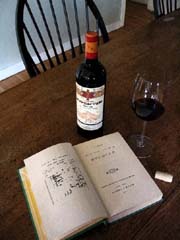
20090128_cellar-bookIn order to really enjoy this book, I believe that you need to already know a lot about wine as well as be an academic or history buff. If you fit into those categories, grab a copy today.

One thing is clear to me after reading this book; people back then longed “for the good old days” in wine just like many people say they do today. Not much has changed in over 100 years in that respect. Personally, I believe the good old days are now, but I enjoyed reading Saintsbury’s notes about the wines of that era nonetheless.

Most of the wines Saintsbury talks about in his Notes are not the kinds of wines the typical wine consumer will ever drink today. However, his examples give me hope that in my own wine searches, some of the great wines I’m finding from newer producers today will turn out to be the next Mouton Rothschild, which he found at a ridiculously low price before it established its reputation.

While Saintsbury was a prolific writer, this was his only book devoted to wine. In this book, he is tactful, but certainly not bashful, about giving his opinion about wines he tasted. For example, he wouldn’t say that a certain wine was bad; he’d just say he didn’t like it or he never bought it himself.

I was amazed by how much Saintsbury read, how much he wrote, and how much he ate and drank himself. Reading his eight-course dinner menus that were accompanied by eight wines gave me both a stomach ache and a headache. And to think that in all of his tasting, he says he never had an American wine.

In sum, I enjoyed the book, but I wonder if it fits the reading palate of most of our readers. If you’ve already read Notes on a Cellar-Book, please leave a comment and let us know what you thought of it.

For those of you who would like to read along with us in the Wine Book Club, the next three selections are:
February: Champagne: How the World’s Most Glamorous Wine Triumphed Over War and Hard Times by Don Kladstrup
March: Adventures on the Wine Route: A Wine Buyer’s Tour of France by Kermit Lynch
April: The Science of Wine: From Vine to Glass by Jamie Goode


Filed under: Wine Book Club, Wine Books