
Helpful Hint: Preserving a partially consumed bottle of wine


By John ~ November 7th, 2008

Since a standard wine bottle contains 750ml of wine which is equivalent to four or five glasses, there are many times that we find ourselves with partially consumed bottles. If you are single or the only wine drinker in your household, you may find yourself in this position even more often.
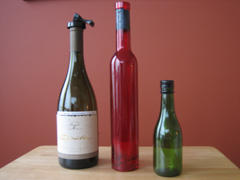
We never want wine to go to waste, so here are a few tips for preserving a partially consumed bottle of wine. Keep in mind that air and temperature are the two biggest enemies of an opened bottle of wine. So once you have opened a bottle and consumed a portion of it, you’ll want to close it back tightly with a bottle stopper to prevent more exposure to the air. Better yet, pour the remaining wine into a smaller sized empty wine bottle (such as a 375ml bottle that you keep around for that purpose) so that there won’t be as much air space between the wine and the stopper. If you want something a little more fancy-looking, smaller decanter sets are sold for this purpose as well. Some people recommend pumping the air out of the partial bottle with a vacuum wine saver gadget. However, I’ve heard winemakers caution against pumping saying you’ll lose wine aromas in the process; therefore, we do not pump.
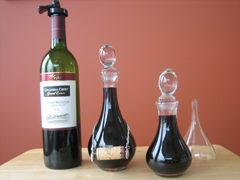
Once you’ve solved the air issue as recommended above, put the partial bottle into the refrigerator until you want to consume the rest. Refrigeration slows down chemical reactions detrimental to the preservation of the wine. If it’s a red wine, pull it out of the refrigerator thirty minutes to an hour before you intend to consume it and the serving temperature should be about right. For a white wine, only ten to fifteen minutes out of the refrigerator will probably do the trick.

By following these tips, we’ve found that most wines will remain drinkable for as long as a week after first opening the bottle. (Note: These tips are meant to be used with your everyday wines. If you’ve forked over big bucks for a 1996 Chateau Lafite Rothschild, you should enjoy it with friends and family all in one sitting.)

What have you tried to preserve your partially opened bottles? How has it worked?


Filed under: Helpful Hint
 

Wine Word of the Week: Clarification


By Kori ~ November 6th, 2008

This week’s Wine Word of the Week is clarification.
Official definition from Jancis Robinson’s The Oxford Companion to Wine:
Clarification is the wine-making operation which removes suspended and insoluble material from grape juice, or new wine, in which these solids are known as lees. …. Clarification can usually be accomplished naturally by simply holding the liquid in a storage tank until the larger particles settle and then siphoning, or racking, the clear upper layer from the compact layer of solids at the bottom of the tank. This takes time, however, especially if the wine is stored in small barrels where full clarification can take a year or two and several rackings.

Most winemakers, therefore, and certainly all concerned with high-volume production, choose to speed the process by intervening with one or more of filtration, centrifugation, flotation, and the much cheaper process of fining, the addition of agents which aid agglomeration and settling of colloids in the must or new wine.

Layman’s terms from Kori:
Clarification is the winemaking process in which undesirable particles (those that cause a wine to be cloudy, etc) are removed by centrifuging, filtering and/or fining.


Filed under: Wine Word of the Week
 

Vineyard Walk at Michel-Schlumberger


By Kori ~ November 5th, 2008

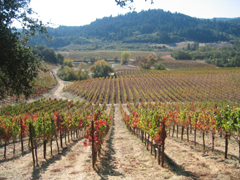
During the recent Wine Bloggers Conference in Sonoma County, California, Dad (John) and I had the pleasure of taking a vineyard walk at Michel-Schlumberger (pronounced “mi-shell’ shloom’-bear-zhay”). We hopped into vans and headed up to the Dry Creek Valley in the northern part of Sonoma County.

After driving along winding, wine country roads, we arrived at Michel-Schlumberger which is located off the beaten path in Wine Creek Canyon. Led by winemaker Mike Brunson and general manager Judd Wallenbrock, our walk started near the top of Bradford Mountain. As we enjoyed a walk in the morning sun and took in the picturesque surroundings, Mike and Judd shared with us some of the winery’s history, vineyard practices, and philosophy of winemaking.

Founded in 1979 as Domaine Michel, Michel-Schlumberger came to be in 1993 when Jacques Schlumberger became majority partner and president. Michel-Schlumberger utilizes sustainable farming techniques and is in the process of pursuing an organic farming certification. In fact, all of the Dry Creek Valley is moving towards following organic principles. In keeping with these organic principles, Michel-Schlumberger has sheep that help with mowing around the vines and chickens that assist with controlling bugs in the vineyards. Under the direction of winemaker Mike Brunson, they produce hand-crafted small lot wines and specialize in Bordeaux varietals such as Cabernet Sauvignon and Merlot.
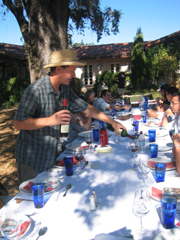
Lucky for us, most of our walk was downhill, winding along Wine Creek from Bradford Mountain down the hillside to the valley vineyards near the winery. About three-quarters of the way through our walk, we stopped at a beautiful spot overlooking the vineyards to enjoy some barrel samples of Petit Verdot, Malbec, and Cabernet Franc. Then we continued down to the valley vineyards, past the chicken coop, and were led to a long table set for us on the lawn next to the winery for a family style lunch catered by Liza Hinman of Santi and paired with Michel-Schlumberger’s 2004 Cabernet Sauvignon and 2005 Coteaux Sauvages. Fabulous food, good wines, the company of new friends, and a gorgeous wine country day made this a truly memorable experience.
If you are ever in the Sonoma County area, I highly encourage you to make an appointment to visit Michel-Schlumberger. They offer a wide variety of tours and tastings; all of which promise to be very memorable experiences. And if a vineyard walk like this appeals to you, you might want to consider one of the Sonoma Vineyard Walks offered by Zephyr Wine Adventures for your next vacation.


Filed under: American Wine, California Wine, Vineyards, Wine Activities/Events, Wine Travel
 

Fielding Hills Syrah Vertical Tasting


By Kori ~ November 3rd, 2008

For those of you who are not familiar with a vertical tasting, it is not a tasting at which you are standing up (although I suppose that you could). A vertical tasting is one in which you taste different vintages of the same wine from the same winery.

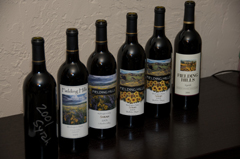
You may remember that we fell in love with the 2005 Fielding Hills Syrah back in August. After that discovery, we were anxious to try other vintages of the Fielding Hills Syrah. We were fortunate to get our hands on all six vintages that they have produced, from their very first 2001 vintage to their recently released 2006 vintage.

Fielding Hills Winery, located in Wenatchee, Washington, is a small, family-owned winery run by owner/winemaker Mike Wade and his wife Karen. The grapes for all six of these wines were sourced from the Wade’s Riverbend Vineyard in the Wahluke Slope AVA. However, the 2001, 2002, and 2003 are labeled as Columbia Valley because Wahluke Slope was not established as an official AVA until 2006.

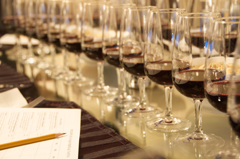
Recently, the four Wine Peeps and our good friends, Ross and Alison, sat down to dinner to enjoy this vertical tasting. While most of our tastings are blind, we decided not to taste these blind. We simply wanted to enjoy the wines and taste them in a logical order. We started with the oldest and worked our way to the youngest before we ate any food to try to get a good baseline for evaluation. This tasting was fabulous! All six of us were amazed at the consistency of quality in these wines and how good they all were considering that Fielding Hills is still a relatively new winery. We were especially impressed with the quality of their first vintage, the 2001. And I’m thrilled to report that we have now tasted two “Wow!” wines in Washington Syrah. The 2004 is different than the 2005 but every bit as good.
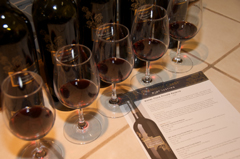
You can’t go wrong with any of these wines; they are all excellent. In fact, all six wines received a Quality Rating of at least 4 stars (out of 5). In order of our preference in this tasting:

2005 Fielding Hills Syrah (Wahluke Slope): Excellent once again. Still the best Washington Syrah I’ve had. Classic aromas, flavors, and finish.
Quality: 5 stars (out of 5)
QPR: 5 bangs for your buck (out of 5)
Where to buy: Winery, $40

2004 Fielding Hills Syrah (Wahluke Slope): Another “Wow!” wine. Every bit as good as the 2005. Luscious black fruits with spicy notes and a hint of smokiness. Well-balanced with a long, pleasant finish.
Quality: 5 stars (out of 5)
QPR: 5 bangs for your buck (out of 5)
Where to buy: Winery, $40

2006 Fielding Hills Syrah (Wahluke Slope): Black fruit aromas and flavors, especially blackberries. Quite a bit of cocoa comes through on the palate as well. Well-balanced with a smooth finish.
Quality: 4.5 stars (out of 5)
QPR: 5 bangs for your buck (out of 5)
Where to buy: Winery, $40; Avalon Wine (Oregon), $42.95

2003 Fielding Hills Syrah (Columbia Valley): Luscious fruit and hints of oak. Nice finish.
Quality: 4.5 stars (out of 5)
QPR: 5 bangs for your buck (out of 5)
Where to buy: Winery, $40

2001 Fielding Hills Syrah (Columbia Valley): Really good for their first vintage. Showing a little age but still has good fruit.
Quality: 4 stars (out of 5)
QPR: 3 bangs for your buck (out of 5)
Where to buy: Winery, $40

2002 Fielding Hills Syrah (Columbia Valley): A good wine but not as good as their other vintages.
Quality: 4 stars (out of 5)
QPR: 3 bangs for your buck (out of 5)
Where to buy: Winery, $40


Filed under: American Wine, Five-Bangs For Your Buck Wines, Five-Star Quality Wines, Red Wine, Shiraz/Syrah, Washington State Wine, Wines Over $25
 

Super Bargain Wines in the $10 to $25 Range


By John ~ October 31st, 2008

A couple of months ago I promised you a series of posts on what we call Super Bargain wines. In early September, I posted on Super Bargain Wines for Tough Times which featured a list of excellent wines selling for less than or equal to $10 a bottle. A few weeks ago I did a post entitled “Wow!” Wines can be Bargains, too. Today I’m going to share with you a list of Super Bargain Wines in the $10 to $25 Range.

Keep in mind that there is a big difference between a cheap wine and a bargain wine. A wine is only a bargain if it’s a good wine yet its price is much less than wines of similar quality. We believe that a wine is a Super Bargain only if it is of excellent quality (4-star quality or higher) by our ratings and its price is less than or equal to one-half of the average price of wines of the same varietal and the same quality level (5 bangs-for-your-buck).
Out of the thousands of wines we have tasted over the years, 77 wines fall into the category of Super Bargain wines with a price between $10 and $25. We have listed eleven of those wines below, those that have a 4.5-star quality rating. Click here for a complete list of all 77 Super Bargain wines in the $10 to $25 range (pdf). We have listed the vintage that established this wine as a super bargain for us (and the price we paid for it at that time), but we believe you can confidently purchase their current vintage and expect an excellent wine drinking experience.

YEAR WINERY LOCATION VARIETAL/TYPE PRICE QUALITY QPR
2000 Columbia Crest Walter Clore Reserve Washington Bordeaux Blend $17.00 4.5 5
2006 Mollydooker Two Left Feet AUSTRALIA Shiraz-Merlot-Cab $20.00 4.5 5
2005 Peter Lehmann Barossa AUSTRALIA Shiraz $12.92 4.5 5
2005 Mollydooker The Boxer AUSTRALIA Shiraz $20.00 4.5 5
2004 Schild Estate Barossa AUSTRALIA Shiraz $25.00 4.5 5
2005 Gilbert Cellars Wahluke Slope Washington Syrah $24.99 4.5 5
2000 Villa Mt. Eden Grand Reserve Monte Rosso California Zinfandel $17.00 4.5 5
2006 Seghesio Sonoma County California Zinfandel $18.00 4.5 5
2007 Kim Crawford Marlborough New Zealand Sauv Blanc $13.75 4.5 5
2004 Nobilo Icon Marlborough New Zealand Sauv Blanc $12.50 4.5 5
2004 Domaine Carneros Brut California Sparkling Wine $20.99 4.5 5

Have you tasted other wines that you believe belong on this list? Let us know in the comments. We’d like to try them.


Filed under: American Wine, Australian Wine, California Wine, Five-Bangs For Your Buck Wines, New Zealand Wine, Red Wine, Sauvignon Blanc, Shiraz/Syrah, Sparkling Wine, Washington State Wine, White Wine, Wines Under $15, Wines Under $20, Wines Under $25, Zinfandel
 

Wine Word of the Week: Fermentation


By Kori ~ October 30th, 2008

This week’s Wine Word of the Week is fermentation.
Official definition from Jancis Robinson’s The Oxford Companion to Wine:
Fermentation, as it applies to wine, is the process of converting sugar to ethanol (ethyl alcohol) and carbon dioxide effected by the anaerobic (oxygen-free) metabolism of yeast. It comes from the Latin word fervere, to boil; any mass containing sugar that has been infused with yeast certainly looks as though it is boiling, as it exudes carbon dioxide bubbles.

Layman’s terms from Kori:
Fermentation is the second step in the winemaking process in which grape sugars are converted to ethanol and carbon dioxide. Fermentation occurs naturally when yeast comes into contact with the sugars in the grape juice that were released during crushing.


Filed under: Wine Word of the Week
 

Highlights from the Wine Bloggers Conference


By Kori ~ October 29th, 2008

This past weekend, Dad (John) and I spent three action-packed days in the company of 170+ fellow wine bloggers, wine industry participants, and media at the first-ever North American Wine Bloggers Conference.

The event kicked off with a bang on Friday as we participated in the fast and furious Live Wine Blogging segment which many people likened to speed dating. There’s nothing like hitting the ground running. From there, we went straight into the Blind Tasting Challenge. During each round, we were asked to blind taste the wines and then either identify them by varietal or match them to a label description. Since all of the wines were from California, we were not sure how we would stack up against the other participants, many of whom are from California and have more experience tasting California wines than we do. Nevertheless, I am happy to report that both Dad and I made it to the 4th round, which was the equivalent of the quarterfinals. Six participants advanced from the 4th round to the semifinals and then two advanced on to the finals with Doug Cook of Able Grape taking the Top Taster award.
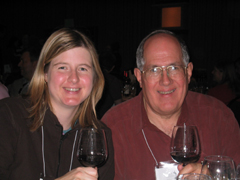
Later that evening, we enjoyed a self-paced New Zealand Wines tasting followed by dinner with Gary Vaynerchuk of Wine Library TV as the keynote speaker. As host of the very popular WLTV and a champion of social media and personal branding, Gary has become an internet celebrity. Even so, he considers himself one of us bloggers and gave a very enthusiastic, motivational keynote. It’s impossible to listen to Gary talk and not get pumped up.
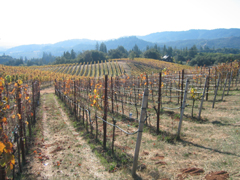
On Saturday morning, we hopped into vans and buses to head for one of five offered vineyard walks. We chose the vineyard walk at Michel-Schlumberger in the Dry Creek Valley. It was a beautiful morning and the setting was breathtaking. We capped off our walk with a family style lunch on the lawn. We got back to the hotel just in time for the breakout sessions. I won’t bore you with the details but we found the sessions very informative. We hope to incorporate some of the suggestions and ideas we formulated during these sessions to make Wine Peeps even better.
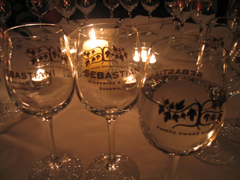
After a brief break to freshen up for the evening, we returned to the conference room for a grand tasting of Sonoma Wines before boarding buses to Sebastiani Vineyards and Winery for dinner. The keynote speaker was Alice Feiring. While I personally do not share Alice’s taste in wine, I did appreciate her encouraging words and particularly noted that she referred to us as wine writers rather than simply wine bloggers. I think that is a telling commentary on the increasing importance of wine bloggers as a part of the larger wine media.
Sunday morning featured the Unconference. An Unconference is an event in which the topic of the sessions is determined by the participants during the event rather than by the organizers prior to the event. Having not previously heard of an Unconference, I was a bit skeptical. However, it turned out to be a very productive event in which we fleshed out some of the previous day’s breakout session topics as well as discussed some new topics as well. The final event of the conference was a Luxe Sonoma Lunch that featured some of Sonoma’s luxury and hard-to-find wines.

While I enjoyed all of the sessions, events, and tastings, the best part of the conference was getting to meet so many of our fellow wine bloggers in person. We had become friends with some of them “online” but it was even better to get to spend time with them “offline.”

Many thanks to Allan Wright of Zephyr Wine Adventures and Joel Vincent of the OpenWine Consortium for organizing this wonderful conference and to all of the sponsors for your support in making it a reality. We are already looking forward to next year!

In the coming weeks, I’ll be posting on our vineyard walk at Michel-Schlumberger as well as the tastings of New Zealand and Sonoma wines.


Filed under: Wine Activities/Events
 

Wine Book Club, Fifth Edition: Wine Politics


By Kori ~ October 28th, 2008

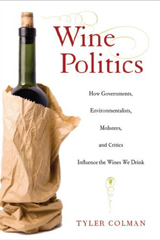
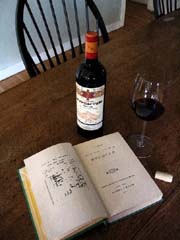
Thank you for joining us for the fifth “virtual meeting” of the Wine Book Club. Many thanks to Dr. Debs of Good Wine Under $20 who originally proposed the idea for the WBC where bloggers and wine lovers all over the world come together for book reviews and discussions every other month after reading a selected text. Dr. Debs is also our host for this edition and the text she selected was Wine Politics: How Governments, Environmentalists, Mobsters, and Critics Influence the Wines We Drink by Tyler Colman.

Tyler Colman, aka Dr. Vino, is a fellow wine blogger and teaches wine classes at NYU and the University of Chicago. His wine writing has also appeared in print publications such as Food & Wine, Wine & Spirits, and the New York Times. Wine Politics grew out of Mr. Colman’s PhD dissertation in the political science department at Northwestern University. He set out to examine the political factors that influence how a wine is made, how much it costs, how it is labeled, what wines we can actually buy, and so forth. A lot of information is packed into this relatively short 148-page read.

While he presents a lot of interesting information, the chapter that I found the most compelling was Chapter 4, Baptists and Bootleggers, particularly the section on distributor politics. As a citizen of the United States of America, home of the free-enterprise system, it is hard to believe that in 2008 there still remain numerous archaic laws regarding the sale and distribution of alcohol. I thought this line summed up how ridiculous these laws can be:

“Because of the odd patchwork of state laws, it is easier for a producer to ship a case of wine from Bordeaux to Berlin than from Napa to New Jersey.”

Let’s think about that: it is easier to ship wine from France to Germany than it is to ship it within the United States of America.
If you really want to know why you can’t buy a bottle of wine you fell in love with on a recent trip to California and have it shipped to your home, then you should definitely pick up a copy of Wine Politics to find out. And then head over to Free the Grapes to join the grassroots effort to remove these restrictions. However, if you’re simply looking for basic wine information or for a recommendation on what bottle of wine to drink tonight, then this book is probably not for you.

If you’ve already read Wine Politics, please leave a comment and let us know what you thought of it.


Filed under: Wine Book Club, Wine Books
 

Live from the Wine Bloggers Conference


By Kori ~ October 24th, 2008

3:30pm
Dad (John) and I are here at the Wine Bloggers Conference in Sonoma County, California. We are just about to begin the Live Wine Blogging segment which will feature 14 wines from 14 wineries. We will update this post as we go.

3:36pm
2004 Bonterra The McNab (Mendocino, California): 60% Merlot, 26% Cabernet Sauvignon, 14% Petite Sirah (Old Vine). Organically grown, biodynamic, single vineyard. Raspberries up front. Listed as 14.1% alcohol but tastes hot. Long but not a great finish.
Quality: 3 stars (out of 5)
Price: $45

3:42pm
2005 Bink Pinot Noir (Yorkville Highlands, Mendocino County, California): Weir Vineyard. Aromas and flavors of cherry, strawberry. Very smooth. Nice, pleasant finish.
Quality: 3.5 stars (out of 5)
Price: $40

3:47pm
2005 Clos LaChance Estate Cabernet Sauvignon (San Martin, California): Big, bold with good fruit (predominantly red fruits and plums). Young wine so tannins are a bit rough now but should soften.
Quality: 4 stars (out of 5)
Price: $30

3:54pm
2006 Sean Minor 4 Bears Cabernet Sauvignon (Napa Valley, California): Red fruits dominate, especially cherry and raspberry. Smooth and approachable. Moderate tannins.
Quality: 3.5 stars (out of 5)
Price: $17

3:58pm
2006 Boho Vineyards Chardonnay (Central Coast, California): Premium wine in a 3L box. Equivalent of four standard bottles. Will stay fresh for at least six weeks. First sniff is a bit off-putting. But tastes better than it smells.
Quality: 2.5 stars (out of 5)
Price: $24

4:04pm
2007 James David Cellars Muscat Blanc (Paso Robles, California): First release from this new winery. Dry, barrel fermented. Aromas and flavors of apricot, peach, and honey. Smooth with a pleasant finish.
Quality: 3 stars (out of 5)
Price: $18

4:14pm
2006 Twisted Oak The Spaniard (Calaveras County, Sierra Foothills, California): Tempranillo, Graciano, Garnacha. Very heavy bottle with a deep punt. Black fruits dominate (blackberries and blueberries). Crisp, smooth. Long, lingering finish.
Quality: 4 stars (out of 5)
Price: $49

4:20pm
2006 Dark Horse Treborce Vineyard Zinfandel (Dry Creek Valley, California): Fruit-forward with hints of oak. A bit hot at 15.4% alcohol. Not as well-balanced as I would like.
Quality: 3 stars (out of 5)
Price: $34

4:24pm
2006 Small Vines Wines Pinot Noir (Sonoma Coast, California): Biodynamic farming. Will be released to mailing list members in November. Aromas of strawberry and raspberry. A bit fizzy.
Quality: 3 stars (out of 5)
Price: $65

4:29pm
2007 Cupcake Vineyards Chardonnay (Central Coast, California): Vanilla and oak on the nose. Typical value Chardonnay. Smooth but not much to it. Just a pleasant sipper on a hot, summer day.
Quality: 3 stars (out of 5)
Price: $12

4:34pm
2007 Kanzler Pinot Noir (Sebastopol, California): Barrel sample. Will be bottled in January 2009 and released in April. Red fruits, especially strawberry, on the nose and palate. A bit tight, would like to try it again in a year.
Quality: 3 stars (out of 5)
Price: $48

4:43pm
2007 Lionheart Wines McGinley Vineyard Roussanne (Santa Barbara County, California): Lime, pear, and floral aromas. Pineapple and lemon also come through on the palate. Crisp acidity and a bit creamy. Good mouthfeel. Smooth finish. Very refreshing.
Quality: 4 stars (out of 5)
Price: $30

4:52pm
Whew! This concludes the Live Blogging segment. You may notice that we reviewed 12 wines instead of 14. Unfortunately, we ran out of time and two of the wineries had not yet made it to our table.


Filed under: American Wine, Cabernet Sauvignon, California Wine, Chardonnay, Moscato/Muscat, Pinot Noir, Red Wine, Roussanne, White Wine, Wine Activities/Events, Wines Over $25, Wines Under $15, Wines Under $20, Wines Under $25, Zinfandel
 

Wine Word of the Week: Crushing


By Kori ~ October 23rd, 2008

This week’s Wine Word of the Week is crushing.

Official definition from Jancis Robinson’s The Oxford Companion to Wine:
Crushing is the wine-making operation of breaking open the grape berry so that the juice is more readily available to the yeast for fermentation. Modern winery equipment that permits sufficiently thorough crushing has effectively speeded up the onset and completion of fermentation. The additional advantages of this are that the rapid accumulation of alcohol discourages any activity on the part of wild yeast and bacteria. …. Crushing was traditionally done by foot, by treading grapes thinly spread on a crushing floor slanted towards a drain and bounded by low walls to prevent the loss of juice. Foot treading is a relatively inefficient method of crushing, however….

Layman’s terms from Kori:
Crushing is the first step in the winemaking process once the grapes picked during harvest have arrived at the winery. Crushing is the step in which the grapes are broken open to make the juice available to the yeast to start fermentation. In the past, crushing was done by trampling the grapes barefoot (remember the classic “I Love Lucy” grape stomping episode). Today, most wineries use a mechanical crusher.


Filed under: Wine Word of the Week