
 Wine Peeps is an independent wine blog dedicated to helping you get the most bang for your buck in wine. We do this through blind tastings of wine from around the world and calculations of
Wine Tasting Dinner: More Washington Syrah
By Kori ~ March 10th, 2008
After Cabernet Sauvignon and Merlot, Syrah is the third most common red grape variety in Washington State. The total amount of Syrah grapes planted in Washington has greatly increased in recent years. As fans of the Shiraz/Syrah varietal, this is a trend that the Wine Peeps are excited to see.
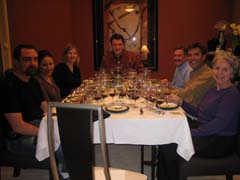 Since we enjoyed all of the Washington Syrahs that we had at last month’s tasting dinner, we decided to try another set at this month’s dinner last Friday evening. As a whole this group of wines was not as strong as last month’s. From the very beginning, the top three set themselves apart from the bottom three.
Both the 2004 Chateau Ste Michelle Ethos Syrah and the 2003 Three Rivers Syrah were excellent with the 2005 Amavi Walla Walla Syrah finishing a solid third. For me, the biggest surprise of the evening was the 2003 Columbia Crest Grand Estates Shiraz which finished in last place. Columbia Crest is one of our favorite wineries, producing excellent wines at reasonable prices. Columbia Crest wines of many different varietals and vintages have been in a number of our 57 previous wine tasting dinners. I cannot remember a single one of their wines finishing below 2nd place until now. In fact, their 2003 Columbia Crest Two Vines Shiraz won last month’s tasting. And generally speaking, the Grand Estates label is considered superior to the Two Vines label. But that is definitely not the case with the 2003 Shiraz.
From 1st to last in the group consensus rankings:
2004 Chateau Ste Michelle Ethos Syrah: Pleasant aromas of spice and lavender with hints of horseradish and tobacco. Crisp, black fruit flavors, ripe tannins and a long finish.
Quality: 4 stars (out of 5)
QPR: 4 bangs for your buck (out of 5)
Where to buy: MadWine (Washington), $25.99
2003 Three Rivers Syrah: My favorite of the evening. Movie theater-style buttered popcorn on the nose leads to luscious black cherry and plum flavors. Smooth tannins and good acidity. Well-balanced with a long, lingering finish.
Quality: 4 stars (out of 5)
QPR: 5 bangs for your buck (out of 5)
Where to buy: Pete’s Wine Shop – Eastside (Seattle area), $15.99
2005 Amavi Walla Walla Syrah: Distinct smoky notes throughout. Fruit-forward with subtle tannins and a medium finish.
Quality: 3.5 stars (out of 5)
QPR: 4 bangs for your buck (out of 5)
Where to buy: Pete’s Wine Shop – Eastside (Seattle area), $22.99
2006 Owen Roe Ex Umbris Syrah
Quality: 3 stars (out of 5)
QPR: 3 bangs for your buck (out of 5)
Price: $22.39
2005 Seven Hills Walla Walla Syrah
Quality: 3 stars (out of 5)
QPR: 2 bangs for your buck (out of 5)
Price: $26.99
2003 Columbia Crest Grand Estates Shiraz
Quality: 2.5 stars (out of 5)
QPR: NR (not recommended)
Price: $8.99
Filed under: American Wine, Five-Bangs For Your Buck Wines, Red Wine, Shiraz/Syrah, Washington State Wine, Wine Tasting Dinners, Wines NOT To Buy (1 & 2 Star), Wines Over $25, Wines Under $10, Wines Under $15, Wines Under $20, Wines Under $25


 Almost all significant wine merchants now have a website. Our experience with online buying has been generally very positive. We’ve ordered many, many cases from numerous online vendors without incident. We’ve also found great stores with terrible websites and vice versa. Over time, we’ve found a number of online vendors that we believe stand above the others in terms of ease of use, selection, price, and reliability:
 Sydney, my 13 month old daughter, is asleep right now and I finally have a moment to sit down on the couch, relax, start reading a book that’s been on my nightstand for over a year, and sip one of my all-time favorite wines, the 2002 Peter Lehmann Shiraz. Too many times when Sydney is sleeping, I am frantically trying to get as much done as I can (paying bills, washing dishes, working on these blog posts, etc.) that I rarely take time for myself. This comfort wine theme was perfect in that it forced me to slow down and relax a little.
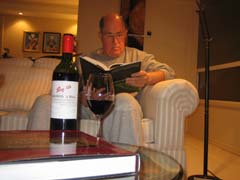 When I’m not studying wine, I’m in the investment management business studying these crazy markets. I unwind at home in my sweats by sipping a good glass of wine while watching the sailboat races on Lake Union from my deck, reading a good book [currently I’m reading New Classic Winemakers of California], or going online where I browse sports, travel [fantasizing about my next trip Down Under], and wine.
 My comfort wine is the Columbia Crest Two Vines Merlot Cabernet. The price is right, averaging between $6 and $8 a bottle, and it is a great all around wine. The wine has a fragrant nose of red cherry and hints of minerality. On first sip it is fruit-forward and balanced with just enough tannins for a good body and a pleasant finish. After it has had a chance to breathe, you can expect the tannins to open up so you can experience its true complexity. It’s not overpowering but definitely not a wimpy wine either.
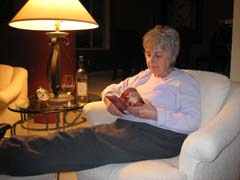 Most evenings I unwind and relax with a book; my reading of choice is fiction. While I read I enjoy sipping a glass of New Zealand Sauvignon Blanc, most often Nobilo. While many people might question a Sauvignon Blanc as a sipping comfort wine, it is those characteristics that it provides that I specifically like: the fresh, tart, grapefruity taste with the soft golden color. I do not like sweet or oaky flavors, but I love a crisp, cold white wine…even in winter!
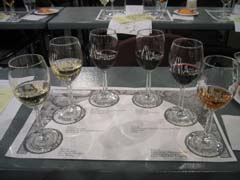 As the program title suggests, during this course we tasted six unique wines from around the world. While many of us have our regular go-to varietals (Shiraz/Syrah, Cabernet Sauvignon, Sauvignon Blanc, etc.), this course was a fun opportunity to experiment a little and try some wines that we had never tasted before. I had only had two of them (Albariño and Amarone della Valpolicella) previously so four were completely new to me.
 That’s exactly what the Wine Peeps did when we got together for dinner and opened a bottle of 1992 Henschke Hill of Grace that Dad (John) had been saving. The four of us fell in love with Australia and Australian wines when we visited in the spring of 2005. One of our favorite stops in our wine touring of the Barossa Valley was
 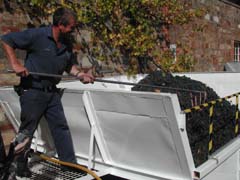 While the wonderful folks at Henschke gave us tastes from $70+ bottles, obviously their top-of-the-line Hill of Grace was not open for tasting. Upon returning home, Dad set out to buy a bottle to see if it was all it’s hyped to be. Since it has great aging potential, he wanted to buy a bottle that already had some age on it so that we could enjoy it sooner. He decided on the 1992 vintage which is considered to be one of their better (although probably not their best) vintages. Once he had it in the cellar, all he needed was an occasion to drink it. Enter Open That Bottle Night.
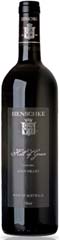 1992 Henschke Hill of Grace: 100% Shiraz. Brilliant with very little dilution in color on the rim despite the fact that it is 16 years old. Very perfumy and peppery with floral hints on the nose. Chewy and full-bodied. Lots of black pepper and black fruits on the palate. Not as overtly tannic or as alcoholic as most big wines. Very smooth and extremely well-balanced with a long finish.
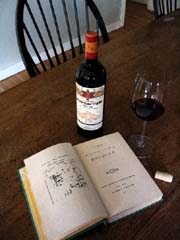 Today is the first “virtual meeting†of the
 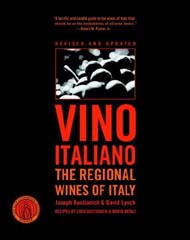 At first the 531-page text seemed daunting but Vino Italiano is actually a very easy read. While I read the book from cover to cover (save for the reference material in Part III), the layout lends itself to use as a quick reference tool. And I am certain that I will be referring back to it frequently. The first section of the book, Part I: The Basics, covers just that—the basics of Italian wine history, laws, and labeling. The meat of the book, Part II: The Regions, covers each of Italy’s twenty-one regions, all of which produce wine. Each region’s chapter roughly follows the same format: introduction, map of the DOC zones of that region, and a discussion of the wines made in the region broken down into the following categories when applicable—Vini Spumante (sparkling wines), Vini Bianchi (white wines), Vini Rosati (rose wines), Vini Rossi (red wines), and Vini Dolci (sweet wines). Each chapter has a “Fast Facts†section that includes a few basic facts, key grape varieties, top vintages, wine touring information, and recommended tastings (all the recommended wines should be available in the American market). And, finally, each chapter concludes with an original recipe by either Mario Batali or Lidia Bastianich to showcase how regional foods and wines go together in Italy. Part III: The Data includes a glossary of Italian wine terms, a list of the grape varieties, a directory of DOC(G) and IGT zones, a list of producers, and additional miscellaneous resources.
 It should be obvious that if you drink too much you are likely to get a headache. So besides cutting back on the quantity of wine you drink at one sitting, or spitting instead of swallowing like the professional tasters do, what can you do to lessen the headache issue?
 Andrew from Spittoon was our host for the February
 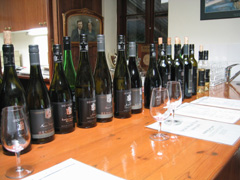 We found visiting
 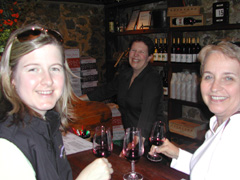 Now, in which of those environments do you feel an obligation to buy? For me, the easy answer is Australia. Even though I am not able to visit Australia frequently, the positive experience that we had there, not to mention the fact that they produce outstanding wines at reasonable prices, makes me want to buy their wines and encourage you to do so also.