
Wine Tasting Dinner: Washington Rhone-Style Red Blends


By Kori ~ January 18th, 2012
The Rhone Valley in France is divided into two parts, appropriately referred to as the northern Rhone and the southern Rhone. While the northern Rhone produces mostly single varietal wines, the southern Rhone is known for producing blends. The most famous AOC in the southern Rhone is Chateauneuf-du-Pape, which is well known for its Grenache-based blends, many of which are GSM’s (Grenache-Syrah-Mourvedre blends). A number of wineries in Washington State are producing blends similar to those produced in the southern Rhone.

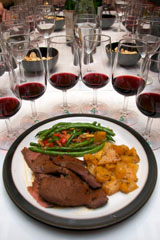
This month’s wine tasting dinner featured Rhone-style red blends from Washington State. It was another fabulous evening of great wines, the company of wonderful friends, and LaGayle’s (Mom’s) excellent food. All six wines paired extremely well with our dinner of tomato basil soup, mixed green salad, roasted beef tenderloin, green beans with almonds and caramelized shallots, roasted rutabagas, and Death by Chocolate ice cream with ladyfingers.

The overwhelming consensus favorite was the 2008 Olsen Estates Red Wine. It received an unprecedented eight out of eight first place votes against some stiff competition. This is the first time in 102 tasting dinners that I can remember a wine sweeping the top spot. And, at $11, this wine is an absolute steal. The bad news is that Olsen Estates is now a defunct winery, officially closing its doors last year. While the Olsens continue to focus their efforts on grape growing, they are no longer making their own wine. But if you see this wine on closeout at a local Seattle retailer, I highly encourage you to grab a few bottles.

Rounding out the top three wines and also receiving Quality ratings of 4.5 stars were the 2008 Rôtie Cellars Southern Blend and the 2008 Grand Rêve Collaboration Series II. As you will see from the quality ratings below, we felt that all six wines were very good. In my opinion, you cannot go wrong with any of these. Not only did all six wines receive a Quality rating of 3.5 stars or higher (out of 5), but five of the six also received a QPR rating of either 4 or 5 bangs for your buck (out of 5).

From 1st to last in the group consensus rankings:
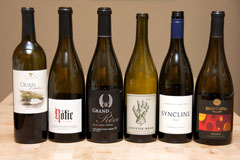
2008 Olsen Estates Red Wine (Yakima Valley, Washington): 70% Syrah, 12% Mourvedre, 12% Cinsault, 5% Grenache, and 1% Counoise. Dark purplish red in color. Nice nose with black cherry, blackberry, spice, and vanilla aromas. A lot going on in this wine. Gorgeous black fruit, nutmeg, pencil lead, and leather come through on the palate. Well-balanced with a long, lingering finish. An outstanding wine from the first sip right on through dessert.
Quality: 4.5 stars (out of 5)
QPR: 5 bangs for your buck (out of 5)
Where to buy: Full Pull Wines (Seattle, Washington), $11; Available elsewhere, $15 to $18

2008 Rôtie Cellars Southern Blend (Washington State): 70% Grenache, 15% Syrah, and 15% Mourvedre. Deep, ruby red. Nose is a bit tight at first but then opens up with nice red and black fruit aromas and a hint of earth. More red and black fruit and earth as well as spice and perfume come through on the palate. Medium to full-bodied with crisp acidity and medium tannins. Well-balanced with a long finish.
Quality: 4.5 stars (out of 5)
QPR: 5 bangs for your buck (out of 5)
Where to buy: Winery, $40; Available elsewhere, $38

2008 Grand Rêve Collaboration Series II (Ciel du Cheval Vineyard, Red Mountain, Washington): 40% Grenache, 38% Syrah, 20% Mourvedre, 1% Viognier, and 1% Roussanne. Deep, dark red. Very aromatic with eucalyptus, violets, vanilla, and a hint of barnyard on the nose. Black plum, vanilla, and oak come through on the palate. Full-bodied with lively acidity and big, bold, chewy tannins. Well-balanced with a very long finish.
Quality: 4.5 stars (out of 5)
QPR: 4 bangs for your buck (out of 5)
Where to buy: Winery, $50; Available elsewhere, $54 to $78

2010 Owen Roe Sinister Hand Red Wine (Columbia Valley): 71% Grenache, 24% Syrah, and 5% Mourvedre. Deep purplish red. Aromatic with strawberry, red cherry, pencil lead, and floral notes on the nose. Black cherry, vanilla, floral notes, and a hint of coffee come through on the palate. Medium to full-bodied with lively acidity, smooth tannins, and a long finish.
Quality: 4 stars (out of 5)
QPR: 5 bangs for your buck (out of 5)
Where to buy: Fred Meyer (Seattle, Washington), $23; Available elsewhere, $20 to $30

2010 Syncline Subduction Red (Columbia Valley, Washington): 31% Mourvedre, 25% Syrah, 21% Grenache, 12% Cinsault, 7% Carignan, and 4% Counoise. Deep ruby red in color. Nice nose with black cherry, raspberry, and cinnamon aromas. Fruit-forward with red and black cherry, spice, and herbs on the palate. Medium to full-bodied with good acidity, medium to high tannins, and a long finish.
Quality: 3.5 stars (out of 5)
QPR: 4 bangs for your buck (out of 5)
Where to buy: Fred Meyer (Seattle, Washington), $18; Available elsewhere, $18 to $20

2007 Brian Carter Cellars Byzance (Columbia Valley, Washington): 51% Grenache, 25% Syrah, 20% Mourvedre, 2% Counoise, and 1% Cinsault. Deep, dark red. Smoked meat, spice, blackberry, and black cherry come through on both the nose and palate. Medium to full-bodied with lively acidity, medium to high tannins, and a long finish.
Quality: 3.5 stars (out of 5)
QPR: 3 bangs for your buck (out of 5)
Where to buy: Fred Meyer (Seattle, Washington), $27; Available elsewhere, $22 to $27


Filed under: American Wine, Five-Bangs For Your Buck Wines, Food & Wine, Red Wine, Washington State Wine, Wine Tasting Dinners, Wines Over $25, Wines Under $15, Wines Under $20, Wines Under $25
 

Wine Word of the Week: Legs


By Kori ~ January 17th, 2012

This week’s Wine Word of the Week is legs (sometimes referred to as tears).

Official definition from Jancis Robinson’s The Oxford Companion to Wine:
Tears is a tasting term used to describe the behavior of the surface liquid layer that is observable in a glass of relatively strong wine. The wine wets the inside of a clean glass and climbs up a few millimeters. At the upper edge of the thin layer on the inside wall patches of the film thicken, become more drop-like, and eventually roll back down the inside wall to the liquid surface. These traces of what look like particularly viscous droplets are also sometimes called ‘legs,’ and may give some indication of a wine’s alcoholic strength.

Layman’s terms from Kori:
When you swirl a glass of wine or take a sip and then hold the glass upright and still, the residual “clear” liquid that you notice slowly dripping down the inside of the glass is called legs. Legs are simply an indication of alcohol. They are not an indicator of a wine’s quality.


Filed under: Wine Word of the Week
 

Women of Washington Wine: Linda Trotta of Swiftwater Cellars


By Kori ~ January 16th, 2012

Today’s post is part of a series featuring the Women of Washington Wine. In an industry once dominated by men, more and more women are joining the ranks as winery owners, vineyard owners, and winemakers. Being a woman myself, I am fascinated by these women and what they have done and continue to do. Through this series, I hope to introduce you to some of the brightest female faces in the Washington wine industry.

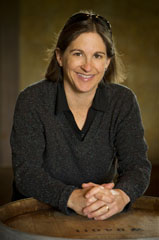
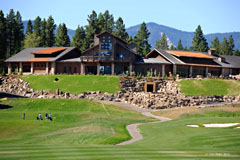
Linda Trotta is winemaker for Swiftwater Cellars in Cle Elum, Washington, about 80 miles east of Seattle. Swiftwater Cellars, a destination winery, restaurant, and event facility located in Suncadia Resort, opened its doors in 2010. A native of Southern California, Linda began her winemaking career in 1986 when she graduated with a degree in Fermentation Science from UC Davis. She spent the majority of her career at Gundlach Bundschu Winery in Sonoma, California, but has also gained valuable winemaking experience working in Italy, Chile, South Africa, and now, Washington State.

Recently, Linda was kind enough to take time out of her busy schedule to answer some questions for me and our Wine Peeps readers.

Highlights from Q&A with Linda Trotta:

How did you first get involved in the wine business?
I grew up helping my Italian grandfather make wine in his garage. Wine was a staple at the dinner table; when we needed more, it was just a matter of going out to the garage and tapping into a barrel. It never occurred to me that people got paid to make wine. I entered UC Davis as a math major, thinking I’d go into teaching. Fortunately, advanced calculus was not my friend. Literally flipping through the university catalogue, looking for something more interesting, I landed on the Enology program.

What were the steps that led to where you are now?
While I took opportunities to work harvests in Italy, Chile and South Africa, prior to Swiftwater, most of my 25-year winemaking career was spent in Sonoma, California. After graduating from Davis, I worked in the cellar at St. Francis Winery and then the laboratory at Sebastiani Vineyards Winery. I spent the next 20 years making wine at Gundlach Bundschu Winery, starting as an Enologist in 1989 and a year later becoming winemaker. Ultimately, I served as Director of Winemaking and Winegrowing, managing the operations for 300 acres of estate vineyard as well as making the wines. As my 20th harvest at GBW approached, I decided that it was time to apply my craft in a new environment. I considered several opportunities across North America and was most excited by what Swiftwater was endeavoring to create. In 2010, I made the move to Washington State and am having a ball!

Has being a woman been an advantage or a disadvantage in your wine journey?
Ultimately, what matters most is how well you do your job. That said, women entering any industry that has been historically male-dominated could face challenges around being accepted and recognized for their skill set. In my experience, at times, it has taken plenty of perseverance and patience to overcome such hurdles. On the flip side, however, being a woman can garner some extra attention. Case in point, I get to talk to you!

What advice do you have for a woman wanting to get involved in the wine business today?
Get educated on the whole business, no matter what type of work you aim to pursue. The more you know, the more valuable and successful you will be. Find and use mentors. Patience and perseverance.

What are your thoughts about the Washington wine industry, in general?
It is an exciting time to be making wine in Washington. The region and its wines are gaining greater widespread recognition. There is energy within the business that is fostering innovation, the seeking of knowledge and the sharing of information. This atmosphere is part of what attracted me to the state.

In recent years the Washington wine industry has grown at a rapid rate. Do you expect that trend to continue?
In terms of wine volume produced, Washington is significantly dominated by a handful of very large producers. The vast majority of wine brands are owned by small producers (under 10,000 cases). Where I see opportunity for growth is for existing small producers to gain a larger share of the market, which will help build robust sustainability for the region as a whole.

What is your vision for the future of Swiftwater Cellars?
Swiftwater is all about providing memorable experiences for folks, whether in the wine bar, Hoist House restaurant, at a private celebration or event, or just hanging out in the lounge. My focus, obviously, is to make distinctive Washington State wines that complement and enhance that experience. Going forward, I hope to develop an interactive wine appreciation program that also provides guests with an opportunity to enrich their enjoyment of wine and food in a fun, relaxed setting. Also in the plans is a facility expansion to include a conference center, amphitheater, and on-site fractional-share cabins. My vision for Swiftwater Cellars is to be the one-stop destination for delicious Pacific Northwest wines and cuisine and experiences of a lifetime.

Feel free to share any other thoughts that you believe would be of interest to our readers.
The comment I most frequently hear from casual wine consumers (which is most of the wine-drinking population!) is an almost apologetic, “I don’t know anything about wine.”  My response is that, if you are interested, there are plenty of resources available to you to learn as much as you want about wine. But as a consumer, all you really need to know is: (a) What you like, and (b) How to get it.

Many thanks to Linda for sharing her story and thoughts with us. I wish her all the best and look forward to following her work and Swiftwater Cellars with great interest, and I hope that you will too.

(Photos from Swiftwater Cellars)


Filed under: American Wine, Interview, Washington State Wine, Women of Washington Wine
 

A Wine for Tonight: 2008 Plantagenet Omrah Shiraz


By Kori ~ January 12th, 2012

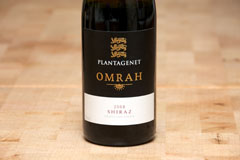
Would you like a quick suggestion for a good wine to drink tonight (or this weekend) that won’t break your budget and is widely available? Many of our readers have said this is something they would like, so here is this week’s selection, the 2008 Plantagenet Omrah Shiraz from the Great Southern region of Western Australia.

Our selection criteria include:

  • A very good Quality rating of >=3.5 stars (out of 5)
  • A price tag of <=$15
  • Must be widely available

Plantagenet Wines was the first winery established in Western Australia’s Great Southern region. The Great Southern region is characterized by a cool, continental climate and granite-laden soils. Founded in 1968 by English immigrant Tony Smith, Plantagenet is named after the local Shire of Plantagenet. Smith’s initial plantings included Shiraz and Cabernet Sauvignon. Later, Pinot Noir, Riesling, and Chardonnay were planted as well. Plantagenet’s Omrah line of wines is named for the SS Omrah ocean liner, which ferried settlers and soldiers to and from Western Australia’s shores in the 1900’s.

“Plush blueberry and plum with just a hint of characteristically regional pepper and spice notes. Subtle oak characters impart a sweet, vanilla chocolate note. The bouquet will evolve with time in the bottle providing further complexity.” –Plantagenet Wines

2008 Plantagenet Omrah Shiraz (Great Southern, Australia): Deep, dark purple in color. Aromatic with black fruit, oak, and a touch of earth on the nose. Fruit-forward with blackberry, black cherry, and a hint of smoke on the palate. Medium to full-bodied with lively acidity and medium to high tannins. Well-balanced with a long finish.
Quality: 4 stars (out of 5)
QPR: 5 bangs for your buck (out of 5)
Where to buy: Received as sample, suggested retail $13; Available elsewhere, $17


Filed under: A Wine for Tonight, Australian Wine, Five-Bangs For Your Buck Wines, Red Wine, Shiraz/Syrah, Wines Under $15, Wines Under $20, Wines Under $25
 

An Unlikely Boutique: Sagemoor Vineyards


By Kori ~ January 11th, 2012

Kori S. Voorhees, our Wine Peeps Editor-in-Chief, has been a contributor to Washington Tasting Room Magazine, a quarterly magazine that focuses on Washington State wine with articles about wineries, vineyards, travel, and lifestyle. The following article, written by Kori, appeared in the Summer 2011 issue.

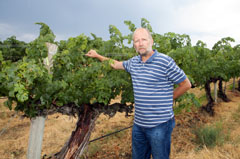
Northwest wineries have been banking on grapes from Sagemoor Vineyards for decades. With novel ideas and deep passion, this powerhouse vineyard team continues to supply winemakers with the right stuff.

The late Alec Bayless, an attorney from Seattle, was the mastermind behind what is today known as Sagemoor Vineyards. This pioneer vineyard, founded in 1968, supplied grapes to a number of Washington and Oregon wineries during those early days that helped put the wine industry in the Pacific Northwest on solid footing.

There are four individual vineyard sites in all, consisting of Sagemoor, Bacchus, Dionysus and Weinbau that make up what is officially known as Sagemoor Vineyards.

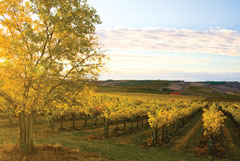
Weinbau is located 12 miles east of Mattawa on the Wahluke Slope, while the other three are located within miles of each other north of Pasco, Washington, on a spectacular site overlooking the Columbia River to the west.

“At 900 acres in size, we are probably the largest ‘boutique’ vineyard in the state because we do not have our own winery,” says general manager Kent Waliser. Since he joined Sagemoor in 2002, Waliser has embraced the idea of working with a large number of grape buyers, both big and small. At last count they sell grapes to over 75 wineries, including Abeja Winery, Barrister Winery, Efeste, Hedges Family Estate, Januik Winery, L’Ecole Nº 41, Rasa Vineyards, Ste. Michelle Wine Estates, Walla Walla Vintners, and Woodward Canyon Winery.

Not only does this practice provide diversification, it best utilizes the makeup of some vineyard sites which don’t ripen evenly (due to variability in soils and topography) and therefore do not appeal to large commercial customers who are looking for uniformity so they can make mass quantities of wine in a consistent style.

Former vineyard manager Todd Cameron mapped the vineyard block and divided them up into smaller rows, or individual sections as they are called. Todd then determined the irrigation and viticulture plan appropriate for each block. Now, each newly planted block takes into account many variables that make sure each grape variety will grow best there. As a result, they have become very attractive to boutique winemakers who want to claim these smaller sections as their own.

Sagemoor is known for producing some of the best Cabernet Sauvignon in the State of Washington, particularly the 1972 Old Vine Cab in block 9 of Bacchus Vineyard. “It has a really nice core of dark fruit and there is a brown herbaceous signature to Sagemoor,” says John Abbott, owner and winemaker for Abeja Winery.

Rick Small of Woodward Canyon Winery has been buying Sagemoor grapes for 34 years and speaks very highly of the growers, as well as their grapes. Speaking about their Cabernet Sauvignon he says, “I like the intensity and the black fruits. I find that the wines are a little bit more elegant. The aromatics, for me, are a key part of Sagemoor, as well as texture. The wine is seamless; it’s wonderful with food.”

At the same time Sagemoor has developed a modern niche growing lesser-known varieties that are not commonly found elsewhere in the state including Barbera, Roussanne, Carmenere, Malbec, Petit Verdot and Cab Franc.

Not content to rest on their laurels as one of the top vineyard growers in the state, Sagemoor Vineyards are progressive in their practices. “The vineyard team understands that they need to continue to farm for better and better fruit. They are willing to work with each winemaker to produce the fruit that each winery is looking for, which is unique. I’m a believer in softer farming, which is a direction that Sagemoor is also willing to go, not only to produce better fruit but also to protect the health and happiness of their workers,” says Abbott.

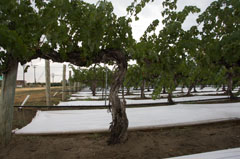
About five years ago, Waliser started using a product called Extenday in the Old Vine Cab block 10. As a tree fruit grower, Waliser had experience using the white reflective material to advance the maturity of cherries and apples more quickly in the growing season, and he wondered if it could help the 1972 block, which tended to ripen late.

His hunch paid off. Using Extenday has allowed Sagemoor to gain heat units and advance maturity by a week to ten days. John Abbott has worked with Waliser to test the effectiveness of Extenday on these grapes by comparing rows that had the material on them versus rows that did not. “It definitely made a difference,” says Abbott.

Sagemoor also provides their winery partners with current and historical brix, acid, and pH values for each block of the vineyard, not unlike a financial report that tracks the individual performance of stocks and bonds for investors. According to Waliser, “We’ve got ten years of data now in there that you can graph by block. Each block is sampled twice a week. It’s posted to our website every day at 4 o’clock.”

This information can be critical for winemakers who don’t live near the vineyard and are unable to visit as often as they would like during harvest to make picking decisions. “We’ve got winemakers on the Olympic Peninsula, in Spokane, in Walla Walla, in Woodinville. They can check on their block’s progress at midnight, 3am or 10am or whenever they want to, because the information is there.”

Even though Sagemoor is a large operation in terms of acreage, they work hard to make sure that each customer is taken care of and their needs are met. Derek Way, vineyard manager, together with Servando Rodriguez and Miguel Rodriguez, have over 70 combined years experience working with winemakers. They know that customer service is critical for success, and they seem to have a lot of fun in the process. Rick Small recalls the fabulous BBQ parties that the original partners would throw for their shareholders. True to their roots, Sagemoor still holds an annual tasting for their winery partners. It’s not only a time to celebrate and enjoy each other’s company but also a time to discuss what is working and what could be improved.

“It’s almost like a family over there, and I feel like I’m a part of that family. They just take great care of the vineyard, and they take really good care of the wineries that get grapes from them,” says Small.


Filed under: American Wine, Vineyards, Washington State Wine, Washington Tasting Room Magazine, Wine Magazines
 

Wine Word of the Week: Finish


By Kori ~ January 10th, 2012

This week’s Wine Word of the Week is finish.

Official definition from Jancis Robinson’s The Oxford Companion to Wine:
Since this is an oft used wine tasting term, I was surprised to find that there was no entry for “finish” is The Oxford Companion to Wine. However, I did locate entries for “long” and “short” that seem the closest to explaining this term. Long is a much-derided tasting term for wines whose impact on the palate is particularly persistent. A wine that is long is usually of high quality. Short is a tasting term for a wine whose impact on the palate is not persistent; the opposite of long.

Layman’s terms from Kori:
The finish is how long a wine’s flavor lingers in your mouth. A well-made wine has a pleasant and lingering finish (sometimes as much as 30 seconds or more.)


Filed under: Wine Word of the Week
 

Happy 4th Birthday to Wine Peeps!


By Kori ~ January 9th, 2012

Today marks four years since we started sharing our wine adventures with you here on Wine Peeps. What an exciting four years it has been! We have written 981 posts and tasted over 4,500 wines. We have had the pleasure to meet so many wonderful people in the wine industry as well as fellow wine enthusiasts. This past year, we traveled to numerous wineries, vineyards, and tasting rooms in Washington, Oregon, and California. Even though our travels kept us on the West Coast, we welcomed the many opportunities we had to expand our palates and taste wines from all around the world through our tasting group, private tastings, samples tastings, trade tastings, and other events.

Thank you so much to all of our readers! I know it sounds cliché, but we could not do this without you. We love wine and love sharing that passion with you through this blog. We are humbled that you care to read what we write.

Our social networking presence has continued to grow on Twitter (almost 3,500 followers), Facebook (over 2,700 likes), OpenWine Consortium, and LinkedIn. It truly has been a pleasure to get to know many of you through comments, email, and these social networking sites. We certainly hope our relationship continues to grow in the year ahead.

In the coming year, we will strive to provide you with even more compelling wine-related content. We hope that you will continue to support us by reading Wine Peeps and telling your friends about it. We welcome the opportunity to connect on any or all of the social networking sites as well.

Cheers from your Wine Peeps,
Kori, John, Colby, and LaGayle

(Photo by Pixelicus)


Filed under: Birthday
 

A Wine for Tonight: 2008 Mission St. Vincent Bordeaux Rouge


By Kori ~ January 5th, 2012

Would you like a quick suggestion for a good wine to drink tonight (or this weekend) that won’t break your budget and is widely available? Many of our readers have said this is something they would like, so here is this week’s selection, the 2008 Mission St. Vincent Bordeaux Rouge from the Bordeaux region of France.

Our selection criteria include:

  • A very good Quality rating of >=3.5 stars (out of 5)
  • A price tag of <=$15
  • Must be widely available

Mission St. Vincent is a 12th century mission, which has been turned into a modern winery. Located between two rivers, the Garonne and the Dordogne, in the Entre-Deux-Mers region in France, Mission St. Vincent extends over fifteen villages. For over 25 years, plots of vineyard land have been carefully selected to obtain the best grapes in order to produce a quality wine.

“Strong color, bright red highlights. Pleasant nose combining the red and black fruit with a woody vanilla. The mouth is round, silky tannins with a lovely aromatic presence. A contemporary style.” –Mission St. Vincent

2008 Mission St. Vincent Bordeaux Rouge (Bordeaux, France): 70% Merlot, 20% Cabernet Sauvignon, and 10% Cabernet Franc. Medium to deep red in color. Aromatic with vegetal notes and a hint of barnyard on the nose. Smoke, black fruit, and bell pepper come through on the palate. Medium to full-bodied with lively acidity, medium tannins, and a long finish.
Quality: 3.5 stars (out of 5)
QPR: 5 bangs for your buck (out of 5)
Where to buy: Received as sample, suggested retail $10; Available elsewhere, $10


Filed under: A Wine for Tonight, Five-Bangs For Your Buck Wines, French Wine, Red Wine, Wines Under $15, Wines Under $20, Wines Under $25
 

Wine Peeps Top 10 Posts of 2011


By John ~ January 4th, 2012

As we begin a new year, it’s time for us to reflect on our body of work in 2011, what we’ve done well and where we can improve in 2012. If you have some suggestions, please tell us.
When you’ve written as many posts as we have this past year, it is quite a project to review them all and pick a Top 10. The ten we selected are not necessarily our personal favorites, although some certainly are, but the ones that generated the most interest and discussion among our readers, not just on our Wine Peeps website, but on social media sites such as Facebook and Twitter as well.

In reviewing the posts that made the Top 10 as well as those that barely missed, it is obvious that our regular features such as Wine Tasting Dinners, A Wine for Tonight, Challenging Wine Pairings, Women of Washington Wine, and the Wine Word of the Week remain very popular with our readers.

So, without further ado, here are our Top 10 posts for 2011, listed in chronological order from oldest to most recent:


Filed under: Best of
 

Wine Word of the Week: Balance


By Kori ~ January 3rd, 2012

This week’s Wine Word of the Week is balance.

Official definition from Jancis Robinson’s The Oxford Companion to Wine:
Wine tasters say that a wine has balance, or is well balanced, if its alcoholic strength, acidity, residual sugar, tannins, and fruit, complement each other so that no single one of them is obtrusive on the palate. (Young wines are expected to exhibit more marked tannins than mature ones however.) This extremely important wine characteristic is quite unrelated to flavor.

Layman’s terms from Kori:
A well-balanced wine has a good blend of fruit with acidity, tannins, and alcohol. Nothing stands out in isolation.


Filed under: Wine Word of the Week