Three Unique Wine Clubs


By John ~ February 9th, 2011

Today many wineries have some kind of a wine club. In fact, not too long ago we wrote a post entitled Should I join a Wine Club? in which we concluded that you should only join the wine club of a winery whose wines you already know and like, not just for the 15 to 20 percent or so discount on purchases through the wine club.

In the course of researching the wine clubs of Washington wineries whose wines we like, we found three wine clubs that are uniquely good for three very different reasons.

Members-Only Room
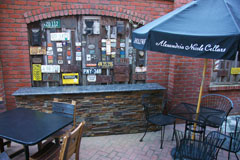
Alexandria Nicole Cellars has a Hidden Door Club room that its members can access any time they visit the tasting room in either Woodinville or Prosser. If you live or work anywhere close to their tasting rooms, it’s an especially attractive perk because they have members-only happy hours, light food available, and no tasting fees. Plus, there are wines available in the members-only rooms that are not available in the tasting rooms.

Lifetime Pricing
Rotie Cellars is offering Lifetime Pricing to all of their Rotiesian wine club members who sign up during the first year of the club (now about six months old). This means just what it says: the price you pay on your wine club purchases will never, ever increase. Plus, you get the other typical wine club perks of free tastings, free shipping on case lots, and access to special offerings.

Recipes and Pairing Suggestions
Columbia Crest always sends out pairing suggestions including detailed recipes with their Summit Reserve Club shipments. LaGayle loves this nice touch, and it gives her good ideas for new food to try. Again, this perk is in addition to wine club member discounts, special events, and other special offerings.

I know these are not the only wine clubs that offer unique perks, but they are three that have caught our attention. Please tell us about the wine clubs you have joined and anything you’ve found that makes them unique.


Filed under: American Wine, General Wine Information, Washington State Wine
 

Wine Word of the Week: Sherry


By Kori ~ February 8th, 2011

This week’s Wine Word of the Week is sherry.

Official definition from Jancis Robinson’s The Oxford Companion to Wine:
Sherry is a seriously undervalued but slowly reawakening fortified wine from the region around the city of Jerez de la Frontera in Andalucia, south west Spain. ‘Sherry’ was used as a generic term for a wide range of fortified wines made from white grapes, but in the mid 1990s the sherry trade successfully campaigned to have the name restricted—at least within the European Union—to the produce of the Jerez DO. …. Only three varieties are now authorized for new vineyards in Jerez: Palomino, Pedro Ximenez, and Muscat of Alexandria. Of these, Palomino is the most important and accounts for around 95 percent of the total vineyard area.

Layman’s terms from Kori:
Sherry is a fortified white wine, made primarily from the Palomino grape, which is produced according to a complex aging and fractional blending process.


Filed under: Wine Word of the Week
 

Three Rivers Winery: Good Wines, Great Value, and Gorgeous Setting


By Kori ~ February 7th, 2011

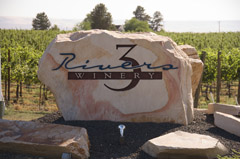
Three Rivers Winery, founded in 1999, is located just west of Walla Walla, Washington. The winery is named for the three most prominent rivers—the Columbia, Snake, and Walla Walla—which feed the vineyards from which it sources grapes. Three Rivers sources fruit from some of the top vineyards in the state including Boushey, Champoux, and Sagemoor, among others. Three Rivers is owned by Foley Family Wines in California and produces 15,000 cases per year. Winemaker Holly Turner, who joined the winery in 2000, oversees all aspects of production.

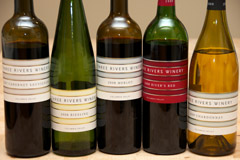
We recently had the opportunity to taste five wines from Three Rivers Winery in a blind samples tasting, the 2007 Cabernet Sauvignon, the 2008 Riesling, the 2008 Merlot, the 2008 River’s Red, and the 2009 Chardonnay. We would recommend all of the wines, except the Chardonnay, and were especially impressed with the Cabernet Sauvignon.

Three Rivers is a destination winery boasting an 18,000 square foot facility, which houses their tasting room, cellar and barrel room, meeting rooms, and a spacious deck. They also offer three short holes of golf for winery guests. I must admit that I have found their wines to be a bit inconsistent in the past. However, if these current releases are any indication, Three Rivers is on the way back up. And, best of all, these wines deliver some serious bang for your buck.

2007 Three Rivers Winery Cabernet Sauvignon (Columbia Valley, Washington): 88% Cabernet Sauvignon, 7% Petit Verdot, and 5% Malbec. Deep, dark red. Very aromatic with black fruits and green bell pepper on the nose. Blackberry, black cherry, bell pepper, spice box, and earth come through on the palate. Full-bodied with crisp acidity and medium to high tannins. Well-balanced with good complexity and a very long, smooth finish.
Quality: 4.5 stars (out of 5)
QPR: 5 bangs for your buck (out of 5)
Where to Buy: Received as sample, suggested retail $21; Available elsewhere, $18

2008 Three Rivers Winery Riesling (Columbia Valley, Washington): Very pale, straw yellow. Nice nose with floral, petrol, and pencil eraser aromas. Fresh citrus and tropical fruits and orange blossoms come through on the palate. Off-dry and medium-bodied with crisp acidity and a long finish.
Quality: 3.5 stars (out of 5)
QPR: 4 bangs for your buck (out of 5)
Where to Buy: Received as sample, suggested retail $15; Available elsewhere, $12

2008 Three Rivers Winery Merlot (Columbia Valley, Washington): 95% Merlot and 5% Cabernet Sauvignon. Deep, dark purplish red. Nice nose with plum, blackberry, and licorice aromas. Black fruits, plum, and smoky notes come through on the palate. Medium to full-bodied with lively acidity, medium to high, drying tannins, and a long finish.
Quality: 3.5 stars (out of 5)
QPR: 5 bangs for your buck (out of 5)
Where to Buy: Received as sample, suggested retail $19; Available elsewhere, $18 to $20

2008 Three Rivers Winery River’s Red (Columbia Valley, Washington): 36% Cabernet Sauvignon, 27% Malbec, 13% Merlot, 11% Tempranillo, 7% Cabernet Franc, and 6% Petit Verdot. Deep red in color. Moderately aromatic with bright red fruits and licorice on the nose and palate. Medium to full-bodied with lively acidity, medium tannins, and a long finish.
Quality: 3 stars (out of 5)
QPR: 4 bangs for your buck (out of 5)
Where to Buy: Received as sample, suggested retail $14; Available elsewhere, $15

2009 Three Rivers Winery Chardonnay (Columbia Valley, Washington): Pale, straw yellow. Nose is tight at first and then some lemon aromas come through. Flavors of lemon, green apple, pear, and a hint of vanilla. Medium-bodied and lively with a long finish. Very watery and plain.
Quality: 2.5 stars (out of 5)
QPR: NR (not recommended)
Where to Buy: Received as sample, suggested retail $17.50


Filed under: American Wine, Cabernet Sauvignon, Chardonnay, Five-Bangs For Your Buck Wines, Merlot, Red Wine, Riesling, Washington State Wine, White Wine, Wines NOT To Buy (1 & 2 Star), Wines Under $15, Wines Under $20, Wines Under $25
 

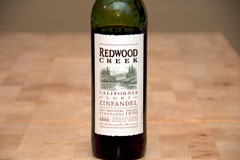
A Wine for Tonight: 2008 Redwood Creek Lodi Zinfandel


By Kori ~ February 3rd, 2011

Would you like a quick suggestion for a good wine to drink tonight (or this weekend) that won’t break your budget and is widely available? Many of our readers have said this is something they would like, so here is this week’s selection, the 2008 Redwood Creek Lodi Zinfandel from the Lodi region of California.

Our selection criteria include:

  • A very good Quality rating of >=3.5 stars (out of 5)
  • A price tag of <=$15
  • Must be widely available

Redwood Creek is one of the brands in the E. & J. Gallo Winery portfolio. E. & J. Gallo Winery, headquartered in Modesto, California, is the world’s largest family-owned winery and the largest exporter of California wine. Sixteen family members spanning three generations of the Gallo family actively work at the winery. Redwood Creek’s winemaker, Cal Dennison, has been making wine for over 25 years.

“This 2008 Lodi Zinfandel embodies flavors of dark berries and blackberry jam with notes of chocolate and spice.” –Redwood Creek

2008 Redwood Creek Lodi Zinfandel (Lodi, California): Deep, purplish red in color. Nice nose with blackberry, cherry, and pasta sauce aromas. More red and black fruits as well as spice and a hint of chocolate come through on the palate. Medium to full-bodied and very crisp with medium to high tannins and a long finish.
Quality: 3.5 stars (out of 5)
QPR: 5 bangs for your buck (out of 5)
Where to buy: Received as sample, suggested retail $7.99; Available elsewhere, $6


Filed under: A Wine for Tonight, American Wine, California Wine, Five-Bangs For Your Buck Wines, Red Wine, Wines Under $10, Wines Under $15, Wines Under $20, Wines Under $25, Zinfandel
 

Tasting Group: New Zealand Pinot Noir


By Kori ~ February 2nd, 2011

Since we live in Washington State and often drink wines from Washington State, we want to make sure that we continue to hone our knowledge of the entire world of wine and maintain well-rounded palates in order to make us even more objective when we evaluate wines from Washington State. Therefore, we are thoroughly enjoying our Wine Peeps Tasting Group which includes what we think is an excellent peer group of knowledgeable wine lovers to taste, share, and learn more about wine together. Unlike our monthly wine tasting dinners in which the guests rotate, this tasting group includes people who are committed to getting together once a month which we believe benefits all of us. In addition to trying varieties and regions that we do not taste frequently, the other main difference between this group and our wine tasting dinners is that each group member brings a bottle consistent with the month’s theme so no one knows all the wines in the blind tasting.

Last week, our tasting group met and explored Pinot Noir from New Zealand. Pinot Noir is a finicky grape that will not grow just anywhere. New Zealand is one of the few places in the world where it does remarkably well. Pinot Noir is the number two most planted variety in New Zealand, after the country’s flagship Sauvignon Blanc. The country’s temperate, maritime climate provides ideal conditions for growing Pinot Noir. In my opinion, New Zealand Pinot Noir has found its niche in style somewhere between the elegance of Burgundy and the sometimes-intense herbal and gamey notes of Oregon Pinot Noir.

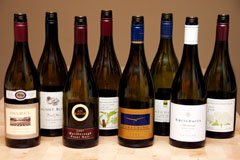
We tasted eight bottles of New Zealand Pinot Noir, and the consensus favorite was the 2006 Isabel Pinot Noir from the Marlborough region. In fact, four of the top five wines in our consensus rankings were from Marlborough. In 2005, we took a trip to the Marlborough region of New Zealand to visit some of the wineries that we had come to love as well as observe New Zealand winemaking up close. It was a fabulous trip and an educational and rewarding wine experience. We found some of the most beautiful wine country and nicest people in the world.

If you’ve never had a New Zealand Pinot Noir or are looking for a more economical alternative to Burgundy or Oregon Pinot Noir, I encourage you to give New Zealand Pinot Noir a try.

From 1st to last in the group consensus rankings:
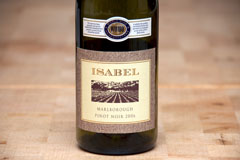
2006 Isabel Pinot Noir (Marlborough, New Zealand): Light to medium ruby red in color. Very aromatic with raspberry, cranberry, earth, smoke, and barnyard on the nose and palate. Medium-bodied with crisp acidity and fine silky tannins. Well-balanced and long, smooth finish.
Quality: 4 stars (out of 5)
QPR: 5 bangs for your buck (out of 5)
Where to buy: Wine World (Seattle, Washington), $24.99; Available elsewhere, $19 to $43

2007 Kim Crawford Pinot Noir (Marlborough, New Zealand): Medium ruby red with slight browning around the edges. Nice nose with red fruit and dusty aromas with a hint of smoke and barnyard notes. Bright red fruits and smoke come through on the palate. Medium-bodied with fresh acidity and smooth tannins. Well-balanced with a long finish.
Quality: 4 stars (out of 5)
QPR: 5 bangs for your buck (out of 5)
Where to buy: Fred Meyer (Seattle, Washington), $18; Available elsewhere, $16 to $20

2006 Walnut Block Pinot Noir (Marlborough, New Zealand): Light ruby red in color with a slight browning around the edges. Nose is a bit tight at first and then opens up with red fruits and perfume. Flavors of raspberry, cranberry, and spice. Medium-bodied with crisp acidity, medium tannins, and a long finish.
Quality: 3.5 stars (out of 5)
QPR: 4 bangs for your buck (out of 5)
Where to buy: Garagiste (Seattle, Washington), $30; Available elsewhere, $20 to $35

2008 Peregrine Pinot Noir (Central Otago, New Zealand): Light ruby red. Aromatic with nice bright red fruits, spice, and smoke on the nose. Raspberry, cranberry, and spice also come through on the palate. Medium-bodied and lively with medium tannins and a long, slightly bitter, finish.
Quality: 3.5 stars (out of 5)
QPR: 5 bangs for your buck (out of 5)
Where to buy: Available from various retailers, $19 to $27

2007 Whitehaven Pinot Noir (Marlborough, New Zealand): Medium ruby red in color. Aromatic with cherry, raspberry, spice, earth, and a bit of funk on the nose and palate. Medium-bodied and lively with soft tannins and a long, slightly bitter, finish.
Quality: 3 stars (out of 5)
QPR: 4 bangs for your buck (out of 5)
Where to buy: QFC (Seattle, Washington), $18; Available elsewhere, $15 to $27

2007 Pyramid Valley Vineyards Growers Collection Calvert Vineyard Pinot Noir (Central Otago, New Zealand): Medium ruby red. Barnyard, earth, dark cherry, and raspberry aromas lead to flavors of red fruit, plum, and earth. Light to medium-bodied with soft tannins and a medium finish. A bit thin and plain.
Quality: 3 stars (out of 5)
QPR: 1 bang for your buck (out of 5)
Where to buy: Available from various retailers, $43

2008 Neudorf Tom’s Block Pinot Noir (Nelson, New Zealand): Light ruby red. Aromatic with smoke and barnyard notes on the nose. Smoked meat, beef jerky, and earth come through on the palate. Medium-bodied and lively with soft tannins and a long finish. A bit funky with some effervescence on the back end.
Quality: 3 stars (out of 5)
QPR: 3 bangs for your buck (out of 5)
Where to buy: Wine World (Seattle, Washington), $24.99; Available elsewhere, $21 to $32

2008 Pyramid Valley Vineyards Angel Flower Pinot Noir (Canterbury, New Zealand): Light ruby red with an unfiltered haze. Aromas of cinnamon, nutmeg, licorice, and a hint of dirty diaper. Flavors of red fruits, earth, and oak. Light-bodied with tart acidity, medium tannins, and a long, slightly hot, finish.
Quality: 3 stars (out of 5)
QPR: 1 bang for your buck (out of 5)
Where to buy: Full Pull Wines (Seattle, Washington), $65; Available elsewhere, $66 to $67


Filed under: Five-Bangs For Your Buck Wines, New Zealand Wine, Pinot Noir, Red Wine, Tasting Group, Wines Over $25, Wines Under $20, Wines Under $25
 

Wine Word of the Week: Maceration


By Kori ~ February 1st, 2011

This week’s Wine Word of the Week is maceration.

Official definition from Jancis Robinson’s The Oxford Companion to Wine:
Maceration is an ancient word for steeping a material in liquid with or without a kneading action to separate the softened parts of the material from the harder ones. This important process in red wine-making involves extraction of the phenolics (tannins, colouring materials, or anthocyanins, other glycosides, including flavour precursors, and non-glycosylated flavour compounds) from the grape skins, seeds, and stem fragments into the juice or new wine. Some maceration inevitably takes place in the fermentation vessel. It is governed by temperature, contact between the solids and liquid and the degree of agitation, time, and by the composition of the extracting liquid, in this case the grape juice as it becomes wine.

Layman’s terms from Kori:
Maceration is the red winemaking process in which color, tannin, and flavor components are extracted from the skins of the grape.


Filed under: Wine Word of the Week
 

Women of Washington Wine: Kate Michaud of Covey Run


By Kori ~ January 31st, 2011

Today’s post is part of a series featuring the Women of Washington Wine. In an industry once dominated by men, more and more women are joining the ranks as winery owners, vineyard owners, and winemakers. Being a woman myself, I am fascinated by these women and what they have done and continue to do. Through this series, I hope to introduce you to some of the brightest female faces in the Washington wine industry.

Kate Michaud, the daughter of American ex-pats, was raised in the United Kingdom and travelled throughout Europe while growing up. As a result, she was exposed to wine at a tender age. Kate graduated with a degree in Art History from the University of Oregon before venturing into the wine industry. Bonny Doon Vineyards in Santa Cruz, California, gave Kate her first job in the industry. Since then, Kate has worked in wineries in California and Washington as well as spent time in Australia and New Zealand during harvest in the Southern Hemisphere. She completed the UC Davis Winemaking Certificate Program in 2005 and accepted her current position as winemaker at Covey Run in 2007.
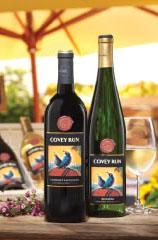
I had the pleasure to meet Kate during the Wine Press Northwest Platinum Judging in November. Recently, she was kind enough to take time out of her busy schedule to answer some questions for me and our Wine Peeps readers.

Highlights from Q&A with Kate Michaud:

How did you first get involved in the wine business?
I had been a ski bum for a while, but those years had run their course and I was looking to move on. In my skiing years, I realized I really enjoyed the manual labor I did to earn a ski pass, and I wanted a working life that had the same physicality and tangible results. Working in a winery fit that bill, plus it was slightly more glamorous as it involved wine. At the time, I shared custody of a pit bull, named Alice, with my ex-boyfriend who lived in California. I went to drop off Alice at his place and found myself working in a winery. Had he lived in Arkansas, my life might have taken a different route.

What were the steps that led to where you are now?
My first job was working in the tasting room at Bonny Doon Vineyards. I moved to production as soon as an opportunity opened up, which was in data entry for their wine tracking system. Data entry for Bonny Doon didn’t consume my day, so I would spend the rest of my hours collecting samples for the lab or hanging out in the lab learning to run a free SO2. Or, I was given a task: stir these 300 barrels or clean this tank. I happened to tour a winemaker from Western Australia around our site and then asked if he perhaps needed some labor at harvest. He did, and I was hired to be the Harvest Enologist although I had spotty lab experience. Shortly after returning to Bonny Doon from a harvest abroad, I followed an ex-Dooner to David Bruce Winery where I was the assistant enologist. The cost of living in California seemed to crush any dreams of owning a home so I moved up to Washington where I got a job at Canoe Ridge as Enologist and was promoted to Assistant Winemaker after a few years. From there I was offered my current job, which was a great opportunity to grow. I haven’t looked back. It’s been great so far.

Has being a woman been an advantage or a disadvantage in your wine journey?
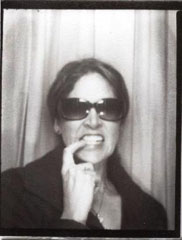
I would say it has been an advantage. At the entry level, there is proving ground stuff going on. There is an expectation that cellar work is mostly a man’s job, so if you are that woman who holds her own, you are celebrated. For example, a guy who cleans the press every night at 2am is still just doing his job, but the expectation for the “girl” would be for that she’ll decide after doing it once she would rather work in a warm lab. If you are that girl who’s cleaning the press at 2am every night, you become something of a celebrated oddity, and therefore you have an advantage. When you reach a higher level, it becomes a point of distinction in the job market.

What advice do you have for a woman wanting to get involved in the wine business today?
Find a great mentor. Ask thoughtful questions. Challenge. Learn everything. Take a job based on a wide purview, or a job that has a tiny exposure to something that will get drilled into your head over and over again. It is okay that it takes time to move up; this leads to a richer payoff (though, maybe not literally). Your feet will be wet, you might drop a barrel off wet forks or make some bad decisions along the way, but you learn from them. Move around, especially early when you are expendable, then maybe decide you want to specialize in Pinot Noir or an area where you start to build something.

I understand that you have worked harvest in Australia and New Zealand in addition to your work at wineries in Washington and California. What have you learned from those experiences?
That there are a lot of ways to skin a cat. The exposure to unfamiliar yeasts, fermentation aids and fining agents or equipment seems equally important to the winemaker’s approach, but the danger is to think all of the information is valid wherever you go. That took me a while to learn. The picture is more complicated than that. Of course, you need to take into account all the particulars like climate, etc., but working harvest generally takes three months, so you don’t really get the whole picture. You get most of it and those experiences are invaluable, but you still have to fill in some blanks.

What are your thoughts about the Washington wine industry, in general?
We have a great opportunity that we aren’t quite capitalizing on. We have great resources for grapes that keep getting better as our growers become more and more vested in growing vinifera and our collective knowledge advances. Winemakers are honing their skills by trial and error, but we haven’t quite hit on the right note to market Washington wine beyond the Pacific Northwest to the rest of the world. We know we are a great value and have great wine but don’t have that singular message.

In recent years the Washington wine industry has grown at a rapid rate. Do you expect that trend to continue?
Not sure. I left California when housing at $200,000 for a shack seemed crazy. That wasn’t the peak, not even close. It seems easy to say that there was a bandwagon that everyone jumped on and that in this economy there will be some shake out. I am sure there will be some wineries that cannot survive at the higher price points, but I am not sure we hit our peak before the economy turned.

What is your vision for the future of Covey Run?
World domination. Quickly. I would like to see Covey embraced by critics who lead with price point and aren’t colored by it. I would like to have fun doing it…to make great wine without all the fuss.

Many thanks to Kate for sharing her story and thoughts with us. I wish her all the best and will continue following her work and Covey Run with great interest, and I hope that you will too.

(Photos from Covey Run)


Filed under: American Wine, Interview, Washington State Wine, Women of Washington Wine
 

A Wine for Tonight: 2009 Chateau Ste. Michelle Sauvignon Blanc


By Kori ~ January 27th, 2011

Would you like a quick suggestion for a good wine to drink tonight (or this weekend) that won’t break your budget and is widely available? Many of our readers have said this is something they would like, so here is this week’s selection, the 2009 Chateau Ste. Michelle Sauvignon Blanc from the Columbia Valley of Washington State.

Our selection criteria include:

  • A very good Quality rating of >=3.5 stars (out of 5)
  • A price tag of <=$15
  • Must be widely available

Chateau Ste. Michelle is Washington State’s founding winery with its roots dating back to the repeal of Prohibition. In 1976, Ste. Michelle built a French-style chateau in Woodinville, just northeast of Seattle. While all of Chateau Ste. Michelle’s vineyards are located on the east side of the Cascade Mountains, all of their white wines, including this Sauvignon Blanc, are made in Woodinville.

“The mostly stainless steel fermentation makes this a crisp, refreshing style of Sauvignon Blanc. The wine offers fresh aromas of herbs and lavender with a beautiful floral note. A touch of Semillon is added for richness. This wine would pair well with dishes with cream sauce.” –Bob Bertheau, Head Winemaker

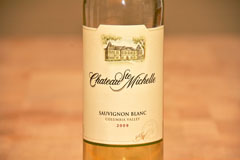
2009 Chateau Ste. Michelle Sauvignon Blanc (Columbia Valley, Washington): 89% Sauvignon Blanc and 11% Semillon. Pale straw yellow in color. Fresh aromas of honeysuckle and orange peel on the nose; orange peel, citrus and tropical fruits, and vanilla on the palate. Dry and light-bodied with crisp acidity and a long finish.
Quality: 3.5 stars (out of 5)
QPR: 4 bangs for your buck (out of 5)
Where to buy: Received as sample, suggested retail $10; Available elsewhere, $8 to $13


Filed under: A Wine for Tonight, American Wine, Sauvignon Blanc, Washington State Wine, White Wine, Wines Under $10, Wines Under $15, Wines Under $20, Wines Under $25
 

2011 Wine Peeps Survey Results


By John ~ January 26th, 2011

Thank you for your input to Wine Peeps. Once again, we had more survey responses than in the previous year. We have studied the survey results very carefully and plan to use them to make Wine Peeps even better in the coming months and years.
We want to give special thanks to those of you who not only checked the boxes and filled in the blanks but also took the time to give us constructive advice in the comments sections. It was amazing to us how many of you obviously took considerable time and gave serious thought to your comments. We really appreciate you and will do our best to make Wine Peeps your favorite wine destination on the Internet.

For those of you who like statistics, here are some highlights:

  1. Over 81% of the respondents said Wine Peeps was either “very good” or “the best” wine blog.
  2. “Interesting, Competent Content,” “Wine Reviews/QPRs,” and “Washington Wines” were the most popular answers to “When you think of Wine Peeps, what is the first thought that pops into your mind?” garnering 95% of the responses between them, distributed fairly equally.
  3. “Wine Reviews”, “Wine Trips/Events recaps,” and “A Wine for Tonight” were our most highly rated “types” of posts, although interestingly enough, they were not the ones that have necessarily generated the most discussion or comments.
  4. The median age of our respondents was a little over 50, with a range from 28 to 66. Men represented 78% of the respondents, and the vast majority preferred red wine.
  5. The answers to “Favorite Varietal” and “Favorite Wine Region” were all over the board, however Cabernet Sauvignon, Red Blends, and Syrah were the top vote getters among varietals; and Washington State had the most votes among regions, no doubt a reflection on our geographical location and blog emphasis.
  6. Only 19% of our respondents said they were in the wine trade, and only one was a wine media/blogger. We were pleased to see that the vast majority of our survey respondents were wine consumers, since consumers are the target audience for our blog. 61% considered themselves “wine intermediates,” as opposed to “wine novices” (5%) or “wine connoisseurs” (14%).

Two things were very clear in our respondents’ comments. First, our readers respect our independence and our willingness to comment on controversial issues. Second, in addition to our wine reviews, our readers want more food suggestions, such as what to pair with wines we recommend, the recipes for food we have in tasting dinners, and wine suggestions to go with less common meals. We will try to continue and expand on these in 2011.

Thank you for your interest in Wine Peeps, and please let us know what else we can do to get and keep your attention.

Cheers!


Filed under: Survey
 

Wine Word of the Week: Micro-oxygenation


By Kori ~ January 25th, 2011

This week’s Wine Word of the Week is micro-oxygenation.

Official definition from Jancis Robinson’s The Oxford Companion to Wine:
Micro-oxygenation, also known by the French term microbullage, is a vinification technique initiated in 1990 by winemaker Patrick Ducournau in Madiran to control the aeration of wines in tank. The method was authorized by the European Commission in 1996 and is used mainly but not exclusively on red wines. Its guiding principle is that all wines require oxygen to a greater or lesser extent, its aim being to enable the winemaker to deliver precise and controlled levels at various stages in the wine-making process.

Layman’s terms from Kori:
Micro-oxygenation is the sometimes-used winemaking process in which oxygen is introduced to the wine in a controlled manner.


Filed under: Wine Word of the Week