Today’s post is part of a series featuring the Women of Washington Wine. In an industry once dominated by men, more and more women are joining the ranks as winery owners, vineyard owners, and winemakers. Being a woman myself, I am fascinated by these women and what they have done and continue to do. Through this series, I hope to introduce you to some of the brightest female faces in the Washington wine industry.
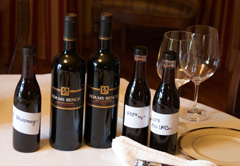
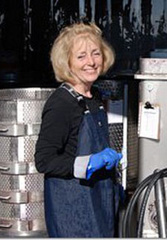 Adams Bench Winery is a small, family-owned winery located in Woodinville, Washington. Founded in 2005 by owners and co-winemakers Tim and Erica Blue, Adams Bench produces Cabernet Sauvignon and Cab blends exclusively. After being bitten by the wine bug, Tim and Erica took enology courses at the famed UC Davis and began making home wine in 2004. They have produced some excellent wines in their short history; their current releases are only their third vintage. They produce 1,000 cases per year. We had the pleasure to meet Tim and Erica and visit their winery last year. The winery is located in a converted horse barn just down the hill from the Blue’s home. It is a gorgeous setting on a few acres overlooking horse pastures with a view of the Olympic Mountains on a clear day. Tim and Erica are both very friendly, welcoming, and extremely enthusiastic about what they are doing.
Recently, Erica was kind enough to take time out of her busy schedule during this holiday season to answer some questions for me and our Wine Peeps readers.
Highlights from Q&A with Erica Blue:
How did you first get involved in the wine business?
Isn’t wine endlessly interesting? I was first captivated as a learner, a taster, and a traveler—but eventually became drawn into the experience of making wine at home, then decided to create Adams Bench with my husband Tim.
What were the steps that led to where you are now?
It’s always hard to identify all the steps. In retrospect I think there were foundations laid as far back as college—I was a chemistry major and loved it. My father, Vance Peavy, was an advocate, who believed wine was part of a good life. He influenced Tim to open his life to wine, and the rest is history. I was an Ob/GYN physician for many years, where I learned the value of patience, and developed a deep respect for the natural rhythms of life. I worked many years in a world of ideas, and at some point developed a longing to create something quite tangible, something I could hold in my hands, which represents the rhythm of the season, and speaks of a time and place, unique, never to be repeated, yet captured in a bottle.
Has being a woman been an advantage or a disadvantage in your wine journey? Please explain.
I think my feminine traits are a natural fit for winemaking—I know what tastes good to me, and others seem to like it too. I am also adventuresome, so I have enjoyed learning many new skills, such as understanding gas fittings, metric wrenches, how to assemble and customize a labeling machine, drive a forklift (though my husband hates to watch me do this), troubleshoot our bottling machine, and work with fermentations to get the results we want.
What advice do you have for a woman wanting to get involved in the wine business today?
Go to school. Study, learn all you can, and then apprentice yourself to a good mentor. I greatly valued Chris Camarda (Andrew Will Winery), who was our consultant, for his patient mentoring. Understand your goals. Be prepared to work hard.
 What are your thoughts about the Washington wine industry, in general?
Infinite potential. The best climate for wine in the U.S. Washington is evolving and finding its place in the world. We have a great Wine Commission here and great people involved in the industry.
In recent years the Washington wine industry has grown at a rapid rate. Do you expect that trend to continue?
Yes, and more importantly, an increase in recognition for Washington’s place in the world of wine.
How do you and your husband, Tim, divide the duties at the winery?
We both do everything, but I am primarily responsible for harvest picking decisions and fermentations. I love this aspect particularly. The long, solitary trips to the vineyard during harvest, punctuated by fragrant walks down the vineyard rows, tasting and testing, color, flavor, seed and skin make me feel alive. I love it.
I understand that Tim continues to practice law full-time and you work part-time as a medical clinic administrator. How do you balance your day jobs with your work at the winery?
Yes, Tim is a trial lawyer and loves his work. And actually, I work full-time for The Everett Clinic. We are both very energetic, and committed to our first professions, and bring the same energy and dedication to Adams Bench.  We make it work—during harvest we do work 7 days a week, and we have family who have come to play important roles.
What is your vision for the future of Adams Bench Winery?
Our vision is to continue producing 1,000 cases each year—creating Cabernet Sauvignon and Cab blends which continue to evolve as something truly special, consistently special—making just a little, and working very hard to make the best. We’ll develop our 3.25 acres over time, in a manner which complements the rural environment, maintaining peace and ambience as we improve our buildings, add a small vineyard, gardens, and more lavender. We will remain open only by appointment, as small groups allow us to enjoy getting to know our customers, many of whom are just as interested and devoted to Cabernet as Tim and I are!
—
Many thanks to Erica for sharing her story and thoughts with us. I wish her and Tim all the best and will be following their work and Adams Bench Winery with great interest, and I hope that you will too.

 Wine Peeps is an independent wine blog dedicated to helping you get the most bang for your buck in wine. We do this through blind tastings of wine from around the world and calculations of
 As the year 2009 comes to a close, it’s time for us to reflect on our body of work this year, what we’ve done well and where we can improve in 2010. When you have written as many posts as we have this year, 256 to be exact, it is quite a project to review them all and pick a top 10.

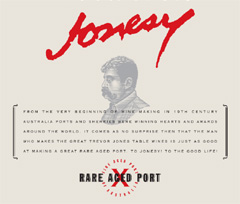 When you are winding down and relaxing after dinner on a cold, winter evening, there’s nothing better than a small glass of port wine. Add in a piece of chocolate with your port around the holidays and you have a treat that’s hard to beat.
 This week’s Wine Word of the Week is enophile.
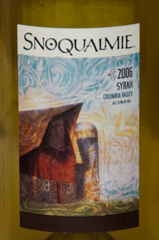 Would you like a quick suggestion for a good wine to drink tonight (or this weekend) that won’t break your budget and is widely available? Many of our readers have said this is something they would like, so here is this week’s selection, the
 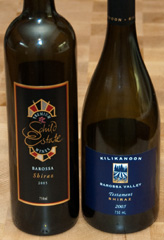 Recently, we had what turned out to be a Barossa Valley (Australia) Shiraz showdown in one of our private tasting dinners pitting the 2005 Schild Estate Shiraz against the 2005 Kilikanoon Testament Shiraz. We liked both of these wines but all four of us preferred the Schild. In fact, we thought it was outstanding, and with a QPR of 5 bangs for your buck, it is a great buy as well! It’s rare to find a wine of this quality under $20. Unfortunately, though, it may be difficult to find this wine at that price any longer. It is mostly sold out. Both of these wines are excellent and paired well with Mom’s dinner of pot roast, sweet potatoes, carrots, green beans, Southern biscuits, and pineapple. For a more complete description of how we set up these private tastings, please refer to
 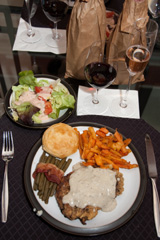 Chicken Fried Steak is a southern dish that is believed to have been adapted by Texans through the influence of German immigrants and their wiener schnitzel. An inexpensive cut of meat such as cube steak or tenderized round steak is dipped in an egg and milk mixture and dredged through flour before being cooked in hot oil.
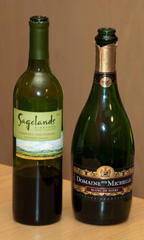 With this very basic meal, we did a blind tasting of the NV Domaine Ste. Michelle Blanc de Noirs and the 2006 Sagelands Vineyard Four Corners Cabernet Sauvignon. And by blind tasting, I mean that the other three Wine Peeps did not know what the two wines were; though they obviously could tell that we were having one red wine and one rosé sparkling wine. Since the meal was an inexpensive one, I wanted to be sure that the wines were at an equally inexpensive price point, and both of these fit that criterion.
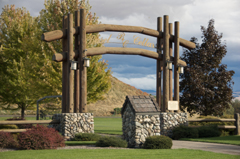 The majority of Washington State wineries are small, “Mom and Pop†operations, many operating out of garages, office parks, or other small facilities.
 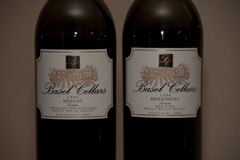 Basel Cellars owns two estate vineyards in the Walla Walla Valley, Pheasant Run and Double River Ranch, which were planted in 1997. They grow Cabernet Sauvignon, Merlot, Syrah, Cabernet Franc, Tempranillo and Semillon.
 This week’s Wine Word of the Week is reserve.


