Helpful Hint: Opening a Screwcap


By Kori ~ October 3rd, 2008

While corks continue to be the most commonly used closures, more and more wineries are experimenting with alternative closures such as screwcaps in an attempt to eliminate cork taint. Therefore, these days you don’t always need a corkscrew to open a bottle of wine. However, sometimes opening a screwcap can be just as difficult.

Here’s a short video to demonstrate an easy way to open a screwcap bottle:

Cheers!


Filed under: Helpful Hint, Video
 

Wine Word of the Week: Fortified


By Kori ~ October 2nd, 2008

This week’s Wine Word of the Week is fortified.

Official definition from Jancis Robinson’s The Oxford Companion to Wine:
Fortified wines are those which have been subject to fortification and therefore include sherry, port, Madeira, vermouth, Malaga, mantilla, Marsala, liqueur Muscat, Liqueur Tokay, and several strictly local specialties. Fortification is the practice of adding spirits, usually grape spirit, to wine to ensure microbiological stability, thereby adding alcoholic strength and precluding any further fermentation.

Layman’s terms from Kori:
Fortified wines have had alcohol added to stop fermentation and increase its alcoholic strength (some to as high as 20 percent). The most common fortified wines are port and sherry.


Filed under: Wine Word of the Week
 

Private Tasting: Sauvignon Blanc


By Kori ~ October 1st, 2008

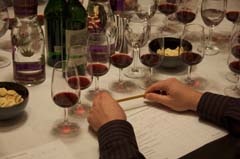
Even though summer has officially ended and the cooler weather has us thirsting for big red wines to help warm us up, the Wine Peeps still enjoy white wines year-round as well. We recently had another one of our double-blind private tastings. This time when we sat down for our dinner of lobster tails with wild rice and asparagus, all we knew were that the two wines in front of us were white, but we did not know their region of origin or varietal. For a more complete description of how we set up these private tastings, please refer back to my Private Tasting: Rioja post.

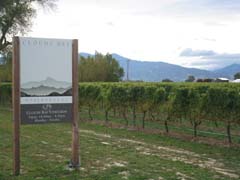
While we found both wines enjoyable with our meal, all four of us preferred one over the other. When we finished eating and pulled off the sacks to reveal what we had been drinking, we found two Sauvignon Blancs, one from New Zealand and one from California. The 2006 Cloudy Bay Sauvignon Blanc from Marlborough, New Zealand, beat the 2006 Ceago Vinegarden Kathleen’s Vineyard Sauvignon Blanc from Clear Lake, California.

Cloudy Bay has been one of our favorites since we visited the winery in 2005. It is one of the most prominent and well-known wineries in New Zealand, especially known for their Sauvignon Blanc. While this wine definitely has characteristics of New Zealand Sauvignon Blanc, it is not quite as over-the-top acidic and grapefruity as some can be. And while we love the acidity and grapefruit flavors, I know that some of you may not. If that is the case, Cloudy Bay is one that I recommend you try.

Before this tasting, we had not previously had the Ceago Vinegarden. I learned about it from reading Gary Vaynerchuk’s 101 Wines book in which it was his #65. In general, we have not enjoyed many California Sauvignon Blancs because they have a tendency to be overoaked. While this wine has spent some time in oak, it was fermented in stainless steel and therefore retains more of its fruit flavors. The Ceago does have a bit of an unusual fizziness for a still wine, though.

All in all, this was a good tasting. Both are nice whites that are worth a try.

2006 Cloudy Bay Sauvignon Blanc (Marlborough, New Zealand): Clear, light straw color. Aromas of grapefruit and lime with even more grapefruit and citrus flavors coming through on the palate. Extremely smooth with crisp acidity.
Quality: 4 stars (out of 5)
QPR: 3 bangs for your buck (out of 5)
Where to buy: K&L Wine Merchants (California), $23.99 [2007 is their currently available vintage]; Available elsewhere, $20 to $46

2006 Ceago Vinegarden Kathleen’s Vineyard Sauvignon Blanc (Clear Lake, California): Clear, light yellow, a bit darker than the Cloudy Bay. Pear and mango dominate the nose. Flavors of pear are prominent. Has some acidity and is actually a bit fizzy.
Quality: 3 stars (out of 5)
QPR: 2 bangs for your buck (out of 5)
Where to buy: K&L Wine Merchants (California), $15.99; Available elsewhere, $18 to $20


Filed under: American Wine, California Wine, New Zealand Wine, Sauvignon Blanc, White Wine, Wines Under $20, Wines Under $25
 

Book Review: The Battle for Wine and Love


By John ~ September 29th, 2008

The full title of this book by Alice Feiring is The Battle for Wine and Love or How I Saved the World from Parkerization. Without the subtitle, I don’t believe this book would have sold 10 copies. Alice hasn’t saved the world from anything. In my opinion, she has a strange palate that seems to mirror her personality and her thoughts on many subjects. In truth I believe she has an inner longing to be as popular as Robert Parker and is jealous of his fame.

She seems to want to move winemaking back to the 60’s and 70’s when every other bottle was bad, sanitation sucked, and winemaking ethics were a sad joke. I don’t. I started drinking wine when Alice was still in diapers, and I do not long for the “good old days” in wine any more than in real life. I believe that wine quality across the board is better than it has ever been in my life.

Ms. Feiring really reveals her personal biases, certainly not any great intelligence, when she expounds on Australian Shiraz and the fact that there is only one Shiraz in all of Australia that she actually likes. I wonder how many she has tasted because she admits that she has never visited Australia. And yet in another section in her book, she talks about how important it is to visit the vineyards and get to know the winemakers and what makes them tick before forming an opinion about their wine.

Then she digs an even bigger hole for herself when she asks why anyone would want to go from France to Australia to learn about Syrah when France has over 150 years of Syrah winemaking history from which to draw. Well, I hate to burst Alice’s bubble, but Australia also has over 150 years of history making Shiraz (Syrah). I know because I’ve been there and I’ve tasted hundreds of those old-vine Shiraz.  Certainly some Shirazes are better than others, and I don’t agree with all of Parker’s touts on them, but to blast them across the board is ridiculous.

Why doesn’t Alice just say that her palate is different than some of the more famous wine writers today and leave it at that rather than implying that anyone who doesn’t fall in love with her favorite Loire reds (Cabernet Franc) is a nut? I only observed one nut while reading this book and it was the author.

In my opinion, Alice is just trying to sell books and promote Alice…and she seems to be doing a good job of both. If you are looking for a good and balanced book on wine or advice on what to drink, I suggest that you look elsewhere.

Have you read The Battle for Wine and Love? If so, what are your thoughts on it?


Filed under: Wine Books
 

Wine Tasting Dinner: Washington Red Blends


By Kori ~ September 26th, 2008

This month’s wine tasting dinner featured red blends from Washington State. Once again, we were able to enjoy six wines throughout a four-course meal and spend quality time with wonderful friends. If you’ve ever thought about hosting your own wine tasting dinner, I highly encourage you to go ahead and do it. They are so much fun! You will have a great time and learn a lot about wine in the process.

Since we have been focusing on Washington Syrah recently and Washington red Bordeaux-style blends have become increasingly popular, we wanted to do a tasting dinner of red blends that all contained at least some Syrah. While this tasting did not contain one single wine that just blew us away, all of the wines were good. They all paired quite well with Mom’s roasted beef tenderloin, chipotle-lime mashed sweet potatoes, and seasoned green beans. And considering that all six wines retail for under $30 with four of them under $20, there are some excellent values here.

As you will see from the quality ratings, we felt that the six wines were very close. Ranking the wines can be difficult when all of the wines are good and none stand out as either really outstanding or extremely disappointing. The bottom line is that, in my opinion, you cannot go wrong with any of these.

From 1st to last in the group consensus rankings:

2006 Mark Ryan “The Dissident” (Columbia Valley): Syrah, Cabernet Sauvignon, Merlot.
Quality: 4 stars (out of 5)
QPR: 4 bangs for your buck (out of 5)
Where to buy: Winery, $28; Compass Wines (Washington), $29.99

2006 Giant Wine Co. Sinner’s Punch (Columbia Valley): Syrah, Cabernet Sauvignon.
Quality: 4 stars (out of 5)
QPR: 5 bangs for your buck (out of 5)
Where to buy: Esquin (Seattle), $14; McCarthy & Schiering (Seattle), $14

NV Townshend Cellar Red Table Wine (Columbia Valley): Cabernet Sauvignon, Merlot, Syrah.
Quality: 4 stars (out of 5)
QPR: 5 bangs for your buck (out of 5)
Where to buy: Winery, $10.95

2005 Bergevin Lane Calico Red (Columbia Valley): Cabernet Sauvignon, Syrah, Merlot, Cabernet Franc, Zinfandel.
Quality: 3.5 stars (out of 5)
QPR: 4 bangs for your buck (out of 5)
Where to buy: Winery, $19; Available elsewhere, $20 to $21

NV Forgeron Cellars Waldeaux Smithie (Columbia Valley): Merlot, Cabernet Sauvignon, Syrah, Zinfandel, Cabernet Franc.
Quality: 3.5 stars (out of 5)
QPR: 4 bangs for your buck (out of 5)
Where to buy: Winery, $16; Available elsewhere, $16 to $22

2004 Whitman Cellars Narcissa Red (Columbia Valley): Cabernet Sauvignon, Syrah, Malbec, Merlot, Cabernet Franc.
Quality: 3.5 stars (out of 5)
QPR: 3 bangs for your buck (out of 5)
Where to buy: Winery, $24; Available elsewhere, $23 to $29


Filed under: American Wine, Five-Bangs For Your Buck Wines, Red Wine, Washington State Wine, Wine Tasting Dinners, Wines Over $25, Wines Under $15, Wines Under $20, Wines Under $25
 

Wine Word of the Week: Sparkling


By Kori ~ September 25th, 2008

This week’s Wine Word of the Week is sparkling.

Official definition from Jancis Robinson’s The Oxford Companion to Wine:
Sparkling wine is wine which bubbles when poured into a glass, an important and growing category of wine. The bubbles form because a certain amount of carbon dioxide has been held under pressure dissolved in the wine until the bottle is unstoppered. Sparkling wine may vary is as many respects as still wine: it can be any wine colour…; it can be any degree of sweetness…; it can vary in alcoholic strength…; and it can come from anywhere in the world where wine is produced.

Layman’s terms from Kori:
Sparkling wine is the generic name for “bubbly.” The most well-known sparkling wine in the world is Champagne but it can only be called Champagne if it is produced in the Champagne region of France.


Filed under: Wine Word of the Week
 

Grower background can make a better winery


By John ~ September 24th, 2008

As I was looking back over my notes from our favorite wineries out of well over 100 winery visits since April of this year, I noticed a common thread running through a number of them—a grower background. However, it was not necessarily a grape grower background. In fact, several of the better ones including Fielding Hills (WA), Gilbert Cellars (WA), Watermill (OR), and Williamson (ID) have a tree fruit grower background.

So how does this give them an edge in winemaking? I have several thoughts on this. First, they each have their own vineyards, thus having complete control of the entire process from bud to bottle as well as getting the first pick of their fruit for their own wines. Second, their fruit growing background probably gives them an edge in vineyard management skills. Third, if they are not the winemaker themselves, having their own vineyards probably gives them an edge in finding a superior outside winemaker because he or she would probably like to work with a grower whose grapes they might also like to access as well.

How could this grower background not be an advantage? If the grower does not really own a great vineyard site or does not have the right winemaker to get maximum expression of their grapes in the wine, they could be just another mediocre producer. And I would especially be wary of the situation where a grape grower starts losing some of their contracts to sell their grapes, and then starts up a winery just as a way to utilize their grape production.

In sum, when you find a winery with a grower background whose wines you like, you probably have found something special that will be consistent over time.


Filed under: General Wine Information, Vineyards
 

Vineyards of Horse Heaven Hills


By Kori ~ September 22nd, 2008

Horse Heaven Hills is one of the newest AVA’s in Washington State. Established in 2005, it encompasses over 6,000 vineyard acres. Even though it is a fairly new AVA, Horse Heaven Hills is home to some of the oldest vines in the state. Located within the greater Columbia Valley AVA, Horse Heaven Hills borders the Yakima Valley to the north and the Columbia River bordering Oregon to the south.

We recently had the opportunity to visit some of the vineyards in the Horse Heaven Hills. The area enjoys warm days and cool nights and receives quite a bit of wind. Most of the vineyards, featuring sandy soils and bedrock, are south sloping with picturesque views of the Columbia River and into Oregon.

Columbia Crest, the state’s largest winery, is located here. In fact, their newest line of wines is called H3 in honor of the Horse Heaven Hills AVA and features grapes grown there. Just above the Columbia River, the Columbia Crest Estate Vineyard is typical of the region in that it is south sloping with deep sand and silt and receives lots of wind.
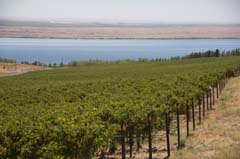
Canoe Ridge Estate Vineyard is owned by Chateau Ste. Michelle. West of Columbia Crest, it is also located just above the Columbia River, runs north/south, and has deep sand. Chateau Ste. Michelle offers a Canoe Ridge collection of wines.

Destiny Ridge Vineyard, the estate vineyard for Alexandria Nicole Cellars, is located west of Canoe Ridge Estate and sits high on the bluffs above the Columbia River. Like Columbia Crest and Canoe Ridge, it features sandy soils. Grapes from Destiny Ridge that are not used in Alexandria Nicole wines are sold under contract to other wineries which have included Darby, Syncline, and Fall Line, among others.

Alder Ridge Vineyard is located west of Destiny Ridge but also sits high above the Columbia River. With over 800 acres set atop a series of ridges, Alder Ridge is known for its different slopes and different soils (sand, rocks, etc) that are planted to different varieties that are best suited for that particular part of the vineyard. Some of the vineyard rows run north/south and others run east/west.

Champoux Vineyard (pronounced shampoo) is one of the most prominent vineyards in the state of Washington. It boasts some of the oldest and most famous Cabernet Sauvignon vines in the state.

“And if you ask any serious Washington winemaker where the state’s greatest old vine cabernet is located, Champoux is the first vineyard they will name.” –Paul Gregutt, Washington Wines & Wineries
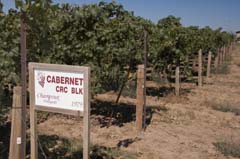
Located five miles from the Columbia River, Champoux is very different from other Horse Heaven Hills vineyards. It is fairly flat and features older soils. While it does not really look like it would be a great vineyard site, it has produced some great grapes which have been used to produce excellent wines. Some of the wineries that have used Champoux grapes include Quilceda Creek, Woodward Canyon, Fidelitas, Andrew Will, and Soos Creek.

Wondering how Horse Heaven Hills got its name? According to Wikipedia, large bands of wild horses once roamed the area and James Kinney, a Yakima pioneer, unofficially named the hills in 1857 when seeing the knee-high grass of the hills for the first time he exclaimed, “This is surely a horse heaven!”


Filed under: American Wine, Vineyards, Washington State Wine
 

Searching for a wine online


By John ~ September 19th, 2008

Sometimes you might not be able to find a wine you want at your favorite local wine shop or online vendor. In that case, services like Wine-Searcher can come in handy. Wine-Searcher lets you search for wine from thousands of wine shops worldwide and then provides links to their websites so you can make a purchase. It makes comparison shopping for price easy and is a great tool for ascertaining the current market value of wines that you already own. You can even get historical prices on wines. The basic version of Wine-Searcher, covering about 200 vendors, is free.

Once you have entered the wine name and vintage, then you have some drop-down choices including whether or not to exclude auction vendors (which I recommend), location of vendor (country and then whether or not you want to limit your search to certain states for shipping law reasons), and the currency in which you want it priced. For the other drop-down choices, I suggest using the defaults unless you are looking to buy a large format bottle.
For frequent online wine buyers, the Pro version, accessing thousands of vendors, is available for a nominal fee of $29.95 per year. If you buy more than a few cases a year online, you’ll probably determine that the Pro version is cost effective for you.

Two other wine search services that are also worth checking out are: WineAccess and WineZap.


Filed under: General Wine Information
 

Wine Word of the Week: Terroir


By Kori ~ September 18th, 2008

This week’s Wine Word of the Week is terroir.

Official definition from Jancis Robinson’s The Oxford Companion to Wine:
Terroir is a much-discussed term for the total natural environment of any viticultural site. No precise English equivalent exists for this quintessentially French term and concept. …. Major components of terroir are soil (as the word suggests) and local topography, together with their interactions with each other and with macroclimate to determine mesoclimate and vine microclimate. The holistic combination of all these is held to give each site its own unique terroir, which is reflected in its wines more or less consistently from year to year, to some degree regardless of variations in methods of viticulture and wine-making. Thus every plot, and in generic terms every larger area, and ultimately region, may have distinctive wine-style characteristics which cannot be precisely replicated elsewhere. The extent to which terroir effects are unique is, however, debatable, and of course commercially important, which makes the subject controversial.

Layman’s terms from Kori:
Terroir is a French term used to describe the soil composition, topography, and climate/weather for a particular viticultural site that some believe imparts unique characteristics on the grapes and, thus, the wines from that site.


Filed under: Wine Word of the Week